
United States Time Change 2026: A Pakistan Student Guide
Check the November 2026 US clock change and dated city-by-city Pakistan conversions, with clear examples for online classes, invitations and calendar entries.
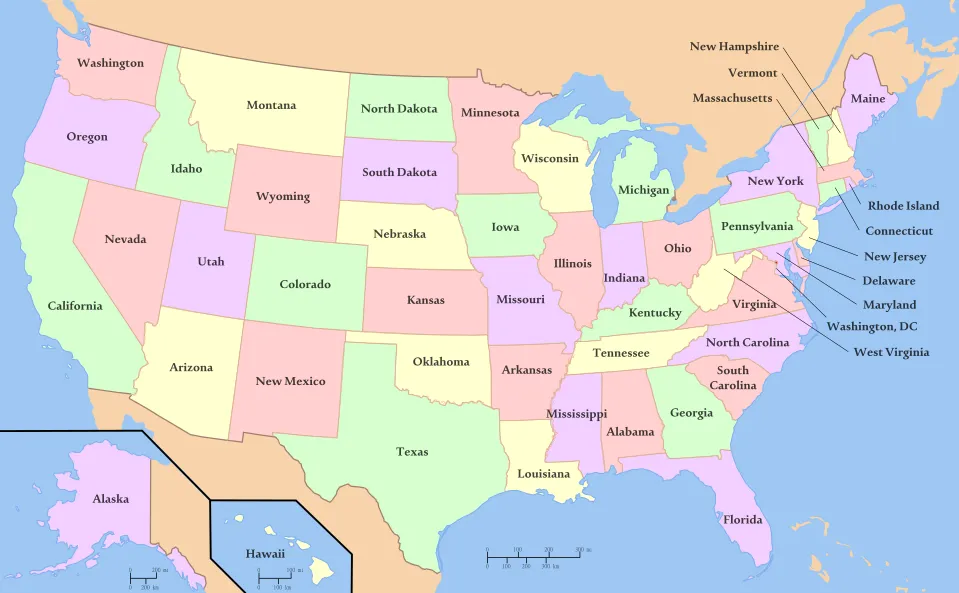
The United States does not have one nationwide clock time, and the difference between a US city and Pakistan can change during the year. On 1 November 2026, most US locations that observe daylight saving time return to standard time. For students following an online class, interview or live event, the practical consequence is a changed local conversion, not a change to the number printed on the organiser's own clock.
This guide uses dated examples to explain that change. The example classes and appointments are fictional; they are not announcements of real events. Confirm an important schedule with its organiser and keep both the date and timezone visible.
When does US daylight saving time end in 2026?
NIST lists the end of daylight saving time as 1 November 2026 at 2am local time in observing areas. The clock moves back to 1am, repeating that hour. Because the transition follows local time, it does not happen at one simultaneous UTC instant everywhere in the country.
The exceptions matter. Hawaii and most of Arizona do not observe daylight saving time; the Navajo Nation is an exception within Arizona. Do not apply a rule about "most of the United States" to every location without checking its own timezone and observance.
For a Pakistan-based reader, the easiest habit is to identify a city rather than guess from the country name. New York, Chicago, Denver, Los Angeles, Phoenix and Honolulu are not interchangeable clock labels. An invitation that says only "US time" is missing information you should ask the organiser to clarify.
What happens to a 9am appointment in Pakistan?
The following are original conversions for a fictional appointment at 9am in each named city. They were checked using timezone-aware software. The table compares 31 October with 1 November 2026; it is not a year-round fixed-offset chart.
| Appointment's local city | 9am on 31 October in Pakistan | 9am on 1 November in Pakistan |
|---|---|---|
| New York | 6pm, 31 October | 7pm, 1 November |
| Chicago | 7pm, 31 October | 8pm, 1 November |
| Denver | 8pm, 31 October | 9pm, 1 November |
| Los Angeles | 9pm, 31 October | 10pm, 1 November |
| Phoenix | 9pm, 31 October | 9pm, 1 November |
| Honolulu | Midnight at the start of 1 November | Midnight at the start of 2 November |
Read the dates in the Honolulu row especially carefully. Midnight is the start of a new calendar day in the conversion shown. Writing only "12" would discard whether it means noon or midnight and whether the date has changed.
The Phoenix row illustrates why memorising one countrywide adjustment fails. Its example does not shift by an extra hour between these dates, while the New York example does. The country is the same, but the local rules are not.
Why does the Pakistan time move later?
Think of the example as one local appointment being scheduled under two different offsets. Before New York returns to standard time, its 9am corresponds to an earlier UTC time. Afterwards, its 9am corresponds to a UTC time one hour later. Converting that instant to Pakistan also produces a time one hour later.
That explanation is about an appointment anchored to New York's local clock. An event anchored instead to a fixed UTC instant may behave differently on the organiser's local display. Identify what the organiser actually intends to hold fixed before changing a calendar entry yourself.
For a fictional weekly lesson, the teacher may say, "We always meet at 9am New York time." In that case the Pakistan display can change across the seasonal transition. If the teacher says the meeting remains at the same UTC time, the New York display can change instead. Those are two different scheduling rules.
This is why a reliable invitation should contain a timezone-aware calendar entry or an explicit instant, not just a number in a chat message. The words surrounding the time determine how the number should be interpreted.
Offset and timezone are different ideas
An offset is the difference from UTC at a particular instant, such as UTC minus five hours. A named timezone describes the rules used by a location across dates, including relevant changes. Treating a named zone as one permanent offset can produce a correct conversion today and a wrong one later.
IANA maintains the timezone database that software commonly uses to represent historical and changing local-time rules. Its documentation explains that the data is updated as boundaries, offsets and daylight-saving rules change. That is a reason to use maintained timezone data rather than an old hard-coded table copied indefinitely.
For your own notes, write the city and date first. Add the abbreviation only as supporting information. Short labels can be ambiguous, and a person may casually write "EST" when they mean the local time in the Eastern region even during a different seasonal offset.
Do not silently correct the organiser's wording if the distinction affects an important appointment. Ask whether they mean a fixed offset or the named local zone. A short clarification is better than being confidently an hour early or late.
Why does 1:30am occur twice during the change?
When the clock moves from 2am back to 1am, the local hour from 1am to just before 2am is repeated. Consequently, a local label such as 1:30am can refer to two different instants on that transition date in an observing zone. A date and local clock reading alone may not distinguish them.
For New York on 1 November 2026, 05:30 UTC and 06:30 UTC both display as 1:30am locally, under different offsets. In Pakistan those instants are 10:30am and 11:30am respectively. The repeated display does not mean time moved backwards for the entire world or that the two instants are identical.
Use a concrete timeline exercise. Draw two marks one hour apart and label them with the two UTC times. Under both, write the New York display. Underneath, add the Pakistan display. The diagram shows why a repeated local label is not a unique identifier for an instant.
For a real booking during that hour, use the organiser's complete calendar record or ask for the intended offset or UTC instant. Avoid choosing the first interpretation merely because an application accepted the text without an error.
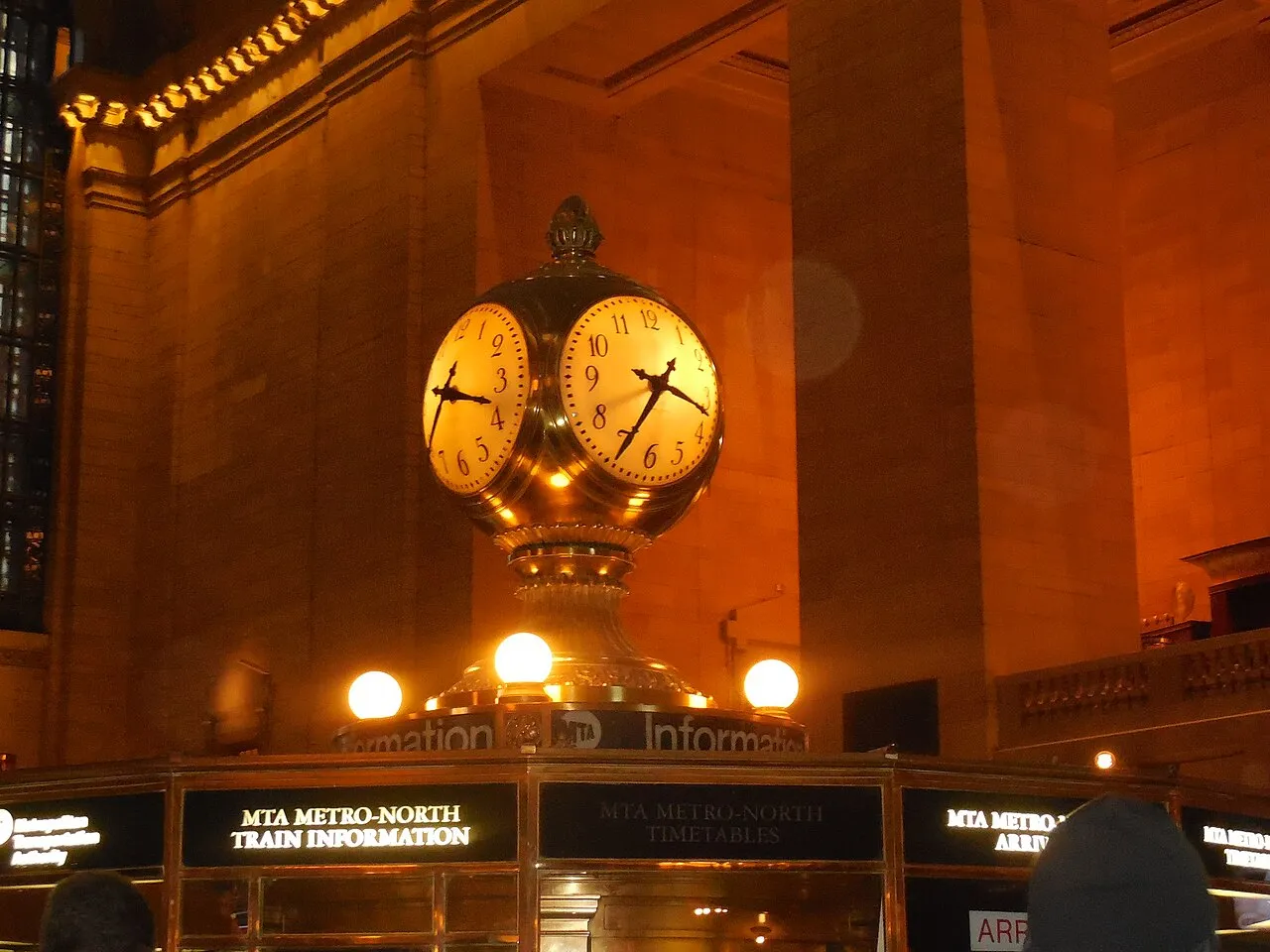
Historical February 2016 photograph of the Grand Central Terminal clock in New York. It is not a live clock or a record of the 2026 transition.
Plan an online class without creating two competing reminders
Start from the original invitation, not a forwarded screenshot. Check the lesson date, named timezone and whether the calendar application has already converted it to your local display. Then record one trusted appointment entry rather than keeping several manually shifted copies that disagree.
For a fictional course meeting, note four fields: organiser's local date and time, organiser's named zone, your converted date and time, and the link to the original notice. Add the date you checked the conversion. This makes a later change easier to investigate without guessing which message was authoritative.
If the organiser revises the meeting, update the same entry and preserve the revision notice. Do not leave an older alert active beside the corrected one. The problem may look like a timezone error when it is actually two versions of an appointment competing on your device.
Also separate the start time from an admission or preparation window. If a host asks participants to join early, that is an additional instruction, not a different timezone conversion. Keep the labels distinct so you know what each reminder is for.
Date formats can cause a second, unrelated mistake
A date written as 11/01/2026 may be read as 1 November in month-first notation or 11 January in day-first notation. A perfect timezone calculation cannot rescue an incorrectly interpreted date. Spell out the month in messages intended for readers using different conventions.
For machine records, a clearly specified format helps, but the time still needs a zone or offset. A string that looks formal is not automatically a complete instant. "2026-11-01 09:00" remains incomplete if the sender does not say whose clock it represents.
A useful classroom task is to give students deliberately incomplete appointment descriptions. Their job is to identify missing information rather than guess a conversion. For example: "Friday at nine, US time" lacks a calendar date, am or pm and a specific zone. Recognising the missing fields is the correct first answer.
This exercise develops a more durable skill than memorising one city's difference from Pakistan. It teaches students to ask what a record actually specifies before doing arithmetic with it.
Display one instant in two places with JavaScript
JavaScript's Intl.DateTimeFormat can display an existing instant in a specified timezone. In this original example, the input includes Z, identifying UTC. The two outputs describe the same instant; the code is not independently scheduling a New York appointment from an ambiguous local string.
const instant = new Date('2026-11-01T14:00:00Z');

for (const timeZone of ['America/New_York', 'Asia/Karachi']) {
  const display = new Intl.DateTimeFormat('en-GB', {
    timeZone,
    dateStyle: 'medium',
    timeStyle: 'short',
  }).format(instant);
  console.log(timeZone, display);
}
For that input, New York displays 09:00 and Karachi displays 19:00 on 1 November 2026. The timezone option controls the location used for formatting; the locale controls presentation conventions. Choosing British-English formatting does not move the instant to Britain.
That last distinction is easy to miss. Language, number layout and timezone are separate settings. A user can read an English-language interface while needing Pakistan time, and a US-based event can be displayed in a day-first date format without changing its actual instant.
Students can explore the underlying objects and loops through our programming courses. A useful extension is to show the date prominently whenever the destination falls on a different day. Do not build a converter that displays only hours and hides a calendar rollover.
A three-part check before joining an event
First, identify the event's intended instant or local scheduling rule. Second, convert using the correct date and named zone. Third, compare your calendar display with the original notice after any announced revision. Each step answers a different question, so passing one does not automatically settle the other two.
For a fictional practice test, give yourself these tasks: convert New York 9am on both dates in the table; explain why Phoenix differs; and identify which information is missing from a bare 1:30am transition-day appointment. Check your explanation, not only your final number.
For more calendar practice, see our November 2026 dates and study-planning guide. Calendar planning and timezone conversion complement each other, but neither should replace an organiser's actual instructions.
Common questions
Is there one United States time?
No. Ask for a city or named timezone, together with the date. A country name is not enough to make a reliable conversion for every US location.
Does every US location change on 1 November?
No. The transition applies to locations observing the relevant daylight-saving rule. Exceptions, including Hawaii and most of Arizona, are why the table uses specific cities rather than one blanket national adjustment.
Should I move a correctly configured calendar entry manually?
Check what the entry already represents first. A timezone-aware invitation may already display the correct local time. A manual extra shift can introduce the very error you are trying to avoid. Confirm with the organiser when the intended rule is unclear.
Does the map prove every local boundary is current?
No. It is a state reference map for orientation, not a time-zone boundary map. For a precise location or important appointment, use current named-zone data and the organiser's confirmed details rather than reading a broad map as a binding local schedule.
Sources
Image credits: cover: Andrew c, source, CC BY-SA 3.0. Resized and converted to WebP. inline: HeatherMarieKosur, source, CC BY-SA 4.0. Resized and converted to WebP.
Found an error or an outdated detail? Report a correction with the article URL and original source.