
VinFast India Explained: Models, EV Specifications and Evidence Checks
Read VinFast India model information, compare variants and range standards, and organise charging, service and warranty questions without guessing.

VinFast is a Vietnamese vehicle manufacturer with an electric-vehicle presence in India. For students and readers following the name in technology news, the useful task is to separate the company, the market-specific vehicle, and the evidence behind a specification. A familiar badge does not mean every model has identical equipment or that an overseas offer applies locally.
This guide was checked on 5 November 2026 using VinFast's official India information. It explains how to read product pages, compare variants and organise questions about charging and support. It does not publish current dealer prices, recommend a purchase or claim that a particular showroom, incentive or feature is available everywhere.
What does the VinFast name identify?
The company name identifies the manufacturer, while a model name identifies a vehicle family within its range. A variant, market and production specification can narrow the description further. These layers matter because an article about the manufacturer may include information that is not a specification for every vehicle carrying its name.
VinFast's official India history describes its January 2025 presentation of the VF 6 and VF 7 at the Bharat Mobility Global Expo. That is a dated company-history reference, not proof of today's stock at a particular dealer. Historical milestones and current retail availability should be recorded in separate fields.
Try a classification exercise using fictional entries: manufacturer, model, variant, market and document date. If a specification has only the manufacturer field completed, important context is missing. Completing the other fields is the first step towards a comparison that another person could reproduce from the same documents.
Why does the country-specific website matter?
Manufacturers can publish different specifications, service arrangements and commercial terms for different countries. A search result may lead to an overseas page because it matches the model name well. Before using its details, check whether the page describes the market relevant to the reader and whether its document date is clear.
For a fictional comparison, imagine one country's page lists a feature as standard while another country's page lists several variants. Neither page should be silently treated as universal. The right response is to find the appropriate local document, not to combine the most attractive claims from several markets into an invented vehicle.
Record the website address, page title and date checked in a small research note. This is especially useful when sharing screenshots, because a screenshot may omit the country selector or footnotes. A preserved source link gives a later reader a route back to the original context.
How should the VF 6 and VF 7 be compared?
Compare exact variants using the same categories. A sensible table might include dimensions, seating, battery information, range test standard, charging compatibility, listed safety equipment and after-sales terms. Leave a cell unconfirmed if the available local document does not establish it. An empty cell is more honest than a guessed answer.
The purpose of the table is not to declare one model universally better. Different users have different requirements, and an educational comparison does not know a reader's finances, household or travel needs. It can show how to organise evidence without making a personalised purchasing recommendation.
Use three labels throughout: confirmed by the cited local document, requires clarification, and not directly comparable. These labels make uncertainty visible. They also stop a table from presenting two figures as equivalent when they were measured under different conditions or belong to different variants.
What can a range figure actually tell you?
A stated range needs its test standard and conditions. A laboratory or certification figure is not automatically the distance every driver will achieve. Comparing numbers without their measurement basis can reward the most favourable test rather than reveal a meaningful difference between two vehicles.
Imagine fictional cars A and B with stated ranges of four hundred and four hundred and twenty kilometres. If the values come from different procedures, the twenty-kilometre difference does not by itself establish better real-world efficiency. The comparison is incomplete until the standards, variants and conditions are understood.
Do not convert this example into a claim about either VinFast model. It is a reading exercise. The habit to learn is writing the unit, test basis and source beside the figure. This habit transfers to computer benchmarks, examination statistics and many other areas where larger numbers attract attention.
Why should battery capacity and charging limits stay separate?
Battery capacity concerns an amount of energy, while a charging-power figure concerns a rate. A product page may also specify a charging interval, such as moving between two battery percentages. That interval is essential context. A partial-charge duration should not be restated as the time to charge from empty to full.
For a hypothetical battery, adding twenty energy units over half an hour implies an average rate of forty units per hour under the exercise's definitions. If the published maximum rate is higher, that is not automatically a contradiction. A maximum and a session average are different observations.
Write a question beside each charging claim: which equipment, starting state, finishing state and conditions were used? A responsible specification summary preserves these details rather than turning a conditional result into an unconditional promise. The actual vehicle manual and compatible equipment determine safe user operation.
How can charger compatibility be checked without guessing?
Start with the exact vehicle's official local documentation and the charging provider's compatibility information. Connector appearance alone is insufficient evidence. Electrical ratings, communication requirements, adapter approval and installation conditions can matter. This article does not authorise improvised adapters, electrical work or experiments with vehicle charging equipment.
A useful research sheet has columns for vehicle input specification, charging-equipment specification, connector and manufacturer guidance. Mark unresolved questions for the authorised provider. The sheet is an information-organising tool, not a substitute for a qualified installer or the product's operating instructions.
When a social-media post says any charger works, ask what evidence supports the word any. A single successful session does not establish compatibility with all equipment. Precise language protects readers from confusing one observation with a general rule that the available evidence cannot support.
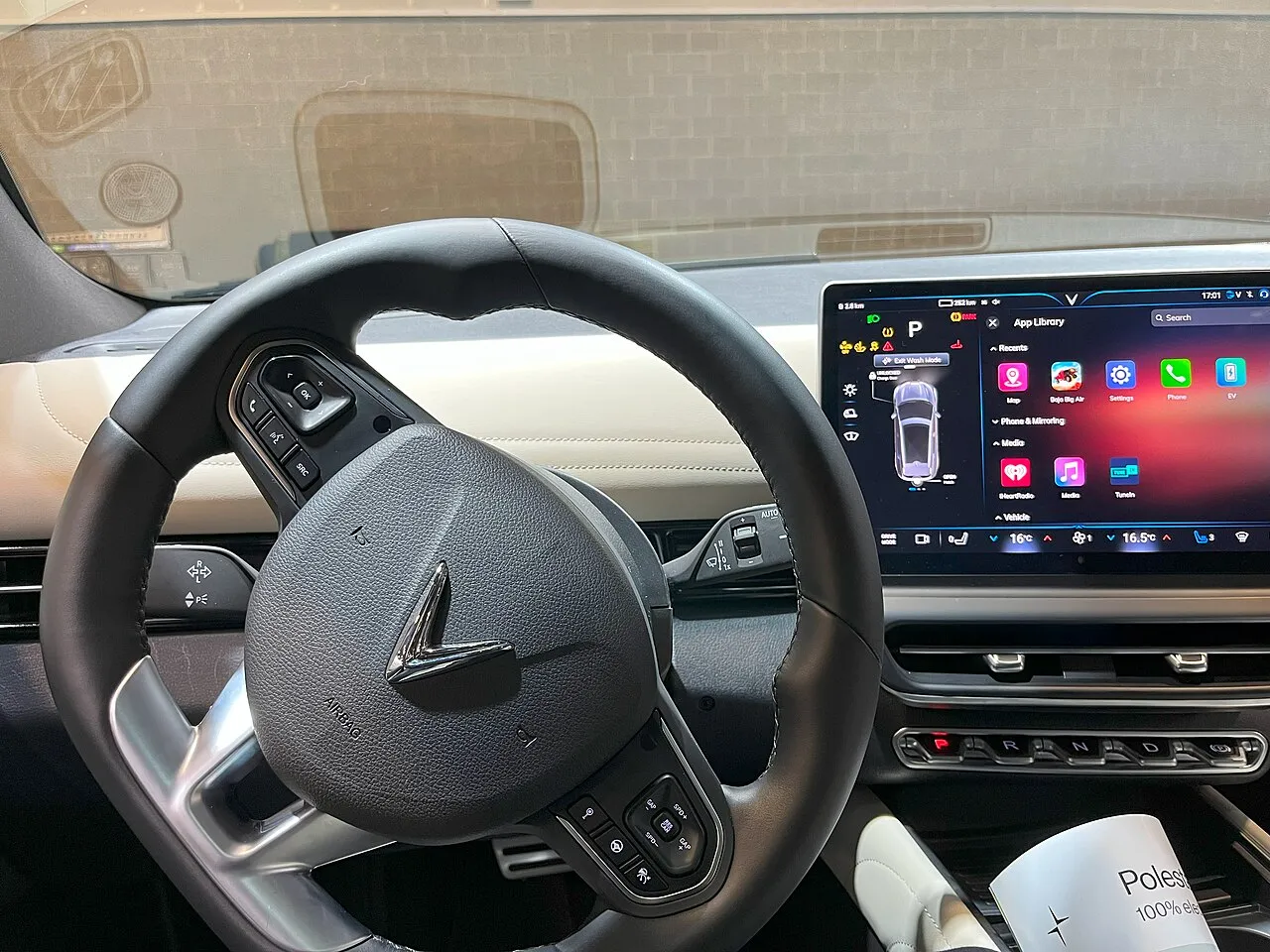
A VinFast VF 7 interior, used as illustrative model context rather than confirmation of equipment in every market or variant.
What is regenerative braking, and what should not be assumed?
Regenerative braking refers to recovering some energy during deceleration within a vehicle's operating limits. VinFast's local VF 7 information includes regeneration-related specifications. The existence of the feature does not mean every setting behaves identically across vehicles or that recovered energy eliminates the need to recharge.
For a classroom diagram, draw energy entering the propulsion system and a smaller return arrow during an invented deceleration event. The arrow illustrates a possible recovery path, not a measured efficiency claim. Real performance depends on the system, conditions and operating limits described in the relevant manual.
Keep an educational description separate from driving advice. Braking behaviour is safety-critical, and readers should follow proper training and manufacturer instructions. The purpose here is to explain why energy recovery belongs in the specification discussion, not to teach road experiments or replace vehicle-specific guidance.
How should driver-assistance features be read?
Feature names can sound similar while their permitted operating conditions differ. A list of cameras or assistance functions is not proof that a vehicle drives itself without supervision. Read the actual manual's description, limitations and driver's responsibilities for the exact model and market.
Make a table containing the feature name, the action it assists, required conditions and limitations. If a promotional sentence supplies only the first field, do not invent the others. A professional comparison distinguishes the existence of a named feature from a verified description of how it should be used.
For a classroom exercise, compare the statements alerts the driver and controls the vehicle. They describe different functions and responsibilities. Students can discuss the difference without operating a vehicle. This is an example of why careful verbs matter as much as impressive technology labels.
What questions belong in an after-sales checklist?
A vehicle comparison should include more than the initial product page. Ask how the official local organisation handles service bookings, parts queries, roadside support and warranty documentation. The relevant answers need to come from current authorised information. A historical announcement does not establish the availability of every service in a reader's city.
Keep warranty duration, distance conditions, exclusions and responsible entity together. A large headline number can be incomplete if the conditions are omitted. Do not assume that battery coverage, whole-vehicle coverage and replacement-part coverage are identical. The actual written terms determine what the manufacturer is offering.
For a paper exercise, write an imaginary service request and identify the information needed to resolve it: model, location, issue and applicable documentation. Use fictional details rather than publishing a real owner's contact information or vehicle identifiers. Good research also respects the privacy of the person making the query.
How can ownership-cost claims be examined?
Separate purchase price, energy, financing, insurance, maintenance and any other relevant category before comparing totals. An article that considers only electricity cost is not a complete ownership calculation. At the same time, a broad estimate should not invent costs that have not been checked for the relevant location and period.
Use an original worksheet with fictional yearly travel of ten thousand kilometres and assumed consumption of sixteen kilowatt-hours per one hundred kilometres. The simplified driving-energy result is sixteen hundred kilowatt-hours. Converting that into money requires a stated tariff and assumptions about charging losses and where charging occurs.
This is a numeracy example, not a VinFast efficiency claim or a cost quotation. Its value lies in showing the calculation's inputs. If the tariff or usage changes, the result changes. Readers can understand sensitivity without being encouraged to treat an invented total as a purchase decision.
What should a news or launch article verify?
Separate announcement date, launch date, bookings, deliveries and local availability. These words can describe different milestones. A story saying a model was presented at an exhibition should not be rewritten as though every customer can collect that model immediately from every location.
Also separate a company's stated plan from a completed event. A future target needs language that preserves its status as a target. If later evidence confirms completion, the article can be updated with a dated source. Removing the distinction to make a headline sound stronger reduces reliability.
Images provide another check. An overseas display photograph can illustrate the model while still requiring an honest caption. It should not imply that the photographed vehicle is the exact Indian variant or that the photograph proves a local delivery event. A truthful caption keeps illustration separate from evidence.
Questions for a confident comparison
Should an overseas review be ignored completely? No, but identify which observations transfer and which depend on the market-specific vehicle. A useful review may explain an interface while offering specifications or commercial terms that need separate local verification. Careful readers preserve that boundary instead of accepting or rejecting everything together.
Does more equipment automatically make a vehicle suitable for everyone? No. Equipment is one part of a requirements discussion. Space, access to compatible charging, service arrangements and the user's actual needs raise additional questions. This guide teaches comparison skills rather than recommending a purchase or predicting resale values.
Can students learn from this without buying anything? Yes. Build a comparison table using official documents and practise marking uncertainty. Continue with study resources for numeracy or programming courses to turn a fictional specification table into a small webpage. Understanding evidence is a useful outcome on its own.
Finish with an evidence ledger
Create one row for every claim in your comparison: the claim, exact local source, variant, date checked and any limitation. For a charging claim, include the stated starting and finishing battery conditions. For a feature claim, distinguish standard equipment from an option. For a service claim, preserve its location and written conditions.
Now exchange the ledger with another learner. Their task is to reproduce the comparison without relying on your memory or a promotional screenshot. If they cannot locate the supporting detail, mark the claim for clarification. This turns a collection of attractive specifications into an auditable learning exercise and gives uncertainty a clear place in the finished table.
Sources
Image credits: cover: Kevauto, source, CC BY-SA 4.0. Resized and converted to WebP. inline: ToyotaCamry7834, source, CC BY 4.0. Resized and converted to WebP.
Found an error or an outdated detail? Report a correction with the article URL and original source.