
Viral Videos: Check the Date, Place and Claim Before Sharing
Use a practical student worksheet to separate footage from its caption, inspect useful frames and report uncertainty without inventing a verdict.

A viral video can be genuine footage attached to a false date, a misleading location or an unrelated caption. Before deciding whether a clip is "real," identify the precise claim being made about it. Checking the pixels and checking the story attached to them are connected tasks, but they are not the same task.
This student guide presents an original verification worksheet and a fictional example. It does not accuse a real uploader, identify private people or claim that one tool can settle every video. The tools and source documentation were checked on 1 November 2026.
What should you check before sharing a viral video?
Write down what the post claims, find the earliest relevant version you can locate, examine useful frames and look for independent evidence about the place and date. Keep a record of what remains uncertain. If the claim is unresolved, do not replace that uncertainty with a confident caption simply because the clip is widely shared.
Separate at least four questions: does this footage exist in an older form; does the claimed location fit; does the claimed date fit; and does the caption accurately describe the visible event? A positive answer to one does not automatically answer the others.
For example, recognising a building can support a location check without establishing when the recording was made. Finding the same clip in an older upload can challenge a claim that it was filmed today without proving who originally recorded it. Verification becomes clearer when each conclusion stays attached to the evidence that supports it.
Begin with a fictional claim, not a verdict
Imagine a post saying, "This park flooded this morning in River Town." River Town and the event are fictional teaching material. The clip shows water, a wall and a short glimpse of a sign. The caption supplies the date and location, while the visible sequence supplies a more limited set of observations.
Your first note should not say "fake video." Write the actual claim: the footage depicts flooding in a specified place on a specified morning. Then list the observations separately. You can see water and structures; you have not yet established the date, precise location or cause.
Now imagine the post also contains a dramatic voiceover. Treat the voiceover as another claim unless you have evidence it belongs to the original recording. A spoken sentence can be persuasive without independently identifying the image's location or timing.
This exercise helps avoid a common shortcut. A viewer can correctly notice that a caption is unsupported while overstating the conclusion as "the whole video is fabricated." The narrower conclusion is often more accurate and easier to explain.
Preserve a small source record
Save the public post URL, account name, visible publication time, caption and the time you checked it. If an item changes later, this record helps explain which version you examined. A screenshot alone may omit the surrounding discussion, the link or the timezone attached to a displayed date.
Do not expose private information in a public checking notebook. The evidence you need for a classroom exercise is usually the claim, public source and relevant visual observations. There is no reason to collect a stranger's home address or identify a child merely because someone appears in a clip.
Keep the distinction between upload time and recording time. The former describes when a particular copy was posted. It may be later than the actual filming. An older upload can establish that the material existed by that point, but a newer upload does not establish that the camera recorded it that day.
For the fictional River Town case, create two rows if you find two posts. Record the dates exactly as displayed and note any timezone ambiguity. Do not overwrite the first row with the second and lose the chain you are trying to understand.
Search useful frames rather than only the thumbnail
Choose a frame that contains a distinctive building, sign, skyline or other relevant visual detail. A thumbnail may be a separate promotional image or an unhelpful moment. A frame from the footage can provide a more direct object for a visual comparison.
Google's official help describes image search through Lens, including uploading an image or using an image URL. Its results may include similar images and pages containing an image or something similar. Similarity is a lead to inspect, not a verdict about a video's complete history.
The AFP Medialab verification-plugin documentation describes tools including keyframe extraction, reverse-image searches and metadata viewing. These can assist a checking workflow. Availability can depend on the service and platform involved, so do not promise that every private, removed or restricted clip will be processed.
For a basic classroom exercise, a manually selected still from a permitted sample is enough. You do not need to install every investigation tool before learning to compare evidence. If you do use a tool, obtain it through its official source and understand what information you are sending to an external service.
How should you interpret a visual-search match?
Open the result and compare the actual image or sequence. Two scenes containing water and a concrete wall are not necessarily the same scene. Look for several corresponding features in the same spatial relationship rather than selecting one vague resemblance and declaring the task complete.
In the fictional example, suppose an older page shows the same distinctive sign, wall pattern and camera movement. Record exactly what matches and what date the older page establishes. You may have evidence that the footage predates the new caption, but you still need care when describing the original event.
The earliest version you find is not necessarily the original version. Search coverage is incomplete, uploads can disappear and a recording can circulate privately before a public post. Use "earliest located in this check" when that is all your research supports.
A missing match is also limited evidence. It does not prove a recording is new, genuine or fabricated. It means that search did not produce a useful match under the conditions you used. Try another distinctive frame or leave the question unresolved rather than turning a blank result into certainty.
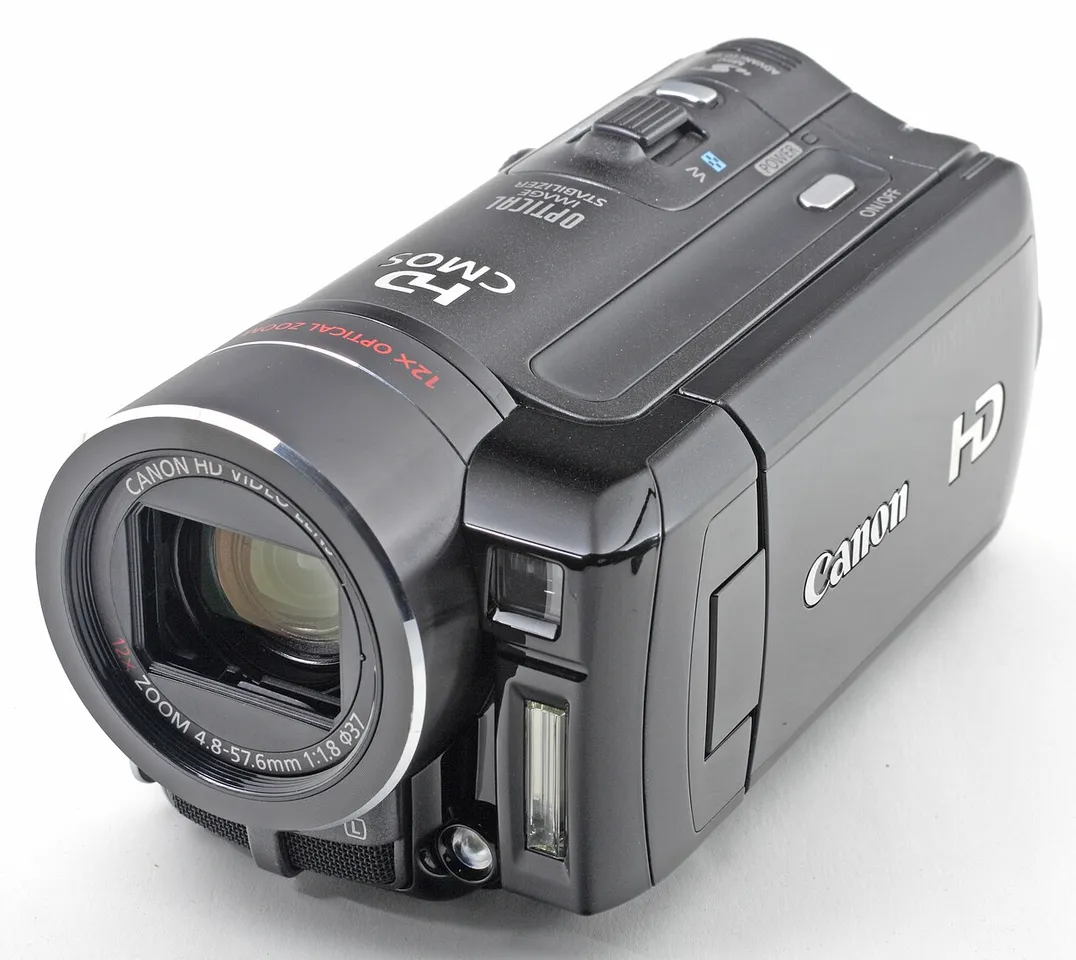
A recording device shown for illustration. The photograph does not establish where or when any video was filmed and is not a product recommendation.
Check the location without identifying private people
Focus on public, relevant features: the shape of a public building, a road layout or a legible place sign. A proposed location should explain several observations together. One common shop colour or a familiar-looking tree is usually too broad to settle a precise location by itself.
Write a comparison note such as "the sign and wall openings match the public reference image." Avoid a stronger sentence such as "every detail proves the entire caption" when your evidence addresses only location. A location match leaves the timing and description to be checked separately.
Do not turn a school exercise into a hunt for a person's identity or address. The purpose is to assess a public claim, not expose someone whose face appears incidentally. Use fictional material, public landmarks or consent-based samples when teaching the method.
Also note what the footage does not show. A camera aimed at one street cannot establish the condition of an entire city. A crowd outside one building does not by itself establish the size or purpose of every gathering nearby. Keep the scope of the conclusion consistent with the scope of the observation.
Treat metadata as one piece of evidence
A metadata viewer can show fields contained in the file it receives. The plugin documentation includes this kind of inspection. A field is useful only when you understand what it represents and which version of the file you are examining.
Do not confuse a file's download time on your device with the time a camera recorded the event. Likewise, an empty field is not an automatic proof that the video is false. If the record is missing, say it is missing; do not invent a timestamp to complete a table.
For the fictional case, create separate columns for the post date, any available file timestamp and the claimed event date. If they differ, investigate the reason. They can refer to different stages in the material's history and should not be merged into one authoritative date without justification.
The same care applies to a tool's highlighted result. Read the label and method before interpreting a coloured box as a final authenticity judgment. This guide does not treat a forensic filter, visual-search result or automated score as a substitute for the full evidence record.
Independent evidence is more than repeated captions
Ten posts repeating one sentence may all depend on the same unverified source. Count distinct lines of evidence, not just the number of copies. If every account links back to one clip, the repetition has not independently confirmed its date or location.
For a public event claim, look for relevant original announcements, identifiable public records or reporting that explains how its facts were established. Compare the specific claim, not merely whether the page mentions the same city. An unrelated report from the same region is not confirmation of this video.
In the fictional River Town exercise, an official notice about heavy rain somewhere else would not establish this park's condition. A dated public record directly concerning the location might be more relevant, but you would still need to compare what it actually says with the clip's caption.
Preserve disagreement when sources differ. Write down the exact point of conflict and which evidence could resolve it. Do not select the most dramatic version because it makes a better headline, or average incompatible claims as though they were numerical measurements.
Use a clear outcome instead of a dramatic label
| Possible outcome | What you can responsibly communicate |
|---|---|
| Earlier matching footage located | The "filmed today" claim needs correction or further explanation |
| Location supported, date unresolved | The place is supported by specified evidence; timing remains unconfirmed |
| Caption contradicted by a relevant record | Explain the precise contradiction and link the supporting record |
| Insufficient evidence | The claim could not be established in this check |
These are reporting categories for the exercise, not automatic legal judgments. A misleading post can be careless, mistaken or deliberately deceptive, and the content check alone may not establish intent. Explain what is wrong or uncertain without inventing a motive.
If you correct a post you previously shared, make the correction understandable on its own. State which claim changed and why. A vague "sorry, maybe wrong" leaves readers guessing what they should stop repeating.
A classroom exercise with no real accusation
Ask students to create a harmless short video of a desk object with permission. Give one group the correct date and another an intentionally altered fictional caption. Their task is to identify which parts can be checked from the footage and which require the accompanying source record.
Next provide two stills with similar objects but different arrangements. Ask students to explain why resemblance alone does not establish a match. They should name the corresponding features they would need to see, rather than relying on a general feeling that the images look alike.
Finally, let each group write a short outcome using the table above. Reward a well-supported "unresolved" when the evidence is incomplete. The purpose is to practise honest reasoning, not to make every exercise end with a triumphant accusation.
Students building a verification notebook through our programming courses can store claim, source URL, checked date, observations and uncertainty as separate fields. Avoid a single "real or fake" switch that hides the reasoning. A structured record is easier to revisit when new evidence appears.
Common questions
Does a large view count prove a video is true?
No. Popularity describes circulation, not independent confirmation of the caption. Examine the claim and evidence regardless of whether the clip has ten views or a very large audience.
Can a real video carry a false story?
Yes. The original footage and the added caption can make different claims. A date or location can be wrong even when the underlying sequence is not digitally fabricated. State which part your check addresses.
Does an unsuccessful reverse search prove originality?
No. It means no useful match was located through that search. It does not establish the complete history of a recording. Keep the search result and the broader conclusion separate.
Are the photographs on this page examples of disputed clips?
No. They show a filmmaking learning activity and a recording device. They do not accuse the depicted people of misinformation or claim that their work is part of the fictional River Town example.
What should I do with an unresolved claim?
Keep the uncertainty visible and avoid presenting it as confirmed news. If you continue researching, record the new evidence and explain how it changes the earlier assessment. Accuracy is more useful than a hurried verdict.
Sources
- Google image-search help
- AFP Medialab verification-plugin documentation
- InVID project: keyframe and metadata tool background
Image credits: cover: Btwien, source, CC BY-SA 4.0. Resized and converted to WebP. inline: Nebrot, source, CC BY-SA 3.0. Resized and converted to WebP.
Found an error or an outdated detail? Report a correction with the article URL and original source.