
Voyager 1’s One-Light-Day Milestone: Date, Distance and Signal Delay
Read NASA’s projected 18 November 2026 Voyager 1 milestone, its India timing, signal delay and the difference between distance and interstellar space.
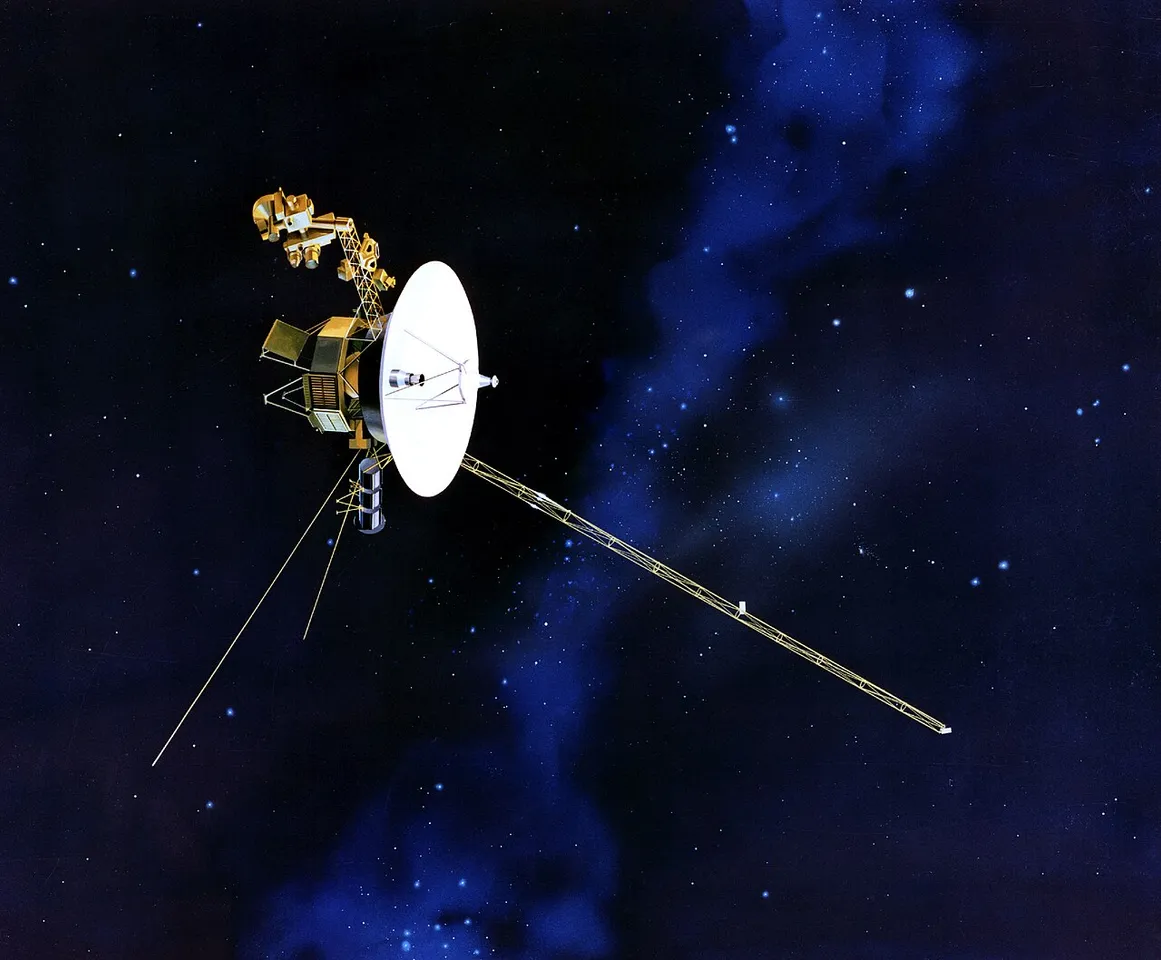
NASA projects that Voyager 1 will reach a distance of one light-day from Earth on 18 November 2026. A light-day is the distance light travels in twenty-four hours. The milestone therefore describes both an extraordinary distance and the approximate one-way travel time of a radio signal between Earth and the spacecraft.
This guide explains what the milestone means, how it differs from the spacecraft's earlier entry into interstellar space and why communicating with Voyager requires patience. The mission information was checked on 5 November 2026. The November event is still a projection at this date, not an achievement that this article claims has already occurred.
What is Voyager 1 about to achieve?
NASA's mission-status page gives 18 November 2026 for the one-light-day distance milestone. It describes a projected Earth-spacecraft separation of approximately 25.902 billion kilometres. The important reference point is Earth: distance from Earth and distance from the Sun are related measurements, but they are not automatically identical.
For an everyday comparison, imagine sending a short instruction and waiting about a day for its radio signal to arrive. Even an immediate reply would need roughly another day to travel back. Actual mission operations also require processing, scheduling and engineering work, so a useful response can take longer than that simple travel-time calculation.
The spacecraft is not suddenly becoming faster than light or beginning a new propulsion mode. It continues its outward journey. Crossing a named distance threshold gives people a meaningful way to understand an otherwise difficult number; it does not imply that the physics changes at that boundary.
A light-day is a distance, not a unit of age
The word day can make the term confusing. Here it is used to define how far light travels during a specified time. A light-year works in the same way with a year instead of a day. Neither term means that an object is necessarily one day or one year old.
In a classroom calculation, multiply the speed of light by the number of seconds in a day. Using a rounded speed of 300,000 kilometres per second and 86,400 seconds produces about 25.92 billion kilometres. The rounded result is useful for understanding the scale, while NASA's mission figure uses a more precise calculation and projected geometry.
Do not treat the small difference between those figures as evidence that the mission page is wrong. A rough exercise and an operational estimate use different precision. State the assumptions before comparing them, especially when a very large distance makes a small percentage difference look like a dramatic absolute number.
When does the projected milestone occur in India?
NASA's published projection gives 18 November at 2:16:07 a.m. Pacific Standard Time. On that date, Indian Standard Time is thirteen hours and thirty minutes ahead of Pacific Standard Time. Adding the difference gives approximately 3:46 p.m. IST on 18 November 2026.
Treat that converted time as a projection based on the stated NASA timing, not a promise of an event visible in the sky at that instant. Voyager is far too distant to become an ordinary naked-eye spectacle merely because it passes a distance threshold.
If the mission updates the prediction, use the updated source rather than preserving an old countdown. Time-zone conversion can be correct while the original projected event time changes. Keep the date, source time zone and publication context together when sharing the milestone.
How is this different from entering interstellar space?
Voyager 1 crossed into interstellar space in August 2012, a finding established through later analysis of its measurements. The one-light-day milestone is a different kind of boundary: a chosen distance from Earth rather than the physical transition associated with the Sun's surrounding environment.
This distinction prevents a common misunderstanding. Voyager did not need to wait until November 2026 to become an interstellar spacecraft. It can already be described that way while continuing to reach new distances. One milestone does not erase or replace the other.
Be careful with the phrase leaving the Solar System as well. Different discussions can use different boundaries, including the heliosphere and much more distant populations of objects. Use NASA's precise description of interstellar space rather than assuming every possible definition refers to the same location.
What makes a spacecraft this distant difficult to operate?
Instructions cannot arrive instantly. Engineers must account for travel time before they can observe the result of a command. A delay is therefore not automatically evidence that the spacecraft ignored the instruction or that a repair attempt failed.
Radio signals also become extremely weak over large distances. Communication depends on specialised ground infrastructure and carefully planned operations. A household wireless-network analogy can help explain the idea of a signal travelling, but it cannot reproduce the actual demands of deep-space communications.
The age and available resources of the spacecraft matter too. An engineering team cannot simply replace a component in person. It must work with equipment already aboard and with information that takes a long time to arrive. That makes cautious diagnosis and verification central parts of the mission.
What did NASA report in October 2026?
NASA published a 29 October update about conserving Voyager 1's power and resolving a brief communications pause. That is a dated engineering update. It should not be turned into a claim that every later silence means the same problem has returned or that all communication has permanently ended.
The mission also publishes information about instruments and power management. Check the current instrument-status page before listing which instruments are operating. A count copied from an older article may have been accurate then while no longer describing the current configuration.
The useful lesson is to distinguish an engineering event, its reported resolution and the spacecraft's broader status. A dramatic headline can collapse them into one frightening statement. Reading the mission update directly helps preserve the sequence and the limits of what was announced.
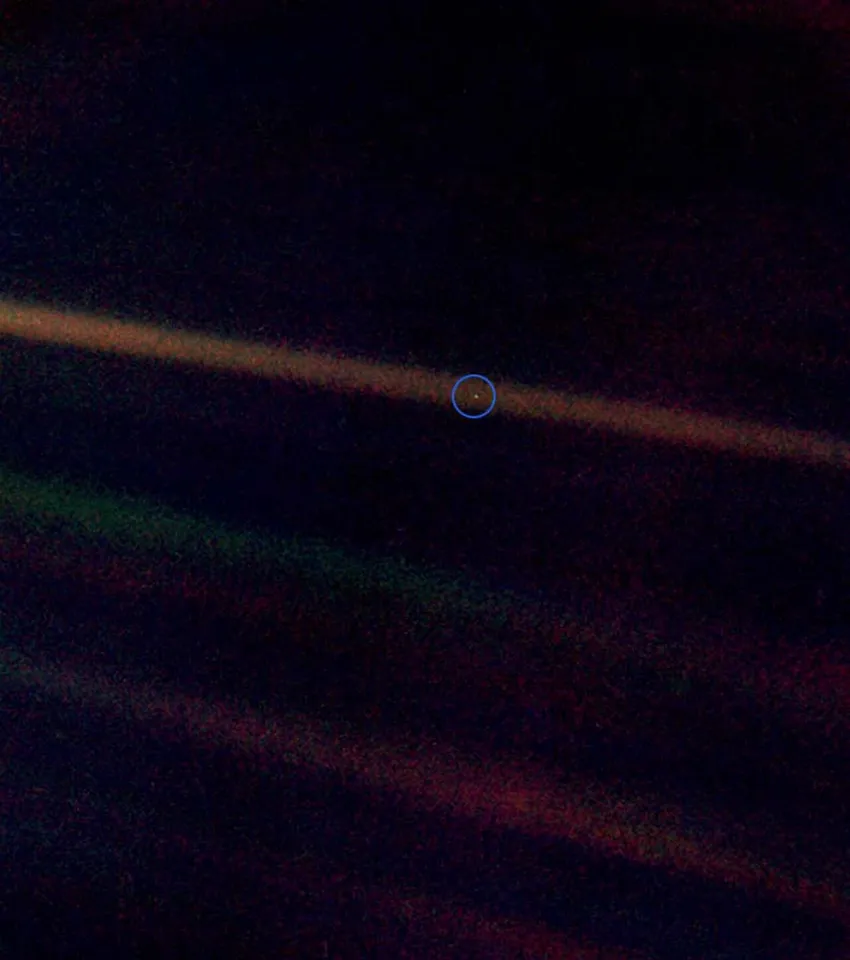
The historical Pale Blue Dot image of Earth from Voyager 1, not a new image taken at the November 2026 milestone.
Why engineers turn instruments off
A long-lived spacecraft has limited electrical resources. Mission teams can reduce demand by shutting down selected equipment while preserving other functions. An instrument being turned off does not, by itself, mean the entire spacecraft has stopped operating.
Think of a simplified battery-powered field station with several sensors. If its available power falls, running every sensor at once may threaten essential communications. Choosing which loads to retain becomes an engineering trade-off. The analogy explains resource management without pretending Voyager has the same equipment or operating conditions.
Use the actual mission statement for the specific decision. Do not invent a shutdown order, an exact remaining lifetime or a future failure date. Those claims require their own evidence. A spacecraft can continue providing valuable measurements even as the range of operating instruments changes.
A one-way delay and a round trip are different
At a distance of roughly one light-day, the signal travel time in one direction is roughly twenty-four hours. Sending a command and receiving an immediate acknowledgement would therefore involve roughly forty-eight hours of travel. The reply cannot return before it has first received the instruction.
Now add real operations. The ground team may need to schedule an antenna, process incoming information and decide what command is safe. The spacecraft may also need time to carry out the requested action. These activities explain why the complete operational cycle can exceed the simple round-trip minimum.
A useful reading habit is to ask which delay a news report describes. One-way light time, round-trip light time and the time taken to resolve a problem are different measurements. Treating them as interchangeable can make an otherwise accurate report appear contradictory.
Distance changes need a reference frame
Earth moves around the Sun, while Voyager follows its own trajectory. As a result, Earth-spacecraft distance is a geometrical relationship between moving objects. A quoted speed relative to the Sun should not automatically be treated as the rate at which distance from Earth increases every second.
For a classroom illustration, imagine two students walking on different paths. Their individual speeds do not, by themselves, tell you how quickly the distance between them changes. Direction matters too. Spacecraft calculations are more complicated, but the principle helps explain why the reference frame must be named.
When comparing two mission numbers, check the date, units and reference point. A value in miles and a value in kilometres can describe the same separation. A value from last year can be smaller without being an error. The labels often explain more than the long strings of digits.
What was the Pale Blue Dot?
Voyager 1's famous distant image of Earth is associated with the phrase Pale Blue Dot. It offers a different perspective on the mission: a spacecraft can produce both scientific measurements and images that change how people think about their planet.
When using the image, retain its historical identity. It is not a newly taken photograph of Earth at the November 2026 milestone. The spacecraft's current work and the original image belong to different stages of a long mission.
Ask what an image can actually show. A tiny point of light can communicate scale and location, but it does not reveal every detail about Earth's surface or current weather. Scientific interpretation combines the image with information about how, when and from where it was obtained.
Explore the mission without trusting a random countdown
NASA's mission pages and visualisation tools provide a better starting point than an unattributed social-media graphic. A third-party countdown can be useful only if it identifies the underlying source and keeps its time-zone assumptions clear.
Use a mission diagram to identify Earth, the Sun and the spacecraft, then read the distance labels. Do not assume that every illustration is drawn to scale. A diagram may enlarge a planet or shorten a gap so the relationships remain visible on a small screen.
Our solar-power learning guide offers another exercise in keeping scientific quantities distinct. Power, energy, speed, distance and time are connected by calculations, but each represents a different kind of information. Correct units make a complex explanation easier to follow.
A small exercise in signal travel
Imagine a distant probe with a hypothetical one-way light time of ten minutes. An immediate reply needs another ten minutes, so the travel portion of the round trip is twenty minutes. Now add five minutes of processing before the reply. The total becomes twenty-five minutes.
Repeat the structure with a one-way light time of twenty-four hours, keeping any processing time separate. You do not need to know every detail of Voyager's computer to understand the distinction. The exercise models the sequence, not the spacecraft's actual operating timetable.
Finally, write one sentence describing the November milestone without using the word already. As of 5 November, NASA projects it for 18 November. That phrasing preserves both the exciting scientific scale and the fact that the named event still lies ahead of this article's check date.
Questions readers are asking
Has Voyager 1 already reached one light-day away?
Not according to the timing discussed in this 5 November guide. NASA projects the milestone for 18 November 2026. Check the latest mission page if you are reading later, and do not confuse a future countdown with a confirmation that the event has occurred.
Will a reply take only one day?
One day describes the approximate one-way signal travel at that distance. A command and an immediate reply involve travel in both directions. Actual operations add processing and scheduling, so the complete response can take longer than the basic round-trip calculation.
Did Voyager enter interstellar space in 2026?
No. Its interstellar-space crossing is associated with August 2012. The November 2026 projection concerns a distance from Earth. These are different milestones and should not be combined into a single newly occurring event.
Can I see the milestone from my roof?
The threshold is a distance calculation, not a new naked-eye display. Use mission information and visualisations to explore it. Do not expect an ordinary photograph of the night sky to reveal Voyager simply because the projected time has arrived.
Sources
- NASA mission status and one-light-day projection
- Voyager 1 mission overview
- NASA mission questions and answers
- 29 October 2026 engineering update
- JPL mission history
Image credits: cover: NASA/JPL, source, Public domain. Resized and converted to WebP. inline: Public-domain source, source, Public domain. Resized and converted to WebP.
Found an error or an outdated detail? Report a correction with the article URL and original source.