
Ziaur Rahman Sharifi: Afghanistan Bowler, Identity and Test Cricket Context
Identify Afghanistan’s Ziaur Rahman Sharifi correctly and learn how his dated Test contribution, bowling style and scorecard figures should be read.

Ziaur Rahman Sharifi is an Afghanistan cricketer identified in the ICC's tournament player profile as a bowler, with right-arm medium-fast bowling and right-handed batting. His name also appears in the Afghanistan Cricket Board's report of the drawn first Test against Zimbabwe at Sharjah in November 2026. He should not be confused with another person sharing the name or with the separately named Zia-ur-Rehman Akbar.
This guide explains the verified identity and dated match context, then helps students read a pace bowler's contribution without inventing a live career total. It is checked on 14 November 2026. Any ongoing second-Test figures remain separate from the completed first-Test report and should be verified through a current scorecard before being shared.
Which Ziaur Rahman does this article cover?
It covers the Afghan cricketer Sharifi. The identity was clarified before drafting because the shortened name can refer to different people. An initial search result, familiar surname or isolated statistics row is not enough to merge those identities safely.
The ICC player entry establishes an Afghanistan association and bowling role. The ACB's completed first-Test report provides the expanded Sharifi name in a specific team context. Reading those details together is more reliable than relying on spelling alone.
For a student building a profile, begin with country, sport and the full name used by an authoritative source. Add a dated appearance only after confirming that the record belongs to the same individual. This prevents a plausible-looking biography from combining unrelated careers.
Why does the similar Akbar name matter?
The ACB report names Zia-ur-Rehman Akbar and Zia-ur-Rehman Sharifi separately. Their contributions should therefore remain separate. A wicket credited to Akbar should not be copied into Sharifi's tally merely because the shortened names look similar.
Sports databases can vary in punctuation, spacing and transliteration. Those differences can make a search difficult, but they do not justify treating distinct players as one. Look for expanded names, player identifiers and the actual match record.
This principle also applies to club records and age-group teams. Two rows can be related through a team without belonging to the same person. An accurate source comparison checks identity before calculating a total or making a career claim.
What is verified about the November first Test?
ACB's report dated 9 November describes Afghanistan and Zimbabwe drawing the first Test at Sharjah. It credits Sharifi with one wicket in Zimbabwe's first innings, while naming other bowlers' contributions separately. That is the dated match fact used here, not a claim about his latest complete career tally.
The report also identifies the second Test as scheduled to begin on 13 November. The completed first match and the later fixture are different records. A live panel from the second cannot be silently added to an earlier summary as if the whole series were finished.
The draw does not erase individual contributions. Nor does one wicket establish every detail of a bowler's performance. Runs conceded, deliveries bowled, conditions and the team's task would also matter for a fuller spell analysis.
What does right-arm medium-fast describe?
It is a bowling-style category, not a promise that every delivery travels at the same speed. A bowler can vary pace, angle and length within a recognized role. The category helps a reader understand the general kind of delivery, while measured speed requires actual tracking data.
Do not invent an exact speed from the label. A phrase in a player profile does not establish a particular kilometres-per-hour figure for a wicket ball. Likewise, a fast-looking broadcast clip is not a calibrated speed measurement.
For a beginner, distinguish the role description from a measured event. The first can be established through the official profile. The second needs a trustworthy measurement from the actual delivery being discussed.
How does a pace bowler contribute beyond a wicket count?
A spell can restrict scoring, challenge a particular area or support pressure created at the other end. Those effects should be described through the available evidence rather than assumed simply because a player is called a bowler.
Wickets are important, but they are not the only column in a complete bowling table. The length and run cost of the spell help establish its scale. A one-over contribution and a long Test spell do not provide the same opportunity to take wickets.
When reviewing Sharifi, begin with the verified table and the match situation. If a source provides only a wicket count, state that narrow contribution. Do not manufacture a detailed tactical account to fill information the report does not supply.
How should bowling figures be read?
A notation such as one for 30 means one credited wicket and 30 conceded runs. Overs are a separate measure. A beginner should not confuse wickets taken with overs completed or read the second number as the team's total.
For a fictional four-over spell of one for 24, economy is six runs per over. The average for that spell is 24 runs per wicket, and the strike rate is 24 legal balls per wicket. The numerical similarity in this example does not mean the measures are interchangeable.
Write the units beside each result. That habit prevents a calculation from becoming a mysterious number and helps a student recognize why batting strike rate uses a different formula from bowling strike rate.
Why is overs notation not ordinary decimal notation?
An entry of 5.2 overs means five complete overs and two legal deliveries, or 32 legal balls. It does not mean five and two tenths overs. Cricket's notation counts the balls after the point rather than using a decimal fraction.
Convert to legal deliveries before calculating a rate. If a fictional bowler concedes 32 runs in 5.2 overs, the spell lasts 32 legal balls, equivalent to five and one third six-ball overs. The resulting economy is six runs per over.
An incorrect conversion can distort comparisons even when the rest of the arithmetic is neat. Checking the unit first is usually more useful than trying to correct a confident conclusion after the calculation has already been shared.
What is the difference between line and length?
Line concerns the delivery's direction relative to the batter and stumps. Length concerns where it pitches along the surface. A description of one does not automatically establish the other.
Watch a sequence and record both only where the camera view supports it. A delivery outside off stump can be full or short. A ball pitching close to the batter can follow different lines. The combination influences the available shot or defensive response.
Avoid labelling every wicket delivery perfect solely because it produced a dismissal. A batter can make a mistake against an ordinary delivery, while a well-directed ball can go unrewarded. Outcome and execution should be considered together rather than treated as identical concepts.
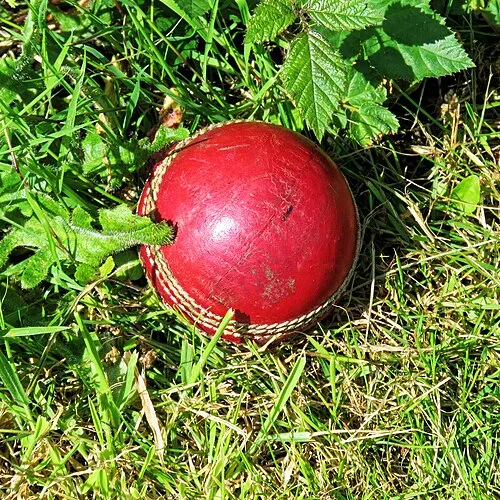
Archive cricket-ball photograph at High Beach Cricket Club, England. This illustrates equipment only; it is not Sharifi’s ball, personal kit or the Sharjah fixture.
How are swing and seam different?
Swing refers to movement through the air, while seam movement concerns deviation after contact with the surface. A replay can help explain the distinction, but one distant angle may not prove which effect occurred on a particular ball.
This guide does not diagnose every delivery in Sharifi's spell from the final wicket count. Technical claims about a specific ball require suitable footage or trustworthy analysis of that ball. A scorecard alone cannot show its complete path.
For a classroom activity, draw the ball's route before and after pitching on a simple diagram. Label the drawing hypothetical. This introduces the vocabulary without pretending to reconstruct a real delivery that has not been examined.
Why does the Test format change the context?
Test cricket allows a different match structure from a fixed twenty- or fifty-over innings. A bowler's opportunities and the team's goals can change across sessions, innings and the remaining time. A draw is also a meaningful possible result.
A defensive batting period in a Test should not automatically be judged by the expectations of a late T20 chase. Similarly, a bowling economy rate that looks low or high in one format may carry a different significance in another.
When comparing Sharifi's records, separate formats before drawing a trend. State whether the sample concerns a match, series, competition or entire career. A combined unexplained total can hide the very differences a reader needs to understand.
What does a draw establish?
It establishes the completed match result under the relevant conditions. It does not prove that every phase was equal, that no side had an advantage or that individual performances were unimportant. A match can contain substantial batting and bowling contributions without ending in a win.
The ACB's first-Test report is used here for the dated draw and the identified player contribution. A complete account of every session would need the full match record, not a summary expanded through guesswork.
For a student, compare the outcome statement with the scorecard. Ask which questions the result answers and which require more information. This helps explain why a sporting contest can be interesting even when the final label is only one word.
Why should an ongoing score not become a career fact?
An in-progress bowling figure can change with the next delivery. A player may take another wicket, concede more runs or return for a later spell. Calling an interim snapshot the final record creates an avoidable error.
Check the status label before sharing. Live, stumps, innings break and completed describe different stages. A date alone does not establish that a Test or series has finished, especially when play can extend across several days.
This article therefore avoids copying a transient second-Test panel into a permanent profile. The completed first-Test report remains a stable historical reference, while current match figures belong on a clearly updated score service.
How should cached profile ages and totals be handled?
An official tournament profile can retain information from the event's reporting point. That does not mean an age or career total displayed there is automatically current months later. The identity and role can be useful while changing fields still need a fresh check.
This guide does not supply an unverified present age, international wicket aggregate or current ranking. Those fields are omitted rather than guessed from an old page. A missing changing number is preferable to a precise-looking but outdated one.
For research notes, label stable identity details separately from changing statistics. That makes future updates easier and reduces the risk that a profile is silently presented as a live dashboard when it is actually a dated reference.
A player-identity and scorecard worksheet
Start with full name, country, official player link and the dated match source. Add any spelling variants that clearly refer to the same record. Keep a separate note for similarly named players so their figures are not combined.
Next, record the format, opposition and match status. If a complete bowling table is available, calculate the rate measures with their units. If only a wicket contribution is established, do not create the missing overs or conceded runs.
Finally, write a paragraph with one verified identity fact, one dated contribution and one limitation. This produces a useful profile without padded claims about private preparation, future selection or records the sources do not actually establish.
What can beginners learn safely from elite bowling?
They can learn how to observe and describe the sport without trying to copy maximum effort from a video. Physical bowling technique and workload are better addressed through appropriate coaching and equipment, not a general written player guide.
Paper-based activities can still be engaging: compare deliveries, draw a field or calculate a fictional spell's economy. Clearly label the examples and avoid presenting them as drills personally used by Sharifi unless a reliable source explicitly says so.
The RayTech article library contains related cricket explanations. Use those guides to build vocabulary and numerical skills while keeping each player's identity, format and reporting date intact. Understanding the record is more useful than memorizing an unsupported superlative.
Common questions
Is Sharifi the same player as Zia-ur-Rehman Akbar?
No. The reviewed ACB report names them separately. Their individual contributions must not be merged because of similar abbreviated names.
What bowling style does the ICC profile list?
It lists right-arm medium-fast bowling. That is a category, not an exact speed measurement for every delivery.
Does this page provide the latest second-Test figures?
No. It uses a completed dated report and explains why ongoing figures should remain separate from a permanent profile.
Does one source's age or total automatically apply today?
No. Changing profile fields require a current check. This guide does not invent a live age, ranking or career aggregate.
Sources
- ICC: Afghanistan player profile for Ziaur Rahman
- ACB: completed first Test and separately named bowling contributions
Checked on 14 November 2026. Hypothetical calculations and classroom activities are original teaching material. No live match total, private routine or future selection is asserted.
Image credits: cover: Tashmetova808, source, CC BY-SA 4.0. Resized and converted to WebP. inline: Acabashi, source, CC BY-SA 4.0. Resized and converted to WebP.
Found an error or an outdated detail? Report a correction with the article URL and original source.