
Arshdeep Singh: Left-Arm Bowling and Tournament Records
Explore Arshdeep Singh with clear explanations, worked examples, source checks and practical questions for independent student learning.
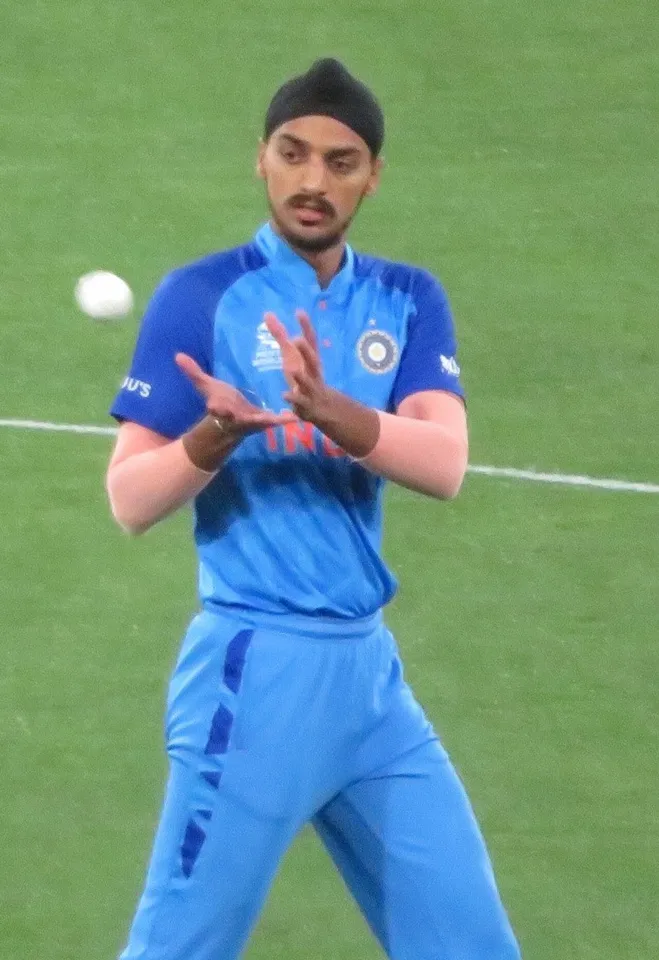
Arshdeep Singh is an India left-arm medium-fast bowler whose official records include seventeen wickets at the 2024 Men's T20 World Cup. A useful player guide should distinguish that tournament total from a single-match return or a current career total. His bowling arm, role and dated achievements provide a starting point for learning how pace-bowling statistics are recorded and compared.
This article was checked on 2 November 2026. It uses official cricket sources for a limited profile and develops original exercises about legal balls, wicket attribution and match phases. It is not a live ranking feed, fitness bulletin or physical training prescription. Invented spells below are teaching examples rather than additional Arshdeep performances.
What does the official profile establish?
The ICC lists Arshdeep as a left-arm medium-fast bowler. BCCI's profile describes his international arrival in 2022 and his place in India's 2018 Under-19 World Cup squad. Those are different stages: a youth tournament appearance is not the same as a senior international debut.
BCCI also describes his 2024 tournament contribution, with seventeen wickets and a joint-leading wicket-taking position. The ICC's annual report records the same wicket total in its tournament statistics. That is a dated competition sample, not a number to be repeated as though his whole career ended at seventeen wickets.
Keep role, team, category and date in separate fields. A player can have domestic, youth and senior records on the same page. A clear profile explains how they relate without adding every figure together into an unlabeled total that no recognised competition actually uses.
Why does left-arm matter in a description?
It identifies the arm used to deliver the ball and can be relevant to angles and matchups. It does not guarantee a particular amount of swing or make every delivery identical. A broad style label is not a measured trajectory, and a precise technical claim needs evidence from the specific delivery or an appropriate analysis source.
For an original paper exercise, draw a pitch and mark two possible release positions, keeping the sketch conceptual rather than measured. Ask how the apparent line to a batter might differ. The model introduces geometry without pretending to reproduce Arshdeep's action or the physics of a real ball.
Young learners do not need to copy a professional bowling action to understand that diagram. Physical technique and workload require suitable individual coaching. This guide keeps practice focused on observation, records and arithmetic rather than encouraging unsupervised attempts to match an elite bowler's speed or movements.
What does a tournament wicket total mean?
It sums the wickets credited to the bowler in the matches included by that tournament record. It is not the number of wickets taken in one spell, the number of team victories or a measure of every useful delivery. The competition boundary and inclusion rules are part of the statistic's meaning.
For an original fictional tournament, a bowler takes two, three, one and four wickets in four matches. The total is ten. That does not mean the player took ten in a single game, and it does not establish whether the team won all four matches. Each additional claim needs its own record.
The same care applies when an article is updated. A historical tournament total should remain attached to that event even as a career total changes. Do not replace one with the other or describe a new cumulative figure as though it were the old tournament's result.
What does joint-highest mean?
It means more than one participant shares the highest value in the stated category. It is different from an outright lead. If a source reports a tie, preserve that word rather than removing it to make a profile sound more impressive. A shared achievement remains an achievement without altering its definition.
Use an original table with wicket totals of twelve, twelve, ten and eight. The first two players are joint leaders by wickets. If another ranking system uses additional criteria, identify that system separately. Do not silently invent a tie-break and claim that the table had one unambiguous leader all along.
This is a useful language lesson as well as a statistical one. Highest, joint-highest, second-highest and tied for second describe different relationships. A single missing word can change the factual meaning of a headline even when every displayed number is correct.
How do bowling phases change the question?
A new-ball spell and a late-innings spell can involve different batting objectives and field settings under the relevant rules. The bowler's task depends on the situation. A broad description of someone's strengths does not prove the precise intention of every delivery in a particular match.
For an original fictional comparison, one bowler delivers early with the batting side trying to establish an innings, while another bowls when twelve runs are needed from six balls. The same economy figure might arise from very different circumstances. Add the phase and match state before making a larger judgement.
This guide does not claim access to team plans or private conversations. If a player or coach explains a decision publicly, attribute the account. Otherwise distinguish the observed use from your possible explanation of why it occurred. That keeps tactical discussion interesting without presenting speculation as fact.
What is a yorker?
The term describes a very full delivery directed near the batter's feet or the base of the stumps in ordinary cricket discussion. Whether a particular ball fits that description should be judged from suitable evidence. Do not label every late-innings wicket a yorker simply because the bowler is associated with that skill.
For an original observation activity, compare drawings of three fictional landing lengths and discuss how the batter's position changes the description. Mark the drawings as conceptual. They are not measured pitch maps and should not be used to infer the exact length of an unseen delivery.
An educational article can explain vocabulary without prescribing an individual's physical technique. Use age-appropriate, supervised coaching for real bowling practice. The record-reading task here is to understand what a description claims and what evidence would be needed to confirm it in a specific instance.

Historical regional cricket context, not a venue claim about a specific Arshdeep performance.
How is economy rate calculated?
Economy is runs conceded per six-ball over. Convert partial overs into legal balls first. For conventional cricket notation, 3.4 means three overs and four additional legal balls, or twenty-two balls. It does not mean 3.4 ordinary decimal units of time.
In an original fictional spell, a bowler concedes twenty-two runs from 3.4 overs. Twenty-two divided by twenty-two and multiplied by six gives an economy of six. A calculation using the decimal number 3.4 would produce a different result and misinterpret the source notation.
Preserve the original inputs when rounding. If you round each match's economy and then average those displayed rates, you can create a result that differs from the aggregate rate. Combine runs and legal balls for the relevant sample, then calculate the rate and round only the presentation.
Are all team wickets credited to a bowler?
No. The team's wicket count and a bowler's credited wickets are related but distinct. Run-outs are not credited to the bowler. A summary saying that two wickets fell during an over can therefore differ from a bowling return showing one wicket credited in that over.
For an original example, imagine a caught dismissal followed by a run-out. The batting side loses two wickets, while the bowler receives credit for the caught dismissal. A good event record can acknowledge the fielding contribution and team change without inflating the bowling figure.
This is important when adding highlights to a player profile. An edited clip may show several dismissals during the same spell. Check the scorecard's attribution before describing every one as a bowling wicket. Correctly identifying a contribution does not diminish the other players involved.
How do average and strike rate differ for bowling?
Bowling average is runs conceded per credited wicket. Bowling strike rate is legal balls per credited wicket. Economy is runs per over. All three can be useful, but none is simply interchangeable with another. A profile should show the labels and units, not only three unexplained numbers.
Use an original fictional sample of thirty-six legal balls, thirty runs and three wickets. The average is ten runs per wicket, strike rate twelve balls per wicket and economy five runs per over. The same underlying data supports different questions through different denominators.
If the wicket count is zero, the per-wicket ratios are not finite ordinary values. Do not display a zero average, which would imply something very different. A transparent not-applicable or undefined state is more informative than a polished number produced by an invalid division.
Why is a small sample not a guarantee?
A short record can change sharply after one additional match. A strong figure in one situation does not prove the next spell will have the same outcome. Keep sample size visible and avoid treating a rate as a forecast unless the method and assumptions behind that forecast are actually supplied.
For an original example, a fictional bowler begins with two wickets for ten runs, giving an average of five. A wicketless spell conceding thirty raises the combined average to twenty. The second spell's own per-wicket average is not zero, so averaging five and zero would be an invalid shortcut.
This teaches a general data skill: aggregate from the underlying quantities rather than averaging incompatible summaries. The same issue appears in school marks, production rates and many other datasets where the sizes of the groups differ.
What should a fair player comparison include?
Define the format, period and measure, then retain the relevant opportunities and role. A domestic season should not be compared with a senior international career as though both were one competition. A table can look professional while being fundamentally misleading if its rows do not describe comparable samples.
For an original worksheet, create two fictional players with different numbers of overs and wickets. Calculate both volume and rate measures, then ask what the comparison still cannot establish. Conditions, opponents and match responsibilities may remain outside the table. Acknowledging those limits makes the conclusion stronger, not weaker.
Avoid personal attacks or invented motivation when explaining a difficult spell. A player conceding runs does not prove a lack of effort, just as a successful result does not reveal every private decision. Describe the record and support interpretation with the actual available evidence.
A final bowling-record challenge
An imaginary tournament contains spells of 2/20 from four overs, 1/18 from three and 3/24 from four. Total the wickets, runs and legal balls before calculating the combined measures. The sample contains six wickets, sixty-two runs and sixty-six legal balls.
The combined average is approximately 10.33 runs per wicket, strike rate eleven balls per wicket and economy approximately 5.64 runs per over. These are not Arshdeep statistics. They are deliberately fictional values that let learners practise a method and check every step independently.
Explore more cricket learning articles when you are ready. Arshdeep's profile offers a recognisable starting point, but the lasting skill is broader: identify the competition, preserve the date, separate team events from individual credit and explain the unit behind every statistic before drawing a conclusion.
A final comparison should show its inputs as well as its answer. Retain runs, legal balls and wickets beside any derived rate, so another learner can verify the calculation. If a correction changes one input, recalculate the affected measures rather than editing the displayed answer alone. This is a useful habit for both sports spreadsheets and educational software: the underlying record should remain the source of the result, while the presentation explains it clearly. A polished chart is most trustworthy when its quantities and limits remain easy to inspect.
Keep units explicit.
Compare these measures with the worked examples in our Adam Milne profile.
Sources
- ICC: Arshdeep Singh profile, for playing style and player identity.
- BCCI: Arshdeep Singh profile, for the dated youth and senior-career context.
- ICC: 2024–25 annual report, for the 2024 tournament wicket record. All other numerical spells are original fictional exercises, not additional player results.
Image credits: cover: Storm machine, source, CC BY-SA 4.0. Resized and converted to WebP. inline: DeepArjunSingh, source, CC BY-SA 3.0. Resized and converted to WebP.
Found an error or an outdated detail? Report a correction with the article URL and original source.