
Bayern Munich: History, Campus and the Code & Kick Learning Idea
Understand Bayern's selected milestones and club structure, then explore the real Code & Kick education event through original student website activities.
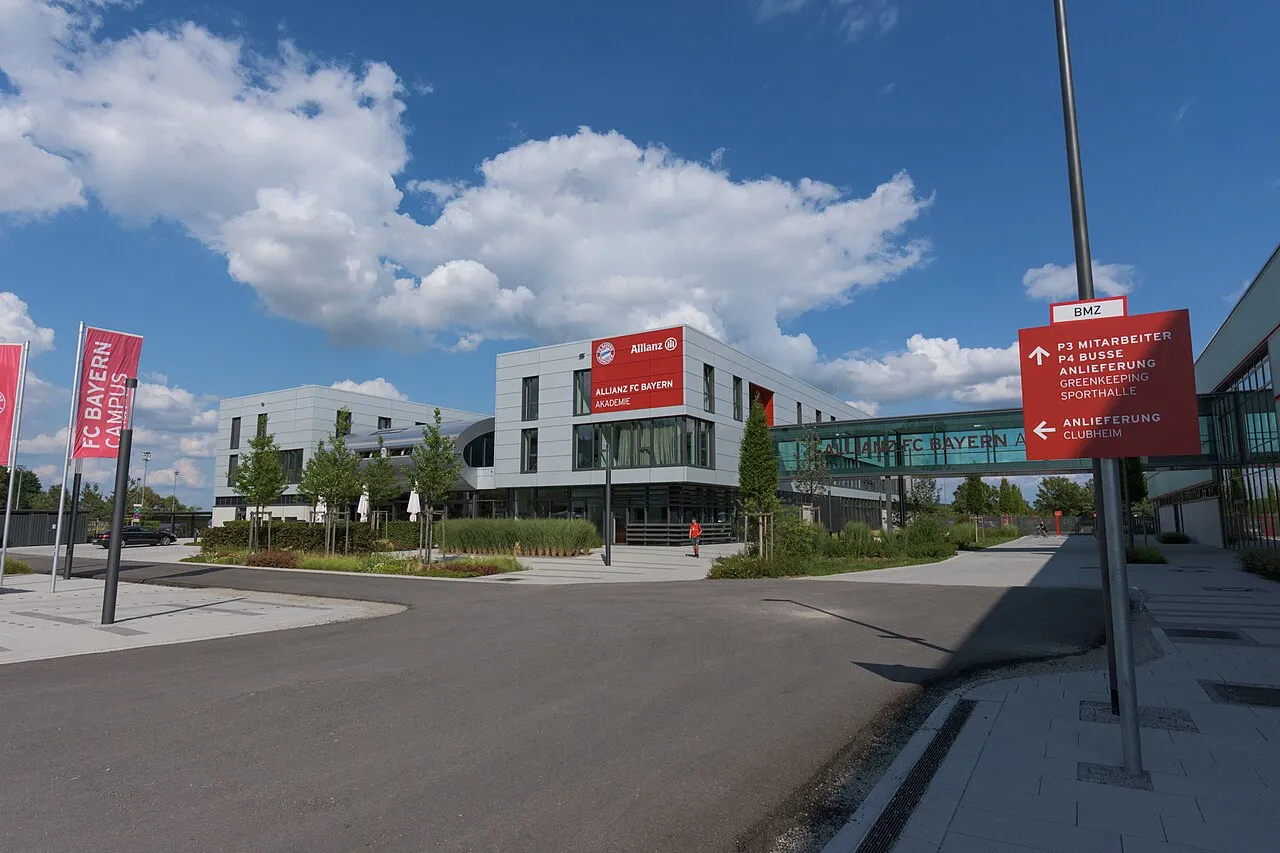
Bayern Munich's identity extends beyond a scoreline or a list of trophies. Its history, member-club structure and development campus offer several different ways to understand the institution. One especially useful example for students is a club event that combined building a small website with playing football.
This guide connects a few verified milestones with that educational example. It explains why the club, its company, an academy facility and a current team sheet should be read as related but distinct things, then suggests original activities that students can try without travelling to Germany or purchasing a programme.
Bayern Munich and Bayern München
The club's official English website uses Bayern Munich, while its formal organisational names include Bayern München. These are name forms associated with the same Munich institution; the spelling difference does not by itself identify a separate club.
A short search such as “Bayern” still needs context. Check the team section, competition and date before assuming a result concerns the men's first team or the fixture you intended to find.
The official site separates club information, company information, history, matches and teams. Those sections answer different questions. A historical page can establish an earlier milestone without telling you who will start the next match.
For a beginner's notebook, use the club name as one field and the specific team as another. That makes the record clearer than putting every piece of information under a single broad heading.
A few milestones, with the competition attached
The club's official timeline records its founding at Café Gisela in Munich on 27 February 1900, led by its first president, Franz John. It records the first German championship in 1932 and Bundesliga promotion in 1965.
That sequence contains an important lesson: “German championship” and “Bundesliga title” should not be treated as identical historical labels across every era. A club could win a national championship before later entering the Bundesliga competition.
The timeline also records European Cup victories in 1974, 1975 and 1976. Keep the competition's historical name attached when discussing that run rather than silently changing the terminology of an old event.
| Milestone | What the date identifies |
|---|---|
| 27 February 1900 | Club founding |
| 1932 | First German championship |
| 1965 | Bundesliga promotion |
| 1974–1976 | Three consecutive European Cup titles |
| August 2017 | Campus inauguration period |
These are selected milestones, not a complete honours list. The purpose is to show how a timeline can remain concise while preserving the meaning of each entry.
Club and company are different information categories
The official website has separate pages for FC Bayern München eV and FC Bayern München AG. The company page lists the club with a 75% share, alongside adidas, Audi and Allianz entries displayed at 8.33% each.
Those labels should not be flattened into a statement that every person associated with Bayern has the same role. A member, a company shareholder, an executive and a player are different categories.
This guide does not interpret an individual's voting rights or offer legal or investment advice. For an actual membership question, use the club's current rules and official membership information rather than inferring rights from a shirt purchase or a social-media post.
For a student, the useful habit is to ask which organisation a document concerns. A company announcement and a member-club notice can both be official while addressing different responsibilities.
Why the percentages appear to total 99.99
Adding the displayed numbers produces 75 + 8.33 + 8.33 + 8.33 = 99.99. That arithmetic should prompt a check of the display precision, not an immediate allegation that an unexplained fraction is missing.
A separate fictional example makes rounding easier to see. Divide one quarter equally among three entries. Each is 8.333…% of the whole. Displaying each to two decimal places gives 8.33%, and the three displayed values add to 24.99% rather than exactly 25%.
This example explains a rounding effect; it is not a reconstruction of the legal share register. The published company information remains the source for its actual holdings.
The broader lesson applies to survey results, pie charts and school spreadsheets. Rounded values can produce a displayed total slightly different from the unrounded total. Retain enough precision for calculations and make the display convention clear.
What the FC Bayern Campus represents
The club published an inauguration gallery dated 21 August 2017 for the FC Bayern Campus. It identifies a development facility, not the founding of the club in 1900 and not a guarantee of a place for every young player who reads about it.
A campus photograph can help a reader understand the setting, but it cannot establish an individual's selection, a current session schedule or public access conditions. Those questions need their own information.
The two photographs in this guide show campus context from different views. They are not presented as pictures of the Code & Kick participants or a recent first-team match.
That is a useful research habit in itself. A relevant image should still be accurately captioned. A building's name does not make every later event mentioned in an article visible in the photograph.
Code & Kick: a concrete education example
An official club report describes around 150 young people from six school classes taking part in Code & Kick on 27 June 2025. The event involved FC Bayern, ReDI School of Digital Integration and the Bavarian FA, with support through the BayCode initiative.
The report says participants aged 13 to 17 learned basic programming and made a small website during a three-hour course, followed by a football session. This is a dated account of that event, not an announcement that the same session is open for booking now.
The example gives students a practical connection between two activities that can appear unrelated. A football interest can supply the subject for a small website; programming can provide a way to organise and explain that interest.
This does not mean every learner has to enjoy sport or that a particular exercise guarantees academic improvement. It shows one actual event design, which can inspire a separately planned local classroom activity.
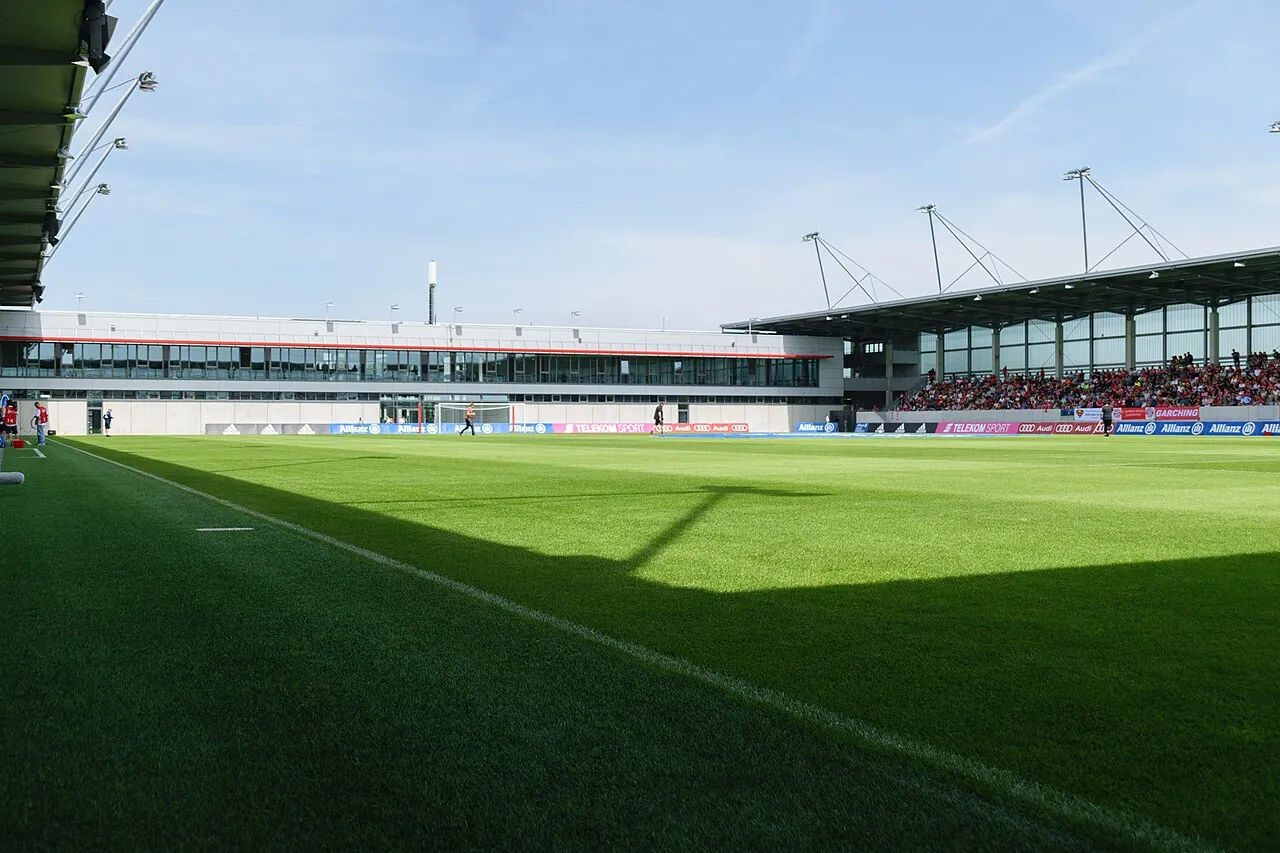
The stadium at the FC Bayern Campus. This illustrates the campus setting rather than a first-team fixture or the specific 2025 education event.
An original classroom version without special equipment
Choose a small project: a fictional school-team page. It can contain a heading, a short introduction, a practice timetable and three player-role descriptions. Use invented names and avoid publishing classmates' personal details without appropriate permission.
Set a clear success condition. The page should be readable on a phone, its links should work and the timetable should use explicit days and times. A small project with those properties is more useful than a large unfinished site whose purpose is unclear.
After a suitable break or a supervised activity, return to the page and test it again. Can someone else find the schedule without being told where it is? Can they identify whether the fixtures are fictional?
These are our original suggestions. They are not the official event's lesson plan, not a Bayern-approved course and not an offer of access to its campus.
Connect football rules with programming rules
Sport supplies simple examples of defined inputs and outcomes. A fictional score table might calculate match points from wins and draws. A timetable might sort sessions by day. A player list might filter roles without revealing personal information.
For a first exercise, create three fictional teams with wins, draws and defeats. Check that those counts add to matches played. Then calculate points using the rule supplied for your invented competition.
Do not silently assume that every sport or tournament uses the same allocation. The rule should be an explicit part of the exercise. If you later use real football data, attach its competition and source.
Our programming courses provide a place to practise headings, tables, lists and conditions. You can learn the underlying ideas in a browser without claiming that your practice page is an official club service.
Why testing belongs in the activity
An attractive timetable can still contain a broken link or an impossible date. A correct calculation can still have a misleading label. Testing should therefore examine both behaviour and meaning.
Ask a classmate to complete one concrete task, such as finding the next fictional practice session. Observe where the page helps and where it causes uncertainty. Then make one focused improvement and repeat the task.
For a score calculation, include an ordinary example and an edge case. What happens with no completed games? What happens if one of the entered counts is negative? The program should communicate the problem rather than producing a confident-looking but meaningless answer.
This is a useful bridge between exercise and programming: both improve through a clear task, feedback and another attempt. It is an analogy for learning, not a claim that the two activities have identical training methods.
Following the current team requires a fresh source
A club-history guide should not pretend to be a permanent current squad announcement. Player registrations, match availability and the selected XI can change, so use the appropriate current team and fixture pages for those questions.
Distinguish a squad list from the team that starts a specific match. A training photograph can identify a setting without guaranteeing selection or a particular tactical assignment.
Our Bayern–Dortmund guide discusses a particular dated league meeting. The present page takes a different route, focusing on the institution and its educational example rather than repeating a match report.
Keep the distinction when sharing links. A friend asking for tonight's score needs a current match resource, while someone asking how the club developed may find a historical guide more useful.
Membership information is not a ticket promise
A person interested in membership should read the current official information about eligibility, charges and any associated conditions. A general club profile cannot establish those details for an individual.
Likewise, a familiar logo on an unsolicited message is not proof of an official offer. Check the organisation, the precise programme and the source of the communication before treating it as an invitation, trial or guaranteed seat.
This page does not recommend a purchase or publish a package price. Its purpose is to explain why membership, attendance and development opportunities should be identified separately.
The same habit applies to educational websites and institutes. A newsletter subscription, course enrolment and certification are different services even when they share one brand name.
A source notebook that keeps the story accurate
Save four separate records: the founding milestone, the company information, the campus inauguration and the Code & Kick report. Beside each, write what the source establishes and the date you checked it.
This prevents an easy but serious mix-up: using a 2025 event report as a current registration notice or treating a campus opening as the club's founding date.
If a source includes a goal or ambition, preserve that status. An organisation's intention is not automatically a measured outcome. A participant count from one event should not become an annual total without another source.
Our online verification guide offers more practice in separating evidence, date and interpretation. Those habits help a reader enjoy sport while becoming more careful with information.
Frequently asked questions
Is Bayern München different from Bayern Munich?
The names are used for the same Munich institution in different language and organisational contexts. Check the team and competition as well as the name when identifying a fixture.
Did the club begin when the campus opened?
No. The club's founding is dated 27 February 1900. The campus inauguration belongs to 2017, a separate milestone.
Is Code & Kick a current open invitation?
The event described here took place on 27 June 2025. This article does not establish current enrolment, places, fees or eligibility for a later event.
Can students try the learning idea without visiting Bayern?
Yes. The original fictional team-page exercise can be completed locally with ordinary browser tools. It does not require a club account or access to a private system.
Sources
- Official club milestones
- Club information
- Company and published shareholding information
- Campus inauguration gallery, 21 August 2017
- Code & Kick event report
Image credits: cover: EL Loko, source, CC BY 4.0. Resized and converted to WebP. inline: EL Loko, source, CC BY 4.0. Resized and converted to WebP.
Found an error or an outdated detail? Report a correction with the article URL and original source.