
BTC to USD on Binance: Quote Units and Conversion Guide
Explore BTC to USD on Binance with clear explanations, worked examples, source checks and practical questions for independent student learning.

BTC to USD means expressing an amount of bitcoin in United States dollars, but the exact trading pair matters. A BTC/USDT quote is denominated in the USDT token, not automatically a bank-dollar balance. To interpret a Binance screen, identify the base asset, quote asset, market type and timestamp before multiplying an amount by a displayed price.
This educational guide was checked on 2 November 2026. It does not publish a live exchange rate, recommend a purchase or promise that a service is available to every reader. All prices in the worked examples are fictional and deliberately round. They demonstrate units and arithmetic, not current market conditions or expected returns.
What does a trading pair represent?
A pair names the asset being priced and the asset used to express that price. In BTC/USDT, BTC is the base asset and USDT is the quote asset. A displayed value describes quote units per unit of the base asset within that market. It is not a statement that every pair containing BTC has the same numerical price.
Binance's educational material uses BTC/USDT as an example of a spot-market pair. Its developer documentation provides symbol information separately from market-price endpoints. That separation is useful: identifying a market and obtaining a current quote are different tasks, and neither should be inferred from a vague search phrase alone.
For an original classroom model, imagine a pair called BOOK/POINT. A price of ten means ten points per book. Two books would have a simple quoted value of twenty points before any other conditions. The fictional model makes the direction of the quote clear without requiring a real financial account.
Is USDT the same as USD?
USD is the currency code for the United States dollar. USDT is a digital token whose issuer describes a dollar-linked design. A token intended to track a currency is still a different asset from cash or a bank deposit. Its market price, access conditions and redemption arrangements should not be assumed identical to holding dollars directly.
The issuer's description is useful for understanding the intended relationship, but it is not a personal guarantee that every transaction will occur at exactly one dollar per token. A calculation using USDT should retain that unit unless a separate USDT-to-USD rate is supplied and applied explicitly.
This guide does not recommend treating a token balance as insured bank money or promise a redemption route for a particular reader. The practical learning point is narrower: preserve the asset label. A correct multiplication becomes misleading if the result is silently renamed from USDT to USD without checking the additional conversion.
How do you calculate a simple quoted value?
Multiply the amount of the base asset by the quote price per unit. Keep the units visible so they cancel correctly. The result is a gross quoted value under the example's assumptions, not necessarily an executable sale amount, cash received or a bank withdrawal balance.
For an original fictional example, suppose one BTC is quoted at 50,000 USDT. An amount of 0.002 BTC has a simple value of 100 USDT: 0.002 multiplied by 50,000. The BTC units cancel, leaving USDT. Neither number is presented as a live price or a recommendation about how much to hold.
Now change the amount to 0.0004 BTC while retaining the same fictional quote. The result is twenty USDT. The exercise demonstrates decimal multiplication. It does not establish that a platform will accept that order size, charge no fee or provide the same quote when a real order reaches the market.
How would a separate USD conversion work?
If a distinct USDT-to-USD rate is supplied, multiply the USDT result by dollars per USDT. The two-stage calculation should display both rates and their timestamps. Without the second input, label the first result in USDT rather than pretending that a dollar conversion has been completed.
Use an original hypothetical rate of 0.99 USD per USDT. The earlier fictional 100 USDT would correspond to ninety-nine USD before any additional conditions. If the hypothetical rate were 1.01, it would correspond to 101 USD. These deliberately invented values illustrate why a peg's intention is not a substitute for the actual conversion input.
Do not interpret the examples as a forecast that a token will move to either value. They isolate a unit-conversion question. A good classroom exercise makes the assumption explicit, performs the arithmetic and stops before turning the result into a trading suggestion.
Which price are you looking at?
A market can display several different numbers: the most recent trade, a best bid, a best ask or a calculated average over a period. Those values can differ while all being correctly labelled. The phrase bitcoin price is incomplete when the purpose requires a precise, executable or time-specific figure.
For an original fictional order book, the best bid is 49,990 quote units and the best ask is 50,010. The spread is twenty quote units per BTC. A last trade at 50,000 is another recorded event, not a guarantee that either side of the book is available for any quantity.
This is not a live Binance order book. It teaches why the field name belongs beside the value. A chart or calculator should not switch from last price to best bid without telling the reader, because the arithmetic may remain correct while the practical question being answered changes.
Why does order size matter?
A displayed best price can apply to a limited available quantity. A larger hypothetical transaction may encounter additional price levels. A simple amount-times-best-price calculation therefore does not always describe a complete execution. The available depth and the order's conditions are separate inputs.
Imagine an original fictional market offering 0.001 BTC at one price and another 0.001 at a different price. A hypothetical 0.002 purchase would combine both levels if those were the relevant available offers. The average price would be weighted by quantity, not chosen by taking whichever level looks most favourable.
This guide does not instruct readers to place such an order. The example explains a data concept. Market conditions can change, and a classroom calculation should not be presented as a promise about what a platform will execute or how much money a reader will receive.
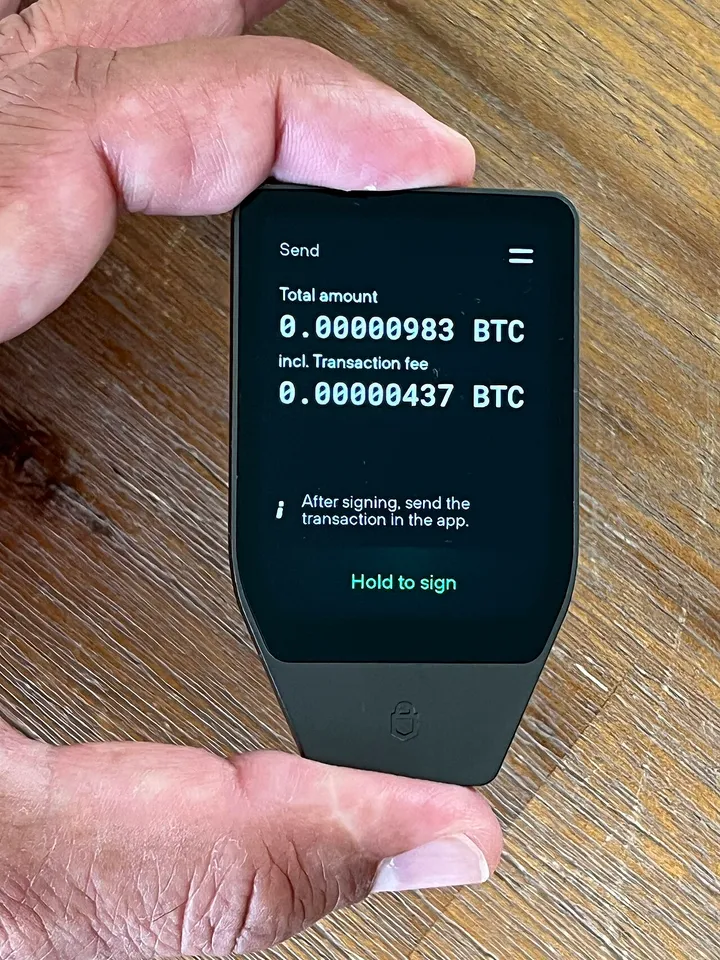
Hardware-wallet illustration, not Binance custody, a price feed or a product recommendation.
What is the difference between gross and net value?
Gross value is the amount before specified deductions, while net value is the amount after the deductions included in the model. A conversion example that excludes fees should say so. Actual charges depend on the service, product and current terms; this article does not supply a universal Binance fee or a personalised quote.
For arithmetic only, imagine a gross value of one hundred units and a fictional charge of one unit. The simplified net is ninety-nine. If another charge applies in a different asset, it needs its own treatment. Do not subtract a number with an incompatible unit and label the result as though everything were expressed in dollars.
Keep withdrawals, network charges and trading charges conceptually separate. They may arise at different stages, and a quoted market price does not automatically include them. A clear educational calculator states exactly which items it models instead of claiming to represent every possible final cost.
How should timestamps be handled?
A price is a dated observation. Record the timestamp and time zone supplied by the source, and distinguish that from the time you opened or refreshed a page. A cached value can be valid for its original moment while being unsuitable as a current quote.
For an original example, a fictional observation at 12:00 UTC and another at 12:05 UTC are two different records even if their values happen to match. If the page displays the first one, changing the browser's clock label does not make the underlying data newer. Update the observation, not just the decorative timestamp.
This static article deliberately does not print a current BTC price. It remains useful by explaining how to identify a quote and calculate with it. Readers needing a live figure should consult the relevant official market and understand its labels rather than treating an old article's example as today's rate.
Can a public API help identify a symbol?
Binance's official spot documentation describes an exchange-information endpoint for current symbol and rule information. It separates that from price and order-book endpoints. A symbol being returned in a market-information record is not the same as confirming that every account or jurisdiction may use every associated product.
For an original software exercise, use a fictional record with baseAsset, quoteAsset and status fields. Display the two asset names separately instead of guessing where to split a concatenated symbol. A robust model reads the documented fields rather than assuming that every currency code has the same number of characters.
The exercise needs no API key, account login or order placement. It can be completed with invented data. Do not paste credentials into a public calculator or browser console simply to learn how a pair is named. Identification and authorised account actions belong to different parts of a system.
Why must decimal precision be considered?
Small asset amounts and large unit prices can produce rounding errors in poorly designed software. Keep enough precision for the calculation, then round the displayed result according to a clearly stated rule. Do not repeatedly round intermediate values and expect the final total to remain unchanged.
For an original example, add three fictional quantities before multiplying by one common price, then compare that with rounding each quantity first. The answers can differ because rounding removes information. The lesson applies to school budgets and measurements as well as digital-asset examples.
For a real service, the relevant quantity increments and precision rules come from its current documentation and market information. This guide does not invent those limits. A learning tool should reject unsupported inputs clearly rather than pretending that any number of decimal places is automatically valid for an actual order.
How can a conversion worksheet remain honest?
Give each input a name, unit, source and date. Separate amount, quote price, optional cross-rate and explicitly modelled deductions. Show the formula and mark missing values. A blank quote should not become zero, and a missing cross-rate should not silently become one.
Try an original worksheet using 0.003 BTC, a fictional 40,000 USDT per BTC and an optional fictional dollar rate of 1.00. The first result is 120 USDT. The second stage produces 120 USD only because that additional rate was supplied as an assumption. Removing it should remove the USD result rather than preserve an unsupported label.
Finally, write a sentence explaining what the result is not: it is not a guaranteed execution, profit forecast or promise of bank cash. That limit is part of the model's meaning, not a disclaimer added after an otherwise misleading number has already been presented.
What should you remember?
Identify the pair before calculating, preserve USD and USDT as distinct units and check the price field and timestamp. A gross mathematical value is not automatically a net executable amount. Fictional examples can teach the method without implying a current price, a service recommendation or a reason to take financial risk.
Explore more practical financial-literacy articles for related numerical skills. The useful outcome is the ability to explain every input and unit in a conversion, recognise what is missing and avoid presenting a precise-looking answer to a question the available data cannot actually settle.
A final calculator check should distinguish an amount of zero from a missing amount. Zero can produce a valid zero result under a supplied price, while a blank input means the model lacks information. Show the reason when a calculation is unavailable instead of displaying a reassuring number that hides the missing field.
For the distinction between a balance, a payment and money owed, read our banking-basics guide.
Sources
- Binance Academy: spot-market interface guide, for pair and market context.
- Binance: official spot API documentation, for symbol-information context; the official site may redirect to its current documentation layout.
- Tether: issuer explanation, for the stated token design, not an independent guarantee of market price. All prices, order books and fee examples in this article are fictional educational assumptions, not financial advice or live quotes.
Image credits: cover: Satoshi Nakamoto, source, Public domain. Resized and converted to WebP. inline: FlippyFlink, source, CC0. Resized and converted to WebP.
Found an error or an outdated detail? Report a correction with the article URL and original source.