
Cameron Green: Career, All-Rounder Role and Stats Explained
Explore verified career milestones and a dated role update, then learn to keep batting, bowling, fielding and availability questions separate.

Cameron Green is an Australian cricketer whose career makes a useful case study in how batting, bowling and fielding roles can change. An all-rounder label describes a range of skills. It does not prove that a player is available to bowl in every particular match, nor does it explain a selection decision on its own.
This guide separates the verified career outline from a dated October 2026 role update, then offers original ways to read a multi-skill player's record. It is not a live fitness assessment or a prediction of the next Australian XI.
Who is Cameron Green?
Cricket Australia's profile identifies Cameron Donald Green as a right-handed batter and right-arm pace bowler, born on 3 June 1999 in Subiaco, Western Australia. It lists his height as 198cm. His ODI debut was on 2 December 2020, his Test debut on 17 December 2020 and his T20I debut on 5 April 2022.
Those separate debut dates are worth keeping separate. A player's first international appearance is not automatically the date of his first Test, and the word "debut" needs a competition or format beside it. Otherwise two correct dates can look like a contradiction when they describe different milestones.
The ICC profile classifies Green as an all-rounder, while the Cricket Australia profile header checked for this guide says batter. That difference should prompt a closer look at the context rather than an automatic accusation that one page must be false. Career skill descriptions and match-specific duties are different kinds of information.
The career milestones that establish the background
Green began first-class cricket for Western Australia with a five-wicket performance against Tasmania in February 2017. His first Test century came in Ahmedabad in March 2023, and his unbeaten 174 in Wellington followed in February 2024. These are historical milestones, not claims that the same role or form applies in every later series.
A milestone list is a starting point rather than the whole evaluation. One exceptional innings establishes that the innings occurred. To describe a season, you would need the wider season record; to assess consistency, you would need a defined sequence rather than a single selected highlight.
Consider how you would organise a school project about the career. Put the date, event, format and source in different columns. A Test century and a domestic five-wicket haul should not be combined into one competition total. Keeping the categories explicit protects the meaning of both achievements.
Do the same with photographs. A fielding image from 2022 can illustrate the player without proving anything about his condition in late 2026. The captions on this page preserve that difference so an older image is not mistaken for visual evidence of a new selection or training session.
What did the October 2026 update actually say?
A Cricket Australia report dated 25 October discussed Green's expected return for the South Africa series decider in a specialist batting role, with bowling unavailable at that stage. That is a dated pre-match report. It is not a medical diagnosis from this website or confirmation of his availability for an unspecified later match.
The limited claim matters. A story saying a player is preparing to return does not by itself establish the eventual playing XI, batting position or number of overs delivered. Check the confirmed match record for what actually happened and a newer official update for any subsequent change in availability.
This is a useful general distinction in sports reporting: expected, selected, started and performed are different states. They may occur in sequence, but one is not proof of the next. Do not convert a training report into a completed-match statistic.
It also explains why an all-rounder may be discussed as a batter. A player can possess bowling skills while being used only for batting in a particular period. A career label does not override a dated availability statement, and neither should be stretched into a permanent prediction.
A snapshot is useful only when its date is visible
The Cricket Australia Test table checked on 1 November 2026 displayed 40 matches, 64 batting innings, 2,012 runs, 39 wickets and 42 catches. These are a recorded page snapshot, not a live-updating promise. Readers checking later should open the current official profile and compare the same format and fields.
| Field | What it counts | What to avoid assuming |
|---|---|---|
| Matches | Appearances in the selected competition or format | Every match contains the same number of batting opportunities |
| Batting innings | Times the player batted | The same thing as dismissals |
| Runs | Runs credited to the batter | The team's innings total |
| Wickets | Wickets credited to the bowler | Every dismissal involved the bowler in the same way |
| Catches | Catches credited in that scope | A complete measure of all fielding value |
A table may let you switch between international formats and a domestic competition. Before copying a row, note the selected tab. A Test figure cannot be made into a career total across all cricket simply by removing the word "Test" from the heading.
For a data exercise, save the snapshot as a dated record and create a separate later record when you check again. Do not overwrite the original date while leaving old numbers in place. That produces an apparent current statistic without the evidence needed to support it.
Why matches, innings and dismissals are different
In Test cricket, a team can have two innings in a match, but a particular player does not necessarily bat twice. A match might end earlier, or the team's innings might finish before the player is required. That is why dividing runs by matches is not the ordinary calculation for batting average.
A fictional example makes the difference clear. Suppose a player scores 300 runs across ten batting innings and remains not out twice. Runs per innings would be 30. Batting average would use eight dismissals as the denominator, giving 37.5. Both calculations can be correct if their labels are correct.
Now change the question to runs per match. You would need the number of matches as a separate input. It cannot be recovered simply by dividing the innings count by two. That shortcut assumes a pattern the record may not contain.
This is a transferable lesson for students: choose the denominator that answers your question. A school attendance rate, a cricket average and a website conversion rate all become misleading if the denominator changes without a corresponding change in the label.
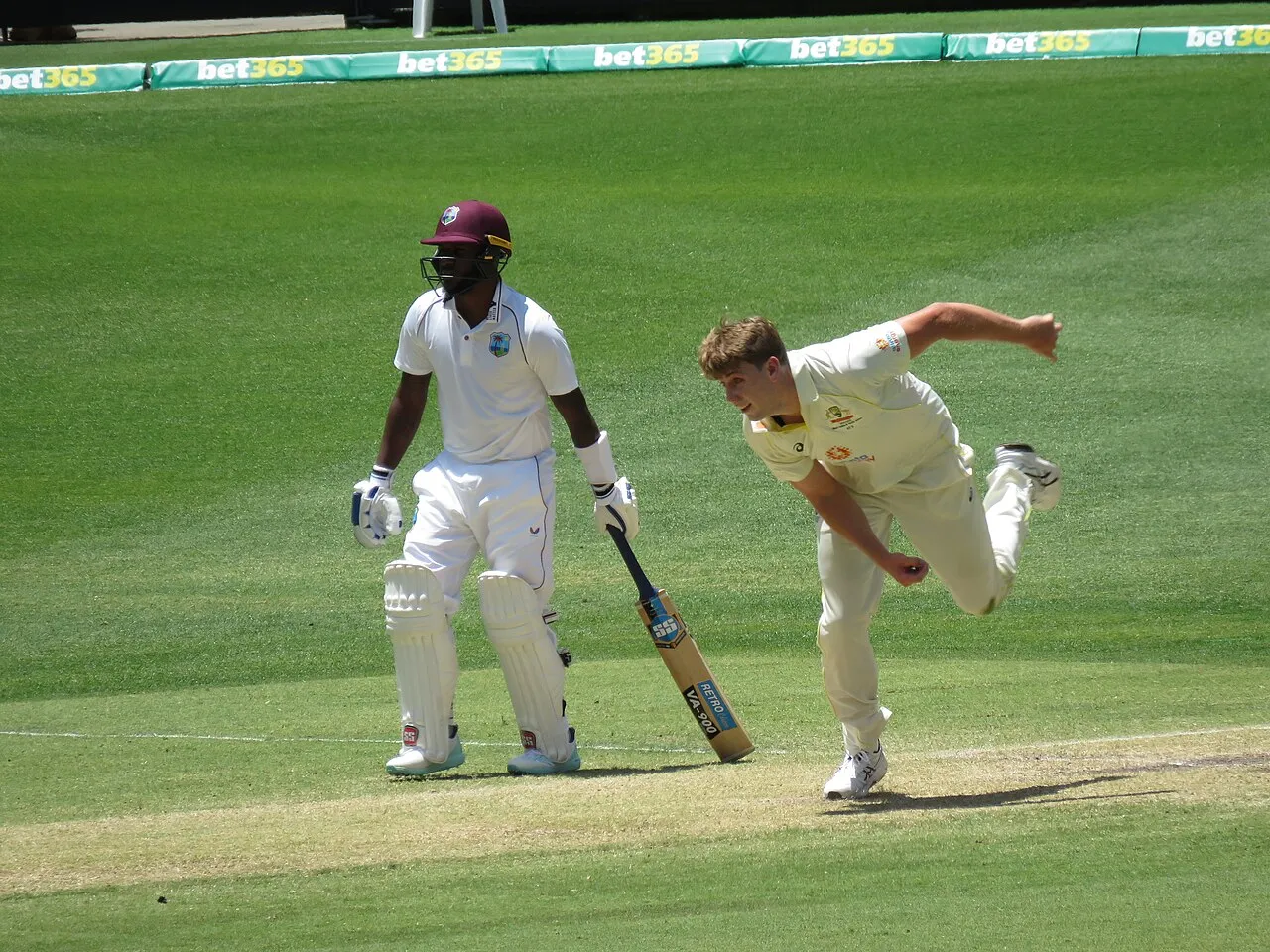
Green bowling to Jermaine Blackwood in the Australia–West Indies Test at Perth on 2 December 2022. This is historical bowling action, not an October 2026 appearance.
Do not add batting and bowling averages together
A batting average and a bowling average both use the word "average," but they describe different relationships. The first relates runs scored to dismissals. The second relates runs conceded to wickets taken. Adding them does not produce an accepted all-rounder quality score.
Instead, keep the dimensions visible. If your question concerns batting output, examine batting opportunities and results. If it concerns wicket-taking, examine bowling opportunities and wickets. If it concerns a team's balance, also ask which roles need covering in the particular match.
Imagine a fictional player contributes 45 runs but does not bowl because of the role assigned that day. Another contributes 15 runs and two wickets. You cannot fairly reduce the comparison to "45 is bigger than 15" and ignore the second skill. Equally, an unused bowling option is not two imaginary wickets waiting to be added.
A better comparison starts with a stated task. Who provided more batting runs in that match? The first player. Who took more wickets? The second. Which contribution was more useful overall? That requires match context and a reasoned argument rather than a convenient total of unlike units.
Batting position is an opportunity, not a guarantee
A position in the order influences when a player may enter, but it does not specify the exact score or condition he will face. A number five can arrive during a collapse or after a substantial partnership. The position alone does not tell the entire story of the innings.
For a fictional comparison, place the same batter at number five in two scenarios: 35 for three and 280 for three. The title of the role is unchanged, but the scoreboard context differs considerably. A useful discussion would explain the difference rather than assuming the player has one identical job every time.
This is why reports about moving up or down the order should preserve their uncertainty. A suggested change is not a confirmed batting card. A confirmed position in one Test is not a promise for the next tour. Record the match and date whenever you make the comparison.
If you watch highlights, look for the score at entry and the dismissals already recorded. Those observable facts support a more specific explanation than simply saying a batter "rescued the team" or "had an easy situation" without examining the actual scorecard.
Fielding deserves its own observation
Catches are valuable recorded events, but a catch total does not describe every fielding action. A stop, a relay, a throw or pressure that discourages a run can matter without becoming a catch in the statistical row. Avoid treating the available column as the entire skill.
For your own viewing, choose one fielder and follow the starting position before several deliveries. Note where the ball travels and whether an action is required. If the broadcast does not show the complete movement, record that limitation rather than assuming you saw the whole event.
A tall player's reach may be visually noticeable, but a photograph alone cannot establish a complete technical assessment. Do not invent a measurement of reaction speed, catching probability or injury risk from a still image. Specific observations are more useful than a confident conclusion built from appearance.
Build a small all-rounder comparison project
Create a fictional dataset first, so you can test your method without accidentally publishing invented statistics about real players. Give each record a format, date range, batting innings, not-outs, runs, wickets and runs conceded. Leave a field empty when you do not know it rather than entering zero by default.
Then write a function that refuses an impossible denominator. If a record has more not-outs than innings, it needs correction. If a bowler has no wickets in the selected sample, do not divide by zero or display a fabricated numerical bowling average.
def batting_average(runs, innings, not_outs):
    if min(runs, innings, not_outs) < 0 or not_outs > innings:
        raise ValueError('Check the batting record')
    dismissals = innings - not_outs
    return None if dismissals == 0 else runs / dismissals

print(batting_average(300, 10, 2))  # Fictional example: 37.5
The None result means the chosen formula has no numerical value for that record. It does not mean the player scored nothing. Explaining that distinction is part of presenting the data honestly, rather than hiding the problem behind a zero.
Use our programming courses to practise the underlying functions and data structures. For a different bowling-focused example, the Kagiso Rabada milestone guide distinguishes career wickets from figures in an individual match. The format and time window should remain visible in both projects.
Common questions
Is Cameron Green a batter or an all-rounder?
His career includes batting and pace bowling, and the ICC profile labels him an all-rounder. A particular team's use of him can be narrower. Read dated availability and selection reports alongside the career profile instead of assuming the label guarantees a bowling role every day.
Is this a current fitness announcement?
No. The availability discussion is explicitly tied to the 25 October 2026 report. This page does not diagnose an injury, announce clearance or forecast the next match. Use a newer official update for a newer availability question.
Does an unbeaten score mean batting average is calculated per match?
No. Batting average uses dismissals, while runs per match uses appearances. An unbeaten innings affects the dismissal count. Keep the formula and label together so two different measurements are not presented as competing answers to the same question.
Are the images from the latest South Africa tour?
No. They are historical 2022 fielding and bowling images, labelled accordingly. They illustrate different cricket activities and are not evidence of Green's bowling availability in October or November 2026.
Sources
- Cricket Australia player biography and dated statistics snapshot
- ICC player profile and role label
- Cricket Australia role update, 25 October 2026
- First Test century: official March 2023 record
Image credits: cover: WikiWanderer261, source, CC BY-SA 4.0. Resized and converted to WebP. inline: Calistemon, source, CC BY-SA 4.0. Resized and converted to WebP.
Found an error or an outdated detail? Report a correction with the article URL and original source.