
Dilshan Madushanka: Left-Arm Bowling, Career Context and Watching Guide
Meet Sri Lanka's left-arm fast-medium bowler and learn to separate bowling arm, batting hand, delivery observations and historical career evidence.
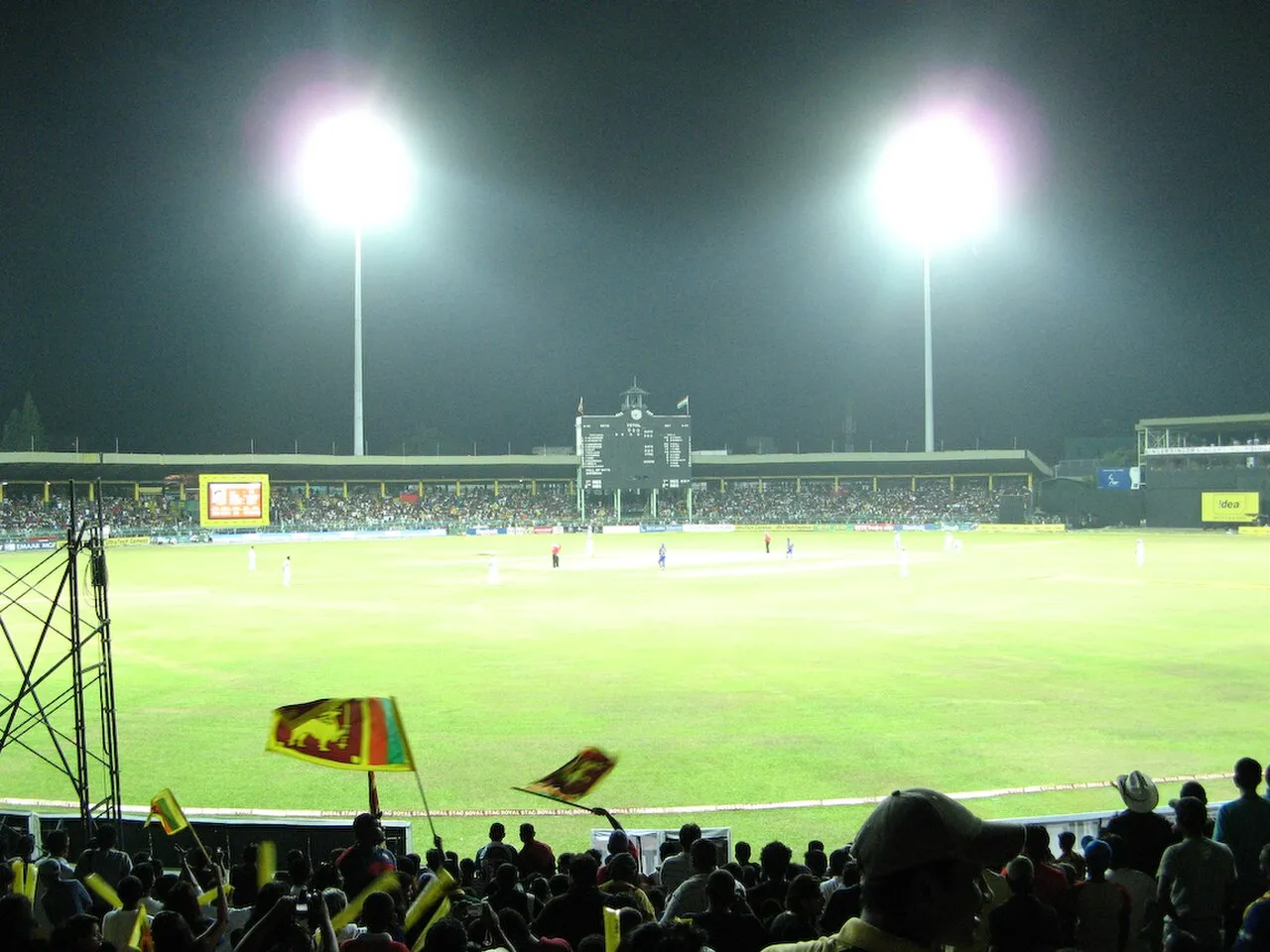
Dilshan Madushanka is a Sri Lankan left-arm fast-medium bowler who bats right-handed. That short description contains an important lesson: batting hand and bowling arm are separate attributes. A player does not have to use the same side for both skills, and a scorecard's shorthand makes more sense once you know which attribute each label describes.
This guide introduces Madushanka through verified profile details and historical performances, then uses original exercises to help you watch a bowling spell with greater understanding. It was checked on 2 November 2026. It does not provide live selection, contract, injury or ranking information. The imagined deliveries and learner records below are teaching examples, not reconstructions of his matches.
Who is Dilshan Madushanka?
Dilshan Madushanka is a Sri Lankan international bowler, born on 18 September 2000. His profile lists right-handed batting and left-arm fast-medium bowling. Keep him distinct from Asitha Madushanka Fernando: the shared name component does not make them the same player. Their full names and bowling arms help identify the correct record.
Player identity is the first step in meaningful analysis. If you search only for “Madushanka,” you may encounter different names or an article using an abbreviated reference. Open the complete profile before copying a statistic. Matching the country alone is not enough when more than one player in that country has a similar name.
For a beginner's notebook, create two separate lines: “batting: right-handed” and “bowling: left-arm fast-medium.” Resist the temptation to combine them into a single label such as “left-handed player.” That phrase loses the distinction you are trying to learn and could mislead someone looking at his batting record.
The words fast-medium are a bowling-style category, not a measured speed for every delivery. They do not justify writing an exact kilometres-per-hour figure for a ball you have not seen measured. A profile describes the general style; a delivery-specific claim needs delivery-specific evidence. This is a useful boundary between description and measurement.
What does left-arm bowling change for a viewer?
Left-arm identifies the arm used to deliver the ball. When analysing an individual delivery, you still need to know the batter's handedness, the bowler's side of the wicket and the actual ball path. Bowling arm alone cannot establish whether the ball swung, seamed, moved towards the stumps or moved away.
Try a paper exercise before using technical language. Draw a pitch as a rectangle with the bowler at one end and the batter at the other. Mark a possible release point, a pitching point and a point where the ball passes the batter. The sketch is an invented delivery, not a diagram of Madushanka's action.
Now move only the release point on the drawing. The line towards the batter changes even if you draw the ball travelling straight between the chosen points. This helps separate the initial angle from a claim about additional movement. A changing camera perspective can complicate the impression further, so avoid treating a television frame as a precise geometric measurement.
Next, change the batter from right-handed to left-handed without changing the physical pitch. Terms such as off side and leg side depend on the batter. A description that was meaningful for one batter cannot simply be copied to the other. Re-establish the viewpoint before describing the next delivery in your notebook.
How should you distinguish angle from observed movement?
Describe what the available sequence actually shows before naming a cause. A still photograph cannot show the whole trajectory, and a change after pitching is different from a change during flight. If the footage or measurements are insufficient, record that limitation instead of presenting a confident technical diagnosis.
Imagine three fictional clips. In the first, the camera shows only the bowler's face and the batter's reaction. In the second, it shows release and contact but not a clear pitching point. In the third, a continuous replay makes the ball's path easier to follow. These clips support different levels of observation, even if the final dismissal looks equally dramatic.
An honest note for the first might say “the batter was beaten; trajectory unclear.” That is more informative than automatically writing “late swing.” You have preserved the visible outcome without inventing the mechanism. You can revise the note if better footage becomes available, but the initial uncertainty should not be disguised as expertise.
This approach also improves classroom discussion. Ask each learner to separate what they saw from what they inferred. Two viewers may disagree because they used different camera angles rather than because one understands cricket and the other does not. Identify the missing evidence first; a precise question is often more useful than a forceful opinion.
Which historical performances help introduce Madushanka?
His franchise profile highlights a 5/38 return against Nigeria in the Plate quarter-final of the 2020 Under-19 World Cup. It also recalls his five wickets against India at the 2023 men's World Cup in Mumbai. These are separate performances, at different levels and in different years, rather than one continuous statistical record.
The tournament stage is part of the information. A Plate quarter-final should retain that label instead of being shortened to a title suggesting the main championship final. Likewise, an Under-19 result belongs to age-group cricket. Removing those qualifiers may make a headline sound larger, but it makes the history less accurate.
The 2023 performance illustrates another distinction: an individual can take wickets in a match without that sentence alone establishing the team's result. A player contribution and the final outcome are separate fields. Look up the complete scorecard when you need to discuss how the performance fitted into the match rather than inferring victory from a five-wicket return.
For practice, build a two-row timeline with year, level, opponent and stated achievement. Do not fill missing columns from memory. A compact table with a clearly empty field is more trustworthy than a fully populated one containing guesses. The purpose of the timeline is to preserve context, not merely to display impressive numbers.
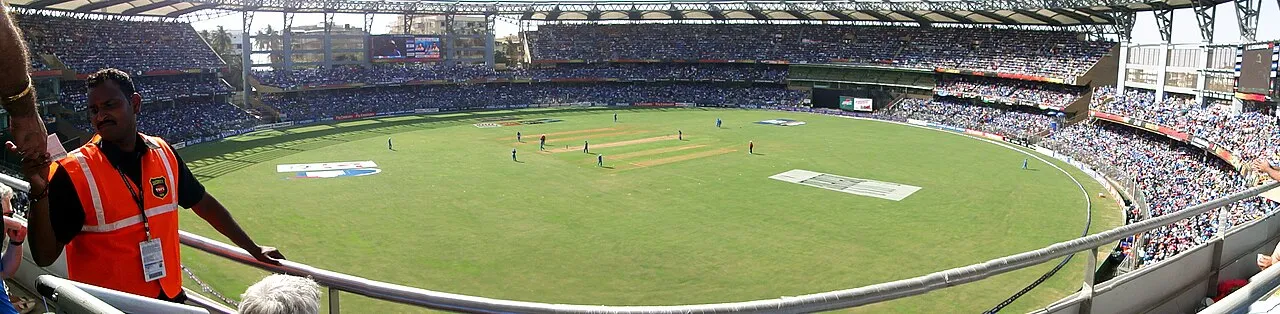
Wankhede Stadium in a historical panoramic photograph. Mumbai venue context, not a photograph of Madushanka's 2023 five-wicket performance.
What can a five-wicket return tell you?
Five wickets in an innings is a specific bowling achievement. It does not by itself reveal the overs bowled, every delivery's quality, the field placements or the team's result. To understand the spell, read the bowling figures alongside the opposition innings and, where available, the sequence of dismissals.
Consider a fictional spell with five wickets across two different phases of an innings. A headline gives you the total, but the delivery log lets you ask when the wickets fell. Did they interrupt a partnership? Were several taken near the end? These are questions for the record, not details you should invent to make a profile more exciting.
You can explore distribution using numbered tokens. Place five tokens on a line representing the innings, first clustering them together and then spreading them out. The total stays the same, while the sequence changes. This original exercise shows why a single aggregate cannot describe momentum without additional information about timing and match position.
Be equally careful with a wicket video compilation. It deliberately selects successful deliveries and may omit the rest of a spell. Enjoy the highlights, then recognise the selection. A fair evaluation needs the deliveries between wickets as well as the wickets themselves; otherwise, you are analysing a curated sample while describing it as the complete performance.
How should a beginner read a powerplay spell?
A powerplay is a phase governed by format-specific fielding restrictions. The precise rules and duration must come from the relevant playing conditions. Describing a bowler as capable in that phase is different from claiming that the same number of overs and fielders applies to every competition or that the player is selected today.
For an original viewing exercise, divide a fictional spell into two labelled blocks rather than assigning unverified official powerplay boundaries. In block A, note runs, wickets and legal deliveries. Repeat for block B. You now have a way to compare phases without pretending that one generic boundary fits every real match you watch.
Suppose block A contains 18 legal balls and block B contains 12. Raw run totals alone are not a fair pace comparison because the blocks differ in length. Convert to the same unit before comparing them. If you are not sure how to convert cricket notation, revisit the Australia scoreboard guide.
The field setting also deserves a separate note. Do not assume a catch was easy or difficult solely from the bowler's figures. Nor should you assume a particular plan because a fielder happened to take a catch. A documented captain's explanation or a clear observed pattern is stronger evidence than a story invented after the dismissal.
Why is an old injury notice not a current update?
The Mumbai Indians profile contains a notice explicitly referring to an injury before IPL 2024. That is historical information. It does not establish Madushanka's health, availability or employment in November 2026. A page remaining accessible is not proof that every time-sensitive sentence on it describes the present.
Read relative phrases with special care. A historical profile may say “this year” within text written around an earlier event. The date of your visit does not automatically change the author's reference year. Find the named tournament and surrounding dates before turning the phrase into a claim about the current season.
This matters for squad information as well. A franchise can keep an old player page online as an archive. Its existence alone cannot establish a current contract. Use a dated current squad announcement for that question. Different pages can be reliable for different purposes without being interchangeable as evidence for every aspect of a player's career.
A useful record therefore includes both the date of the event and the date you checked the page. The first tells you when the reported development happened; the second tells you when you inspected the source. Combining them into one undifferentiated date can make old information look newly announced when nothing has actually changed.
Build your own delivery-observation card
Make six fields: player identity, match identity, batter's hand, visible outcome, observed path and uncertainty. Complete one card for a single delivery rather than an entire highlights reel. Leave a field blank or mark it unknown when the clip does not show enough. Accuracy improves when the form allows uncertainty instead of forcing a guess.
Then compare two cards. Ask whether you used the same definitions for each. If one card records only wickets while the other records all visible outcomes, they cannot support a fair frequency comparison. Keep the sample-selection rule consistent. A good observation habit begins before the calculation, with the decision about what you are counting.
For a programming exercise, store the fields as a small record and display only confirmed descriptions. An unknown trajectory should remain unknown, rather than defaulting to “swing.” Our programming courses offer a place to practise this distinction between a missing value and a meaningful answer. The cricket example makes that abstract data-handling rule easier to remember.
For the separate question of average, economy and strike rate, read the Asitha Fernando bowling guide. Here, the central skill is observing and describing a delivery without overclaiming. A strong cricket reader knows both how to calculate a number and when the available evidence cannot answer the next question.
Before closing your notebook, try a quick evidence challenge. A caption says “left-arm bowler,” a replay shows a right-handed batter, and a scoreboard records a wicket. Which additional claims are justified? You can identify the listed bowling arm, the visible batting stance and the recorded dismissal. You cannot infer a speed reading, a current injury status or a whole career average from those three items. Write one sentence that stays within the evidence, then one question that would require another source. This small habit turns passive highlight watching into active learning without making every uncertain detail sound like a proven fact.
Sources
- ICC: Dilshan Madushanka profile, for player identity and batting and bowling styles.
- Mumbai Indians: Dilshan Madushanka profile, for birth date and the explicitly historical 2020, 2023 and IPL 2024 references. The viewing activities and fictional delivery examples above are original learning exercises, not reports of his specific deliveries.
Image credits: cover: Harshadewa Ariyasinghe from Mount Lavinia, Sri Lanka, source, CC BY-SA 2.0. Resized and converted to WebP. inline: Wankhede_Panoramic_ICC_WCF.jpg: G patkar derivative work: Nev1 (talk), source, CC BY-SA 3.0. Resized and converted to WebP.
Found an error or an outdated detail? Report a correction with the article URL and original source.