
Gulbadin Naib: All-Rounder Profile and Cricket Records
Explore Gulbadin Naib with clear explanations, worked examples, source checks and practical questions for independent student learning.

Gulbadin Naib is an Afghanistan all-rounder, listed by the ICC as a right-handed batter and right-arm medium-fast bowler. His 4/20 against Australia at the 2024 Men's T20 World Cup is a useful historical performance to study. An all-rounder's batting and bowling records describe different contributions and should not be merged into one unlabeled total.
This guide was checked on 2 November 2026. It introduces the player through official profile information and then develops original exercises about roles, bowling returns and match context. It does not promise a current squad place, reproduce an automatically changing ranking or present invented statistics as additional Naib performances.
What does all-rounder mean?
An all-rounder contributes through both batting and bowling, although the balance can vary by match and team role. The label does not mean the player must achieve equal results in both disciplines every time. It also does not supply a mathematical rule for comparing a run scored with a wicket taken.
The ICC identifies Naib in that category and records an international-debut period beginning in 2011. Those broad profile details establish his sporting identity. They do not reveal the precise batting position, overs allocation or tactical assignment in a particular fixture. For those questions, use the relevant team sheet and scorecard.
Imagine an original match in which a fictional all-rounder bats briefly because the top order succeeds, then bowls a full spell. A small batting contribution would not mean the player ceased to be an all-rounder. Opportunity and role help explain the numbers, while the actual record should still be reported accurately.
What is notable about the Australia performance?
The ICC's tournament player information lists 4/20 against Australia on 22 June 2024. Read that as four wickets credited to Naib and twenty runs conceded in that recorded return. The date belongs to that historical match, not to a new performance simply because the player is being searched again in November 2026.
The profile's best-figures label also has a scope. It must not be silently promoted into a claim about every form of cricket unless the record explicitly supports that wider comparison. A tournament page, an international profile and a domestic career record can each organise information differently.
The educational value is that the figures are compact but meaningful. They invite questions: how many legal balls were delivered, what was the innings situation and which dismissals were credited? A headline can identify a memorable return, but a complete analysis requires more than expanding four and twenty into a long paragraph of imagined action.
Why keep the match date with a statistic?
Players can face the same opponents repeatedly, and search results can mix different tournaments or years. A dated figure helps the reader identify the intended match. Without the date and format, even an accurate number may be attached to the wrong event and become misleading when shared.
For an original notebook exercise, create separate rows for a fictional 2024 T20I and a fictional 2026 ODI against the same opponent. Give each a different bowling return. Then hide the date and format columns and ask another learner to identify which result a short sentence describes. The ambiguity becomes obvious.
Keep the source-check date separate from the event date as well. This article was researched in November 2026, but the cited Australia return occurred in June 2024. Updating an article's metadata should not make an old achievement look as though it happened on the day the page was edited.
How do you read a bowling return?
A short return such as 4/20 normally places wickets first and runs conceded second. A full scorecard often adds overs and maidens in separate columns. Read the headings before interpreting a compact line, because similar punctuation is also used for batting-team scores and can represent a different relationship.
Use an original fictional spell of four complete overs, zero maidens, twenty-four runs and two wickets. It can appear as 4-0-24-2 in an overs-maidens-runs-wickets layout. The first four means overs, while the final two means credited wickets. Neither should be mistaken for the batting team's total.
Write a full sentence after decoding the line. “The bowler conceded twenty-four runs in four overs and took two wickets” is easier for a beginner to check than a string of numbers. Once the labels are secure, calculations such as economy and strike rate become much less confusing.
Can batting and bowling strike rates be confused?
Yes, because both use the phrase strike rate but measure different things. Batting strike rate expresses runs per one hundred balls faced. Bowling strike rate expresses legal balls per credited wicket. A higher batting rate and a lower bowling rate can have different interpretations, so the discipline and unit must remain visible.
For an original batting example, thirty runs from twenty balls produces a strike rate of 150. For an original bowling example, twenty-four legal balls and two wickets produces a strike rate of twelve balls per wicket. Those numbers cannot be placed in one column labelled “strike rate” and compared without explanation.
An all-rounder profile makes this distinction especially important because both records may appear on the same page. Use separate sections, labels and formulas. A reader should not need to guess whether a displayed twelve concerns batting pace, bowling wicket frequency or some unrelated ranking measure.
How should a combined contribution be described?
Describe each part first. State the batting runs and balls, then the bowling overs, runs and wickets, with the relevant match context. If a rating system combines them, identify that system and its method. Do not invent a universal conversion such as one wicket equals a fixed number of batting runs.
Imagine an original performance of twenty runs from ten balls and two wickets for twenty-eight. The player contributed in both disciplines, but the importance of each depends on the match. The batting might have finished a chase or come in a lost cause; the wickets might have arrived at different stages. The numbers alone do not establish every consequence.
This does not make statistics useless. It means they are a starting point for a clearly defined question. A well-written account can appreciate a contribution while acknowledging which aspects are recorded and which require interpretation from the actual sequence of play.
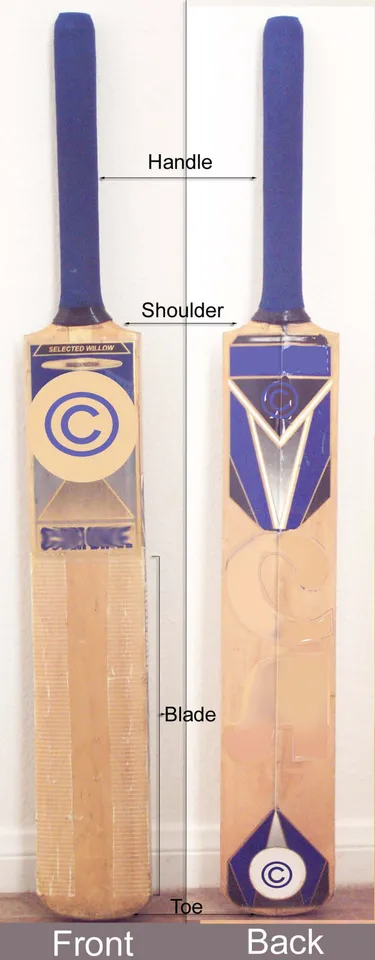
Equipment illustration for the batting side of an all-rounder’s role; not Naib’s personal bat.
What is economy rate, and what inputs are needed?
Economy is runs conceded per six-ball over. Convert the spell into legal balls first, especially when it ends partway through an over. A return containing only wickets and runs does not supply the delivery count needed for the calculation. Do not invent overs because the answer would otherwise be unavailable.
For a fictional example, thirty runs in 3.5 overs means thirty runs from twenty-three legal balls. The economy is thirty multiplied by six, divided by twenty-three, approximately 7.83. Dividing by the decimal 3.5 would answer a different and incorrect question because cricket notation is not decimal time.
If a source provides a complete four-over spell, the calculation is simpler, but the principle remains the same. Keep the original ball count for calculation and round only the displayed answer. Early rounding can create small inconsistencies when several spells are later combined.
Why does match phase matter?
A bowler's assignment can change across an innings. The opposition's objective, remaining wickets and required scoring pace affect the choices available. Two spells with the same final return can therefore arise from different situations. To explain a specific phase, use the actual match sequence rather than a general label such as middle overs.
Consider an original scenario in which a batting side needs thirty from three overs with eight wickets remaining. Compare it with thirty from ten overs and one wicket remaining. The numerical target is the same, but the resources and pressure differ. A delivery's tactical purpose cannot be read from the target alone.
An all-rounder may be used to address a particular matchup or stage, but this guide does not claim to know a captain's private reasoning in a Naib match. When a public interview explains a decision, attribute it. Otherwise describe the observed use and keep the proposed explanation clearly tentative.
What does a highlight clip leave out?
A highlight is selected material. It may show the wickets and omit deliveries that conceded runs or built pressure. It can be useful for observing a moment, but it is not a complete record of the spell. The selection process matters when a viewer tries to explain why an entire performance succeeded.
For an original class activity, invent a twelve-ball sequence with two wickets and several scoring shots. Show one group only the wickets and another the full sequence. Ask what each group can establish. The first group can describe those dismissals, while the second has more information about the spell's overall cost and rhythm.
Do not infer that every wicket involved the same delivery type because the edited clip feels repetitive. Identify each visible event separately. If release, movement or field placement is not shown clearly, leave that detail unresolved rather than supplying a technical explanation from imagination.
How can a player comparison remain fair?
Choose comparable categories and a stated period. An international T20 record, a domestic season and a single tournament are different samples. Keep the player's role and opportunity visible, and avoid ranking whole careers from a small selection of favourable innings or spells.
In an original comparison, Player A faces forty balls and scores sixty runs, while Player B faces ten and scores twenty. Their batting strike rates differ, but so do their opportunities. Add bowling contributions in separate columns rather than blending them into a single unexplained “all-round score.”
For a larger dataset, calculate aggregate rates from underlying totals. Do not simply average match strike rates when the numbers of balls differ. The spreadsheet might execute that formula perfectly while still answering the wrong question. Clear statistical definitions matter as much as correct arithmetic.
A practical all-rounder worksheet
Create a fictional match record with columns for batting runs, balls faced, bowling legal balls, runs conceded and credited wickets. Add category and date fields. Calculate batting strike rate, economy, bowling average and bowling strike rate only when the necessary inputs are present and their denominators are valid.
Test a missing value and a zero-wicket spell. Missing is not automatically zero, and a zero-wicket spell has no ordinary finite runs-per-wicket average. Display the limitation rather than producing a reassuring zero. Then ask a classmate to explain each displayed number in a complete sentence with its unit.
Finally, write a short summary that uses the fictional data without claiming it belongs to Naib. This tests whether the reader can preserve the boundary between an educational example and a real athlete's record. The boundary is essential when attractive charts make invented numbers look authoritative.
What should you remember?
Naib's official profile provides a clear starting point: Afghanistan, all-rounder, right-handed batting and right-arm medium-fast bowling. The historical 4/20 against Australia is a dated achievement. Keep that fact distinct from current totals, and keep batting and bowling measures distinct from each other.
Explore our cricket learning articles for more worked examples. A useful all-rounder profile should help you read the next scorecard independently: identify the match, name the category, preserve the unit and ask which part of the contribution the available evidence actually describes.
A final communication check is to explain each discipline without relying on the word contribution alone. State what was recorded in batting and what was recorded in bowling, then identify the opportunity each player had. This makes comparisons easier to follow and prevents a vague overall judgement from hiding incompatible categories. When a number is missing, keep the missing field visible rather than inventing a value from the player's reputation or the final team outcome.
For another Afghan bowling record with clearly labelled figures, read our Noor Ahmad guide.
Sources
- ICC: Gulbadin Naib profile, for role, playing styles and debut context.
- ICC: tournament player record, for the dated 4/20 Australia entry. Other performances and comparison tables in this article are explicitly fictional teaching examples, not additional Naib statistics.
Image credits: cover: Sonyroy, source, CC BY-SA 4.0. Resized and converted to WebP. inline: No machine-readable author provided. THUGCHILDz assumed (based on copyright claims)., source, CC BY 2.5. Resized and converted to WebP.
Found an error or an outdated detail? Report a correction with the article URL and original source.