
Jobe Bellingham: Dortmund Career, Stats and Midfield Guide
Follow Jobe Bellingham’s verified path to Borussia Dortmund, read a dated Bundesliga statistics snapshot and learn what to observe beyond goals and highlights.

Jobe Bellingham is a Borussia Dortmund midfielder, distinct from his older brother Jude. His route through Birmingham City and Sunderland to Dortmund gives readers a career to examine on its own terms. The most useful profile combines verified background with a clear explanation of what his statistics do, and do not, show.
This guide includes a dated snapshot from the Bundesliga's official player page and a practical way to watch a midfielder beyond a highlights reel. It does not claim that a few statistics establish his complete quality, predict a transfer or reproduce a scouting report from inside the club.
Who is Jobe Bellingham?
Dortmund's official profile records his birth as 23 September 2005 in Stourbridge, England. On the check date for this article, 1 November 2026, that makes him 21. The club lists him in midfield and identifies his squad number as seven.
His football background is not interchangeable with Jude's. The shared surname can dominate headlines, but a meaningful assessment needs to refer to the player who actually appeared, the competition being discussed and the role he performed.
If a search result shows only “Bellingham,” inspect the full name and club before copying its statistics. This is particularly important with photographs, video compilations and social posts, where a familiar surname can travel further than the original context.
How did his club career reach Dortmund?
The club's account traces his development through Birmingham City's academy and senior side, then Sunderland from summer 2023. It records his professional debut for Birmingham at 16 in January 2022. Dortmund announced his signing from Sunderland on 10 June 2025, with a contract running to 30 June 2030.
| Career stage | Verified reference point |
|---|---|
| Birmingham City | Academy development and senior debut in January 2022 |
| Sunderland | Joined in 2023, before the move to Germany |
| Borussia Dortmund | Signing announced on 10 June 2025 |
The sequence establishes a career path. It does not by itself explain every improvement, selection decision or challenge during that path. Those questions require match evidence and attributed accounts rather than a timeline alone.
When reading an older transfer announcement, preserve its date. A description of a player as 19 at signing can be correct in a 2025 report while being out of date as a description of his age in November 2026. Historical reporting should not be silently rewritten as a current profile.
What does the official Bundesliga snapshot show?
The league's player page, checked on 1 November 2026, displayed the following figures for the 2026/27 Bundesliga season. These are a snapshot of the retrieved page, not a promise that the values will stay unchanged or include an update after every subsequent match.
| Displayed measure | Figure in the checked page |
|---|---|
| Appearances | 8 |
| Goals | 0 |
| Assists | 2 |
| Shots on goal | 7 |
| Tackles won | 69 |
| Aerial duels won | 7 |
| Distance covered | 76.1 km |
| Yellow cards | 3 |
The labels are retained because a number without its category can mislead. “Appearances” does not mean “starts,” and a season-specific total should not be presented as a career total. The league page is the source to revisit when you need updated figures.
Do not add these values to a different competition's total without checking coverage. A Bundesliga page and a Champions League page do not necessarily describe the same collection of matches. Combining them can be useful only after you know exactly what each contains.
Why are goals alone an incomplete midfield assessment?
A goal total answers an important but limited question. It does not describe every action a midfielder takes or every responsibility assigned in a particular match. To evaluate a performance, first ask what the role required and then examine suitable evidence.
For an original viewing exercise, imagine a fictional midfielder who receives the ball under pressure, returns it safely and moves to offer another passing option. The sequence produces no goal or assist, yet it gives you something specific to analyse about positioning and decision-making.
That invented sequence is not a claim about a particular Bellingham appearance. It illustrates why a viewing checklist should include actions before the final pass or shot. Look for observable details rather than assuming that a low scoring total means the player contributed nothing.
The opposite mistake is also possible. A goal should not automatically erase every misplaced pass or missed responsibility from a performance review. A balanced account can recognize the decisive moment while examining the rest of the match honestly.
What should you watch when he receives the ball?
Choose one manageable question for a short period of a match. For example: what options are available when he receives, and which one does he choose? Record the nearby pressure and supporting players instead of judging the pass without its context.
Notice the next action as well. Does the player stay available, move into a different space or become difficult for a teammate to find? You can describe what the broadcast shows without claiming to know the coach's private instruction.
Keep camera limitations in mind. A close-up can hide players outside the frame. If you cannot see the available passing options, avoid declaring that the player ignored an obvious alternative. “The broadcast did not show the wider picture” is an accurate limitation, not a failure of analysis.
After several sequences, look for a pattern cautiously. One example can start a question, but it should not become a universal statement about every match he plays. Broader conclusions need broader evidence.
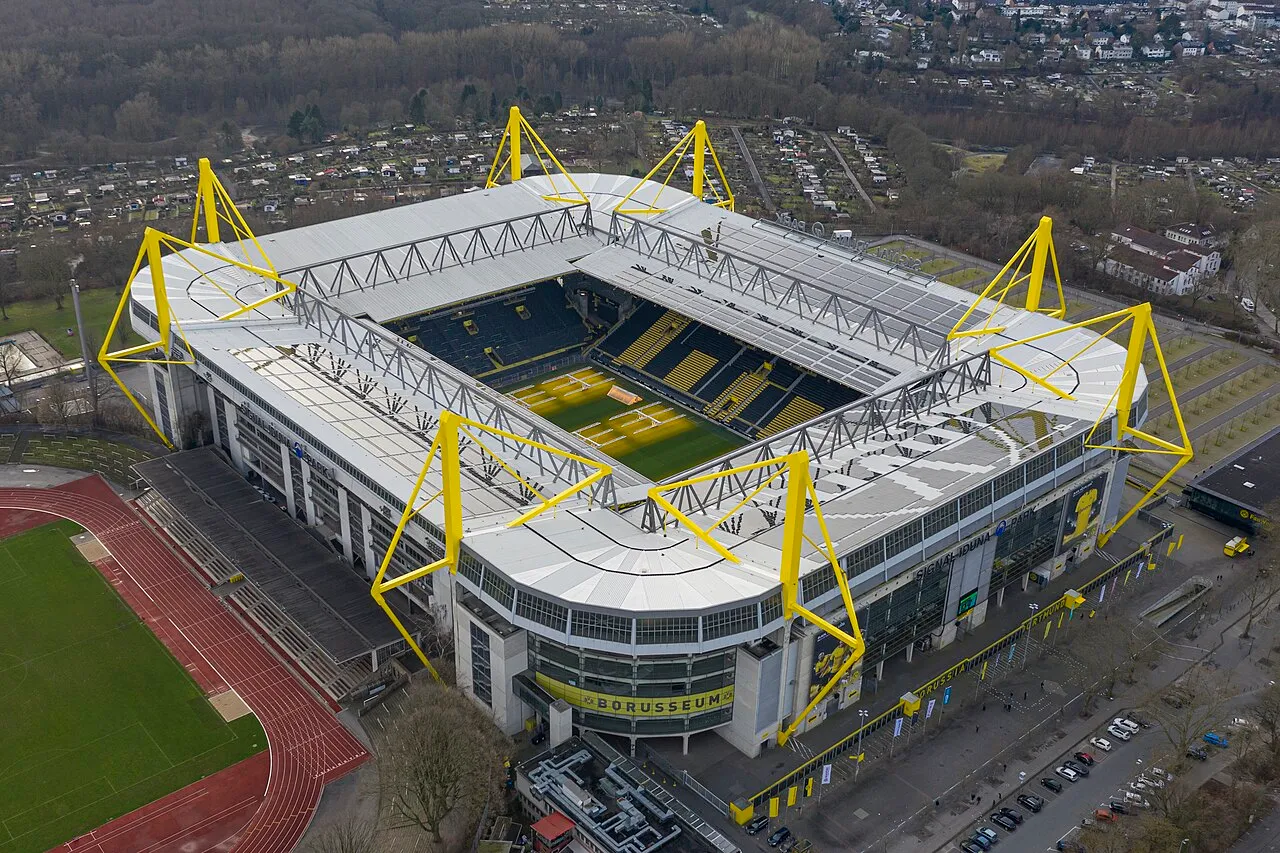
Dortmund’s home stadium, shown for club context rather than as an image of a specific match.
How can you study work without the ball?
Try following the midfielder briefly after possession changes. Watch the space between him, the ball and the nearest opponents. The aim is to notice positioning rather than to attach an advanced tactical label to every movement.
Ask whether the camera shows a passing route being covered, a runner being followed or a player moving to support pressure. Describe the visible action first. Only then consider a possible interpretation, and label that interpretation as yours.
Do not confuse visible effort with an established explanation of the team's plan. A run may look energetic without telling you whether it matched the intended structure. Conversely, a player holding a position may be doing something useful that is not obvious in a short clip.
These questions can make watching more rewarding because they direct attention to decisions between the headline moments. They also help you write a response grounded in evidence instead of repeating a generic compliment such as “he controlled the game.”
How should you interpret distance and activity figures?
A distance figure records an aspect of physical activity within its defined dataset. It does not tell you where every run occurred, whether the player was in the right position or whether the movement helped the team. Use it with role and playing-time context.
For a fictional arithmetic exercise, suppose a player covers 45 km across five appearances. Dividing gives nine kilometres per appearance. That is not automatically a per-90-minute figure because the player may have played different minutes in each appearance.
To calculate a rate per 90 minutes, you need the actual minutes total and an appropriate formula. If the fictional 45 km were recorded over 450 minutes, multiplying 45 divided by 450 by 90 gives nine kilometres per 90 minutes. Different minutes would produce a different rate.
Those values are invented for the exercise and are not Bellingham's minutes or rate. The point is to choose the correct denominator before making a comparison. A neat calculation using the wrong denominator can produce an impressive-looking but misleading statistic.
What makes a fair comparison with another midfielder?
Define the comparison before choosing the numbers. Compare the same competition and time window, and consider minutes, role and the team's situation. A substitute appearance and a full match do not necessarily provide equal opportunities to accumulate events.
Use more than one measure when the question requires it. If you are discussing ball progression, a goal total alone is a poor substitute for relevant passing or carrying evidence. If you do not have suitable data, explain the limitation rather than using an unrelated number because it is available.
Avoid selecting only the statistic that confirms a preferred conclusion. A useful comparison states why each measure belongs in the discussion and acknowledges what it leaves out. It can end with a limited conclusion instead of announcing an absolute winner.
This approach is particularly important with sibling comparisons. A famous surname may make the comparison attractive, but different careers and responsibilities still need to be examined on their own evidence.
How can students make a short match-observation sheet?
Use four columns: match and date, visible action, surrounding context and interpretation. Keep the action column descriptive. “Passed backwards under pressure” is different from “played badly,” which is already a judgement.
Add a fifth column for uncertainty if useful. You might note that a camera cut hid the receiving player's next action. This helps you remember which conclusions are supported by the footage and which remain unresolved.
Choose three or four sequences rather than attempting to record every touch on your first try. Afterwards, write a paragraph linking the observations to one focused claim. You are practising careful reasoning, not producing a professional club report.
For related numerical literacy, our ICC rankings guide explains another situation where a label and denominator matter. The sports differ, but the habit of asking what a number actually measures transfers well.
Where should you check news and availability?
Use the club's current announcements for team news and the league or competition's official records for fixtures and statistics. A historical contract announcement does not establish today's selection, injury status or availability for the next match.
This article does not report an unverified transfer bid, medical update or starting lineup. If you see such a claim elsewhere, look for a dated, attributable source. Do not turn an absence from one photograph or training clip into a diagnosis.
For watching in Pakistan, check the current authorized broadcaster's competition coverage and territorial availability. A highlight clip on social media does not establish that a full live match is legally available through the same account.
What is the most useful way to follow his development?
Keep the verified timeline, current statistical snapshot and your own observations separate. The timeline tells you where his career has been. The snapshot describes a defined set of recorded events. Match observation helps you investigate how he performs particular actions.
Taken together, these give a more informative picture than a comparison built solely around his surname. They also leave room for development without forcing every performance into a prediction about what his entire career must become.
Sources
Source 1: Borussia Dortmund player profile
Source 2: Dortmund signing announcement
Source 3: official Bundesliga player statistics
Checked 1 November 2026. Statistics retain the season and check date. Viewing exercises and rate-calculation figures are original illustrations, not claims about unseen matches or private coaching instructions.
Image credits: cover: Greensquare67, source, CC0. Resized and converted to WebP. inline: Arne Müseler / www.arne-mueseler.com, source, CC BY-SA 3.0 de. Resized and converted to WebP.
Found an error or an outdated detail? Report a correction with the article URL and original source.