
Manuel Neuer: Bayern Contract, Germany Timeline and the Sweeper-Keeper Role
Explore Neuer’s Bayern contract and international timeline, then learn sweeper-keeper positioning, passing decisions and goalkeeper statistics.
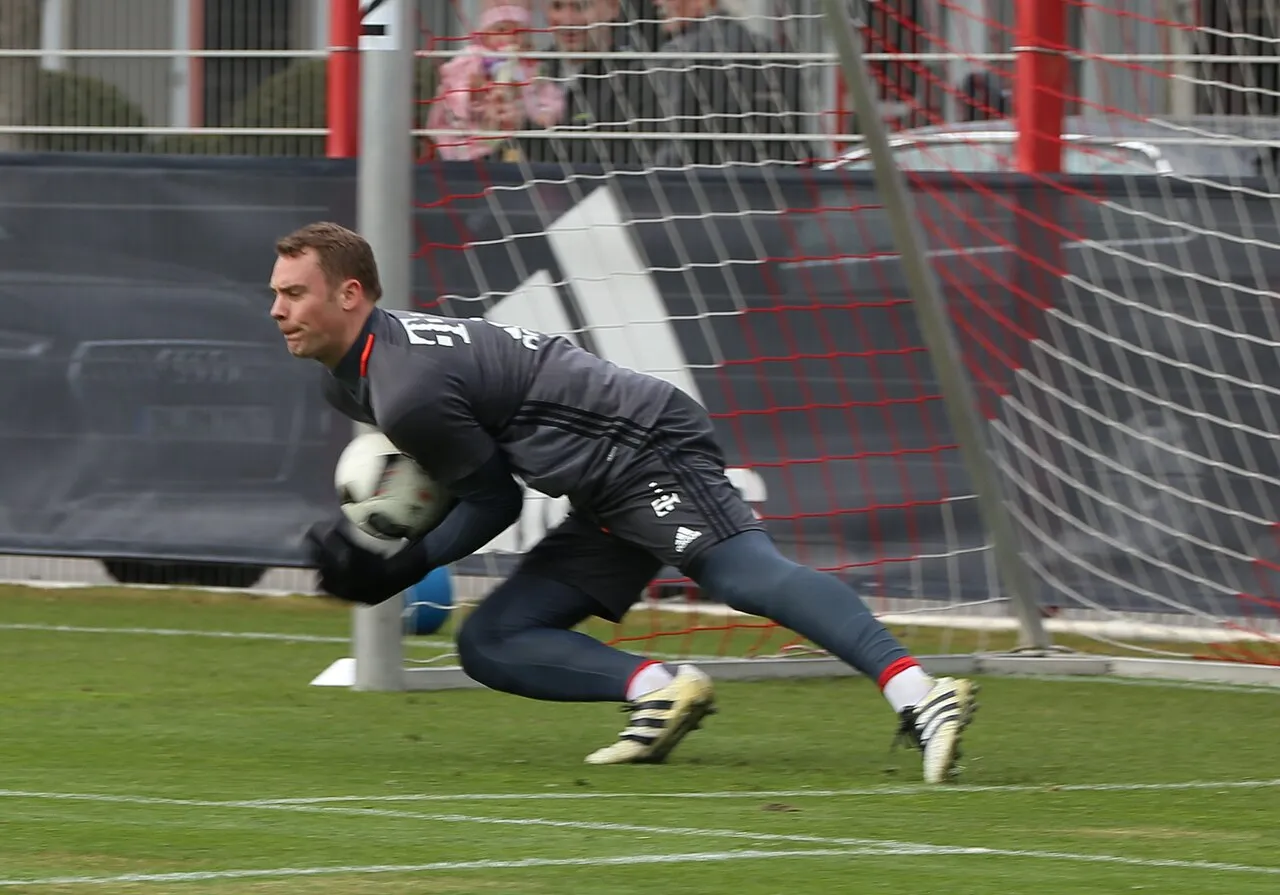
Manuel Neuer is Bayern Munich's long-serving goalkeeper and one of the most recognisable examples of a keeper who contributes far beyond shot-stopping. Understanding his game means watching where he stands before a pass, how he supports defenders and when he chooses to leave his area, rather than collecting only spectacular saves.
There is also an important date check for readers arriving from search. Bayern announced a contract extension through summer 2027 in May 2026. Neuer's international story did not stop at his initial 2024 retirement: he returned for the 2026 World Cup and then confirmed another international retirement after Germany's elimination. Club employment and national-team availability are separate questions.
Who is Manuel Neuer?
Neuer is a German goalkeeper who joined Bayern in 2011 after establishing himself at Schalke. He was part of Germany's 2014 World Cup-winning team and received that tournament's Golden Glove award. Those career facts explain his profile, but they do not tell a viewer how every individual performance should be judged.
A player can have an exceptional career and still make a mistake in a particular match. Equally, an isolated error does not erase years of performance. The useful question is narrower: what decision did the goalkeeper face, what options were available and what happened after the choice? That approach makes a player profile more informative than a sequence of superlatives.
Club retirement and international retirement differ
A goalkeeper can stop representing a national team while continuing to play for a club. An international retirement announcement does not automatically terminate a club contract. Conversely, a contract extension does not promise a starting place in every match or prevent a later change in circumstances.
For Neuer, preserve the order of events. The 2024 announcement belongs to its own date; the 2026 return means that an old headline alone is not a complete current account. The subsequent retirement after the World Cup should also be dated. Avoid compressing those events into an inaccurate claim that he never played internationally after 2024.
What does a sweeper-keeper actually do?
A sweeper-keeper helps defend space behind the outfield defensive line and participates in possession. The word describes a role, not permission to run forward at every opportunity. The goalkeeper still has to protect the goal, assess the ball's path and coordinate with teammates who may be trying to recover.
Imagine a team holding a high defensive line near halfway. An opponent sends a pass into the space behind it. A goalkeeper starting closer to the edge of the penalty area may be able to reach the ball before the attacker. Starting too deep could leave the attacker time; starting too high could create a dangerous lob or a race the keeper cannot win.
This is why the first decision happens before the pass. The keeper observes the opponent's body shape, the pressure on the passer and the speed of the attacking runner. Television clips often begin when the goalkeeper is already sprinting, which hides the preparation that made the intervention possible.
Positioning changes the difficulty of a save
Two saves from similar distances can involve very different problems. The angle, defenders blocking the view, the height of the shot and the keeper's balance all matter. A shot directly at a well-positioned goalkeeper may look easy precisely because the positioning was good.
Think of the goal as an opening whose visible width changes with the shooting angle. Moving to a sensible position can reduce the space an attacker sees, but moving too far or too early can expose another option. Good positioning is a response to the whole situation rather than a fixed point that works for every shot.
For a viewing exercise, pause a legal replay just before a shot. Identify the ball, the nearest defender and the goalkeeper. Ask which part of the goal appears most exposed and whether the keeper can actually see the strike. Then watch the play at normal speed. A freeze-frame can help analysis, but it should not be mistaken for the time available to the player.
Distribution begins before the ball arrives
A goalkeeper supporting possession needs options on both sides. Receiving a back-pass while facing only one teammate makes the next move easier for opponents to predict. Scanning before receiving can reveal an unmarked defender, a pressured full-back or a longer passing option.
The first touch can create time or remove it. A touch into space may open a passing lane; a touch toward pressure may force a hurried clearance. This does not mean every touch should be elaborate. Sometimes the simplest safe action is the correct response to the pressure and the match state.
Short passing is not automatically better
A team may build short when it can create an extra player around the press. If opponents cover the nearby options aggressively, a longer pass can move the ball beyond that pressure. The choice should be evaluated by the available options and the team's plan, not by assuming that one passing distance is always modern and the other always outdated.
Suppose three nearby defenders are tightly marked but a forward has space beyond midfield. A longer pass may be reasonable even if it is not completed. Conversely, a completed short pass can still put a teammate under severe pressure. Completion percentage alone cannot describe the quality of the decision.
Leaving the area carries clear responsibilities
Outside the penalty area, the goalkeeper cannot use the handling privileges available inside their own area. That legal boundary changes how a loose ball can be played. A decision to come out therefore includes both a timing assessment and an assessment of the action the keeper can lawfully make on arrival.
Do not treat a dramatic clearance as proof that every similar charge was required. Another goalkeeper might solve the situation with a different starting position or a recovering defender. What matters is whether the chosen action addressed the actual threat without creating a larger avoidable one.
Young players should practise decisions under appropriate coaching and safe conditions. A professional highlight is not an instruction to attempt a collision, a risky slide or a long sprint into a crowded space. Understanding the role is useful; imitating the most dangerous-looking moment without its context is not.
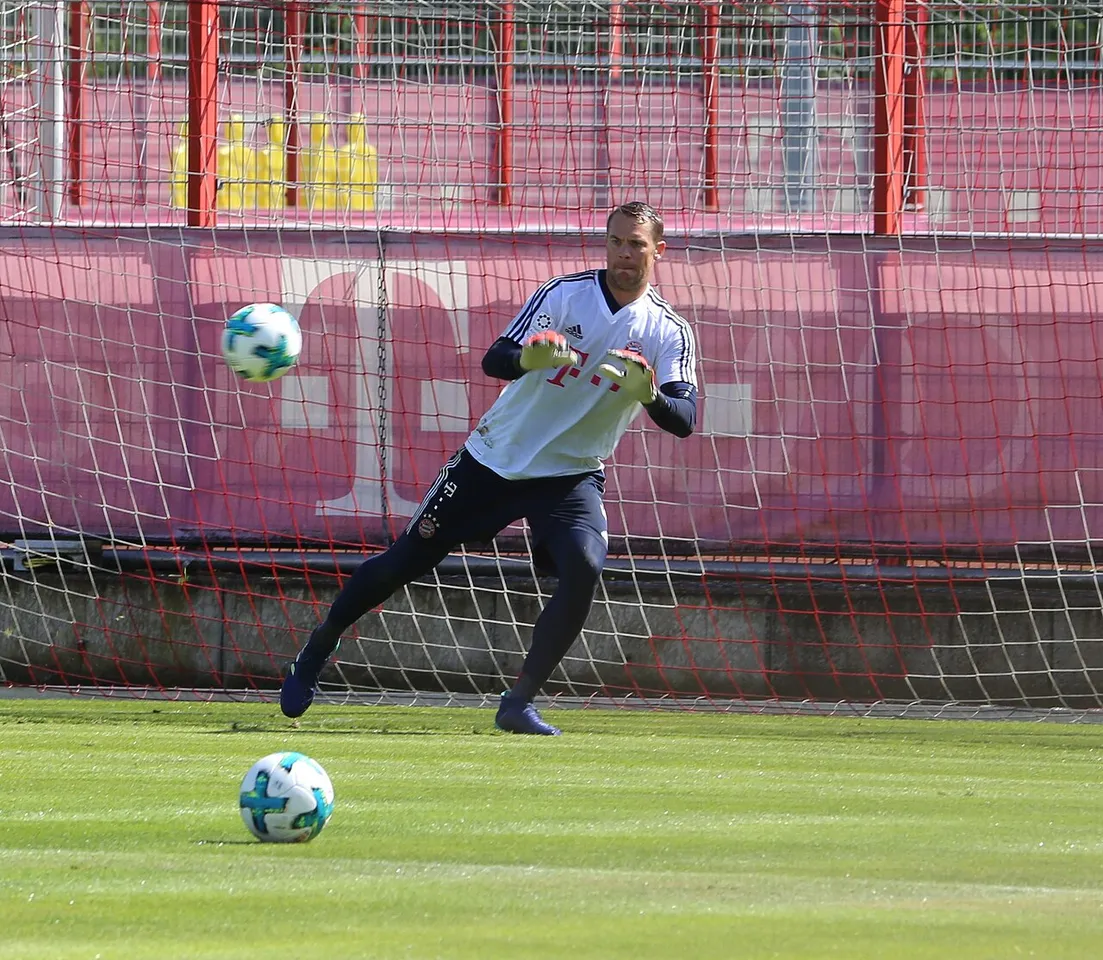
Manuel Neuer during Bayern training in May 2018; historical illustration of the goalkeeper’s role.
Communication is part of the position
The goalkeeper sees much of the field facing forward while defenders may be looking back toward their own goal. Clear communication can help organise marking, identify an untracked runner and decide who will challenge for a ball. A short, recognisable instruction is often more useful than continuous shouting.
The content of the message matters more than its volume. A warning should arrive early enough for a teammate to act. A call to claim a cross should be understood by defenders who might otherwise attack the same ball. Conflicting messages can make a situation worse even when everyone is trying to help.
When watching a match, note the defensive shape before a set piece rather than only the final header. Who checks the far post? Who tracks a runner across the line? Who reacts to a short corner? The keeper's contribution may be visible in the organisation even when no save is required.
Read goalkeeper statistics with care
Clean sheets are team outcomes. A goalkeeper with no shots to face can keep one, while a keeper making several difficult saves can concede. Clean-sheet totals are useful records, but they cannot isolate individual performance from the defending in front of the goal.
Save percentage also depends on the shots faced. Ten attempts from awkward positions are not equivalent to ten close-range chances. A basic percentage divides saves by relevant shots on target, but interpreting that percentage requires context. Different data providers may also classify events differently, so compare like with like.
A worked percentage example
Imagine a goalkeeper faces five shots on target and saves four. The simple save percentage is four divided by five, multiplied by one hundred, giving 80 percent. If the next match contains just one shot on target and it becomes a goal, the two-match total is four saves from six shots, about 66.7 percent.
The combined figure is not the average of 80 percent and zero percent. That would give 40 percent and ignore the unequal number of shots. This arithmetic example is hypothetical; it is not a statistic from Neuer's current season. The lesson applies to many sporting percentages with different sample sizes.
The Bayern match guide illustrates how a result and its league-phase context can be discussed separately. A goalkeeper profile needs the same discipline: identify the event, the measurement and the conclusion instead of treating them as interchangeable.
How experience can change the role
Experienced goalkeepers may rely on anticipation, communication and efficient movement as well as athletic reactions. This is a general observation about the position, not a medical assessment of Neuer. Age alone does not establish whether a player is fit, selected or effective in a particular match.
A coach evaluating an experienced keeper has to consider current training, match demands and the squad's needs. A public profile cannot see all of those factors. Avoid inventing a diagnosis from a short clip or treating an absence from a photograph as evidence of a new injury.
Similarly, a contract announcement establishes the agreement that was announced at that time. It does not guarantee future results. When reporting a later change, cite the new announcement and preserve the earlier date so that readers can follow the sequence rather than encountering two apparently contradictory headlines.
A simple way to watch the next match
Choose one theme for each ten-minute period. First watch starting position when the opposing team has the ball. Next watch the passing options before a back-pass. Then watch organisation at corners or free kicks. You do not need to judge every action at once to learn something useful.
Write down an observation in plain language: the keeper moved higher when the passer was under pressure, or chose a long pass because the nearby options were marked. Avoid claiming what a player was thinking unless there is a direct statement. Describe the visible evidence before offering an interpretation.
At the end, compare your notes with the match result. Did the same team control the ball but allow dangerous counterattacks? Did the keeper make few saves yet contribute regularly to possession? This separates involvement from highlight frequency and makes the game easier to understand.
Questions readers are asking
Does Neuer still play club football?
Bayern's May 2026 announcement extended his contract through summer 2027. That is the reviewed contractual reference for this guide. Individual match selection should be checked against a current squad announcement rather than inferred from the existence of a contract.
Did he retire from Germany in 2024?
He initially announced international retirement in August 2024, returned for the 2026 World Cup and subsequently confirmed another retirement after Germany's exit. Include all three stages when explaining the timeline. Repeating only the first headline would leave out a material later development.
Is a sweeper-keeper simply an attacking goalkeeper?
No. The role includes defensive coverage and support in possession. Moving far from goal without reading the situation is not the objective. The aim is to help the team manage space and pressure while preserving responsibility for the goal.
Can one mistake settle a player's legacy?
No single incident can fairly describe an entire career. It can still be analysed honestly as an individual decision. Good analysis neither excuses every error because of past trophies nor dismisses every achievement because a recent clip went wrong.
Keep analysis separate from a highlight caption
A caption should identify what a photograph actually shows, including its historical date when known. A training image does not prove selection for a later fixture, and a national-team photograph does not establish current international availability. The same discipline applies to video titles: a compilation of older interventions can teach a role without being evidence of a new performance. Match the claim to the date and context of the material before drawing a conclusion.
Sources
- Bayern player profile
- Bayern's May 2026 contract announcement
- FIFA on the 2026 international retirement
- DFB's original 2024 retirement announcement
Image credits: cover: Rufus46, source, CC BY-SA 3.0. Resized and converted to WebP. inline: Rufus46, source, CC BY-SA 3.0. Resized and converted to WebP.
Found an error or an outdated detail? Report a correction with the article URL and original source.