
Marnus Labuschagne: Career and the Value of 58 Not Out
Explore verified career facts and the historical World Cup final innings, with original examples explaining partnerships, not-outs and scoring context.

Marnus Labuschagne's unbeaten 58 in the 2023 World Cup final is a useful answer to a familiar cricket question: can an innings matter even when it is not the biggest or fastest score? Australia won that final, and a large partnership connected two quite different individual contributions. Reading those contributions properly takes more than comparing the runs column.
This guide introduces the verified career background and revisits that completed match as a learning example. It is a historical analysis, not a new final result, a live form assessment or a prediction of his next selection.
Who is Marnus Labuschagne?
Labuschagne is an Australian batter born in Klerksdorp, South Africa, on 22 June 1994. Cricket Australia's profile records his family's move to Brisbane in 2004 and his progress through Queensland cricket. His Test debut came in October 2018, his ODI debut in January 2020 and his T20I debut in April 2022.
Birthplace and representative team answer different questions. Being born in South Africa does not make a profile listing him as an Australian player contradictory. A biography should preserve both pieces of information without inventing a change of international allegiance or assuming a person's identity from birthplace alone.
The profile also records two notable 2023 innings: 111 in the Manchester Ashes Test and 58 not out in the World Cup final. They belong to different formats and match situations. A Test innings and an ODI innings cannot be made into one meaningful comparison merely by placing the raw runs next to each other.
For students making a career timeline, store date, team, format and event together. That small structure makes the account easier to extend later. You can add a new innings without accidentally changing the meaning of an older milestone.
What did he score in the 2023 World Cup final?
Labuschagne finished unbeaten on 58 from 110 balls as Australia beat India by six wickets in Ahmedabad on 19 November 2023. Travis Head made 137 from 120, and the pair added 192 for the fourth wicket after Australia had reached 47 for three. The team finished on 241 for four, chasing 241.
Those figures establish the completed-match context. This article does not recast them as a 2026 result. A later publication date means the guide was written later, not that the historical match changed its date or was played again.
| Record | What it describes |
|---|---|
| 58 not out | Labuschagne's individual runs and dismissal status |
| 110 balls | Deliveries credited as faced in that innings |
| 137 | Head's individual innings total |
| 192 | Team runs added during their partnership |
| 241/4 | Australia's completed chasing total and wickets lost |
| Six wickets | The winning margin, not a six-run difference |
Read the labels before drawing a conclusion. The partnership and individual totals are connected, but they are not interchangeable fields. A good scorecard explanation helps readers preserve those distinctions rather than compressing them into a single impressive number.
Why a partnership is not the sum of two whole innings
A partnership measures the team runs added while two particular batters are together. One batter may already have scored before the other arrives. The stand may also include extras. Adding both players' complete innings totals therefore does not necessarily reproduce the partnership figure.
In this case, 137 plus 58 equals 195, while the recorded stand was 192. That difference is a prompt to check the definition, not to rewrite the official partnership. Their complete individual innings do not describe exactly the same interval as the fourth-wicket stand.
A fictional example makes the point without requiring a ball-by-ball reconstruction. Batter A already has 20 when Batter B joins. During their time together, A adds 30, B adds 25 and the team receives five extras. The partnership is 60, although A's displayed total is now 50 and B's is 25.
Adding their displayed totals gives 75, which is not the stand. Subtracting A's earlier 20 leaves 55; adding the five partnership extras gives the correct 60. Every term has a job, and the calculation works only when the time interval is explicit.
This same reasoning appears in ordinary data work. Two totals from overlapping periods cannot simply be added and called the total for one shared interval. Check the start and end boundaries before deciding that the arithmetic is wrong.
What does the asterisk after 58 mean?
An asterisk is a familiar way to mark not out. It says the batter had not been dismissed when that innings ended. It does not mean the player faced no danger, hit every ball cleanly or was personally responsible for every subsequent team run.
It also matters when calculating a batting average across several innings. Dismissals, rather than appearances alone, form the denominator. If you copy the runs but drop the not-out status, a later calculation can become incorrect even though the visible score still looks plausible.
Keep the complete record in your notes: runs, balls faced and dismissal status. If a source supplies boundaries too, store them separately. Do not assume an absent value is zero. A blank field may mean the information was not included in your source rather than that the event never happened.
For a small classroom exercise, give two fictional players identical runs across three innings but different not-out counts. Ask students to calculate both runs per innings and batting average. The exercise demonstrates why an answer can change when the denominator changes, without requiring a debate about which real player is better.
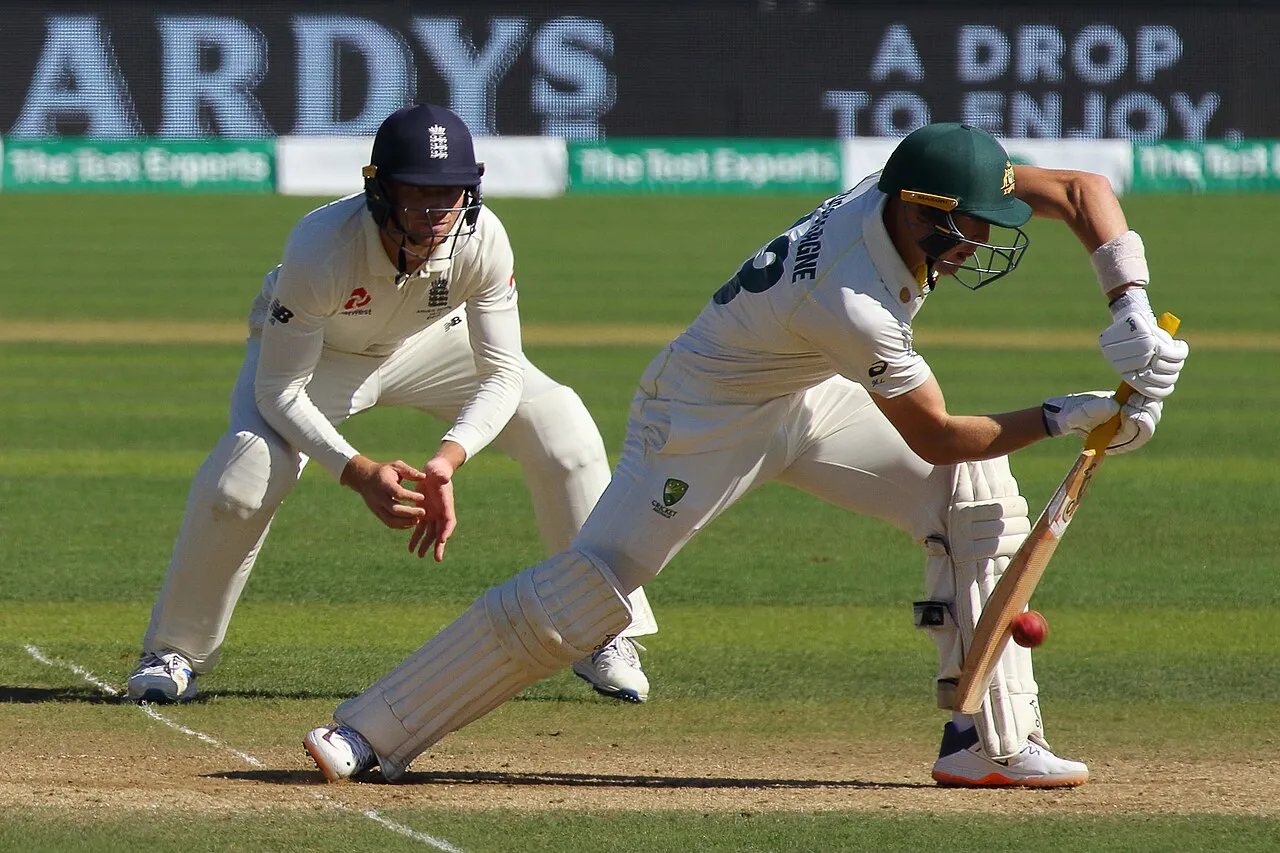
Labuschagne batting during the 2019 Ashes. The historical image illustrates a separate Test-cricket context from the ODI final case study.
Does a lower strike rate make an innings unimportant?
Strike rate describes scoring speed per ball faced. For 58 from 110 balls, the arithmetic gives approximately 52.73 runs per 100 balls. That is one measurement. It does not by itself measure the value of retaining a wicket, supporting a partnership or responding to a particular chase.
The opposite exaggeration is also unhelpful. A slower innings is not automatically an admirable "anchor" contribution simply because it is slow. You still need the target, wickets, remaining deliveries and eventual outcome to explain the role the innings played.
Use a fictional chase to practise the distinction. A side needs 80 from 120 balls with seven wickets available. Compare that with needing 80 from 30 balls with two wickets available. The same individual scoring rate would have very different implications in those two situations.
That does not give us permission to invent a player's private plan. We can observe a recorded partnership and calculate rates. An explanation of intention needs a reliable statement or should remain clearly identified as interpretation. Good analysis does not require pretending to know what was said between every delivery.
How to evaluate an innings without choosing one statistic first
Begin with the question. If you want to know who scored fastest, calculate the rate. If you want to know who scored most, compare runs. If you want to examine a partnership, identify the shared interval. These questions can produce different answers without any answer being dishonest.
Next add the match state at entry and exit. A batter's opportunity is not described fully by his position in the order. The same number four might arrive with the team well placed or after early dismissals. State the actual context where it is verified, and label hypothetical examples as hypothetical.
Then examine how much of the argument your evidence supports. A scorecard can establish runs and wickets. It may not establish every technical adjustment. A highlights package can show selected deliveries, but it does not necessarily show the complete innings. Choose language that matches the evidence you actually have.
Finally, acknowledge the other contributions. A successful chase is a team outcome. Recognising a supporting innings does not require diminishing the century at the other end, just as praising the century does not require pretending its partner contributed nothing.
Test cricket and ODI cricket ask different questions
A Test can end in a draw, while a completed ODI chase is organised around a limited allocation of overs and a target. This changes the kinds of questions a batter faces. Do not import the desired scoring pace from one format into the other without considering the situation.
For instance, a long defensive passage may have a different purpose when a side is trying to survive in a Test than when a short ODI chase is running out of deliveries. The action looks similar at a single-ball level, but the wider objective can differ.
That is why Labuschagne's Manchester century and his World Cup final innings should first be understood within their own matches. A useful project can compare their contexts, but it should not flatten them into a claim that 111 is simply more than 58 and therefore answers every question about the two performances.
Create a comparison sheet with format, match objective, score at entry, runs, balls, dismissal status and result. Fill only the fields your sources establish. Missing information is a research task, not a reason to insert a plausible estimate.
A partnership calculator using fictional data
You can model the fictional stand above with three inputs: runs added by each batter during the partnership and extras during that same interval. Whole-innings totals are deliberately excluded because they are not the values the formula needs.
def stand_runs(batter_a_added, batter_b_added, extras):
    values = [batter_a_added, batter_b_added, extras]
    if any(not isinstance(v, int) or v < 0 for v in values):
        raise ValueError('Use non-negative whole-run values')
    return sum(values)

print(stand_runs(30, 25, 5))  # Fictional example: 60
The function does not discover a partnership from an incomplete scorecard. It adds values already defined for the correct interval. That limitation is important: a short program can calculate accurately while still answering the wrong question if the inputs are misunderstood.
As an extension, build a table of fictional stands with a start score and end score. Check that the difference matches the stand total. If it does not, investigate the input rather than changing a formula until it produces the number you wanted.
Our programming courses can help you practise functions and data validation. For a different individual-innings calculation, the Babar Azam batting-statistics guide examines boundary runs and scoring rates. Keep the formats and events separate when comparing the examples.
Questions readers ask
Was Labuschagne born in Australia?
The official profile gives his birthplace as Klerksdorp in South Africa and records the family's move to Brisbane. He represents Australia. Birthplace, residence history and sporting representation should be recorded as distinct facts rather than forced into one field.
Is the 58 not out a recent 2026 innings?
No. It is from the World Cup final played on 19 November 2023. This guide revisits it as a case study. Check a dated current scorecard for a new match rather than treating a historical career example as breaking news.
Why does the partnership differ from the sum of the two scores?
The stand covers only the interval the two players batted together and includes relevant extras. Whole-innings scores can include runs made outside that interval. Identify the boundaries of the record before adding the values.
Does this guide claim he is in the next Australian XI?
No. Career achievements do not establish a new selection. A future or current XI needs a dated official announcement for the particular match. This article does not turn historical success into a promise about the next team sheet.
Are both photos from the World Cup final?
No. The cover comes from the October 2026 Newlands Test, while the inline image shows batting during the 2019 Ashes. Neither is offered as a photograph of the 2023 final. Their dates and contexts remain visible in the captions.
Sources
- Cricket Australia career profile
- Cricket Australia World Cup final report, 19 November 2023
- Official final match centre
Image credits: cover: EGilham, source, CC BY-SA 4.0. Resized and converted to WebP. inline: Treflyn Lloyd-Roberts, source, CC BY-SA 4.0. Resized and converted to WebP.
Found an error or an outdated detail? Report a correction with the article URL and original source.