
Babar Azam's 103 from 59: Batting Stats and PSL 2026 Context
Use Babar's verified 2026 PSL Qualifier century to understand strike rate, boundary runs and season totals, with original arithmetic and clearly labelled exercises.

Babar Azam's 103 from 59 balls in the 2026 HBL PSL Qualifier provides a clear example of why a batting score deserves more than a glance at the runs column. The PCB's report records twelve fours and four sixes as Peshawar Zalmi reached 221/7 and beat Islamabad United by 70 runs on 28 April 2026.
This guide uses that completed innings to explain strike rate, boundary contribution and the difference between a match score and a season total. It does not present an April result as breaking November news or invent a current international ranking.
Who is Babar Azam?
The PCB's player profile records his birth on 15 October 1994 in Lahore and his right-handed batting style. On this article's check date, 1 November 2026, the birth date makes him 32. A cached automatic age field can become stale, so the date is the firmer reference.
Keep the competition attached when reading his statistics. A Pakistan international innings, an HBL PSL innings and another domestic appearance do not all belong to the same statistical table. A total without its format and competition can create a misleading comparison.
This article focuses on a particular HBL PSL performance and its season context. It does not certify a current captaincy appointment, fitness update or selection for a forthcoming match.
What happened in the 2026 Qualifier?
The PCB's 28 April report says Babar's century helped Peshawar reach the final. His 103 from 59 deliveries included 12 fours and 4 sixes. The team's total and the 70-run win describe the match outcome; the century describes his individual contribution within it.
The later PCB final report records Peshawar winning the title on 3 May and Babar finishing with 588 runs in 11 matches, earning the leading-run-scorer award. The Qualifier and the final are separate events, so a summary should not imply that the 103 was scored in the title match.
Preserving that distinction is important when sharing highlights. A video of an earlier century can remain popular after the final without becoming footage of the final itself.
What does 103 from 59 balls actually tell you?
It gives the batter's credited runs and recorded balls faced. Those two numbers allow you to calculate batting strike rate, but they do not provide every delivery's result, the full field setting or the sequence of scoring shots.
| Verified innings field | Value |
|---|---|
| Runs | 103 |
| Balls faced | 59 |
| Fours | 12 |
| Sixes | 4 |
Do not add team extras to the batter's runs. A team total and an individual score are different records. The scorecard's categories help explain how the team's runs were accumulated without assigning every run to a batter.
For an original exercise, write down which questions the table answers and which it leaves open. It answers the boundary count. It does not tell you the exact number of singles, the score after each over or the final total of a partnership.
How do you calculate batting strike rate?
Divide runs by balls faced and multiply by 100. For the reported innings, 103 divided by 59, multiplied by 100, is approximately 174.58. That is a rate of runs per hundred balls based on this innings, not a prediction that he will score exactly that many in his next hundred deliveries.
Use a simpler fictional example to check the formula: 45 runs from 30 balls gives 150. A different fictional innings of 45 from 45 gives 100. The same run total can therefore represent different scoring rates.
Always name it batting strike rate when the context might be unclear. Bowling strike rate uses a different definition, deliveries per wicket. Our Rabada statistics guide explains that separate measure.
Rounding is the last step. Keep the full calculation internally and round the displayed answer to an appropriate number of decimal places. Repeatedly rounding intermediate values can introduce avoidable differences.
How many of the 103 runs came from boundaries?
Twelve fours contribute 48 runs, and four sixes contribute 24. Together they account for 72 runs, leaving 31 credited runs outside those listed boundary contributions. This is our arithmetic using the report's inputs.
The boundary share of the innings is 72 divided by 103, or approximately 69.9%. Label the denominator clearly: this is the share of his runs, not the share of the team's total or the percentage of deliveries that were boundaries.
The remaining 31 should not be casually described as 31 singles. The summary does not provide enough detail to reconstruct all of those scoring events. Singles, twos and other credited outcomes require a more complete record if you want an exact breakdown.
This is a useful example of a broader data rule: subtraction can establish a remainder without establishing the composition of that remainder. Do not turn one correct calculation into several unsupported claims.
Why does a high strike rate not tell the whole story?
It measures scoring speed relative to balls faced. It does not independently describe the match situation, the risk of particular shots or the contribution of a partnership. Those questions need context beyond the two inputs in the formula.
For a fictional comparison, imagine two innings at a strike rate of 150: fifteen runs from ten balls and ninety from sixty. The rates match, but the volume of runs and time at the crease differ. A useful discussion identifies both rather than treating the shared rate as identical performance.
Likewise, a lower rate in a different situation should not be judged solely against a highlight from another format. State the comparison's purpose and use evidence suited to it. This article does not assign a tactical verdict to an unseen innings.
If you want to discuss how the scoring rate changed during an innings, obtain phase-by-phase or ball-by-ball data. The overall strike rate alone cannot show whether the batter began quickly, accelerated later or scored at a similar rate throughout.
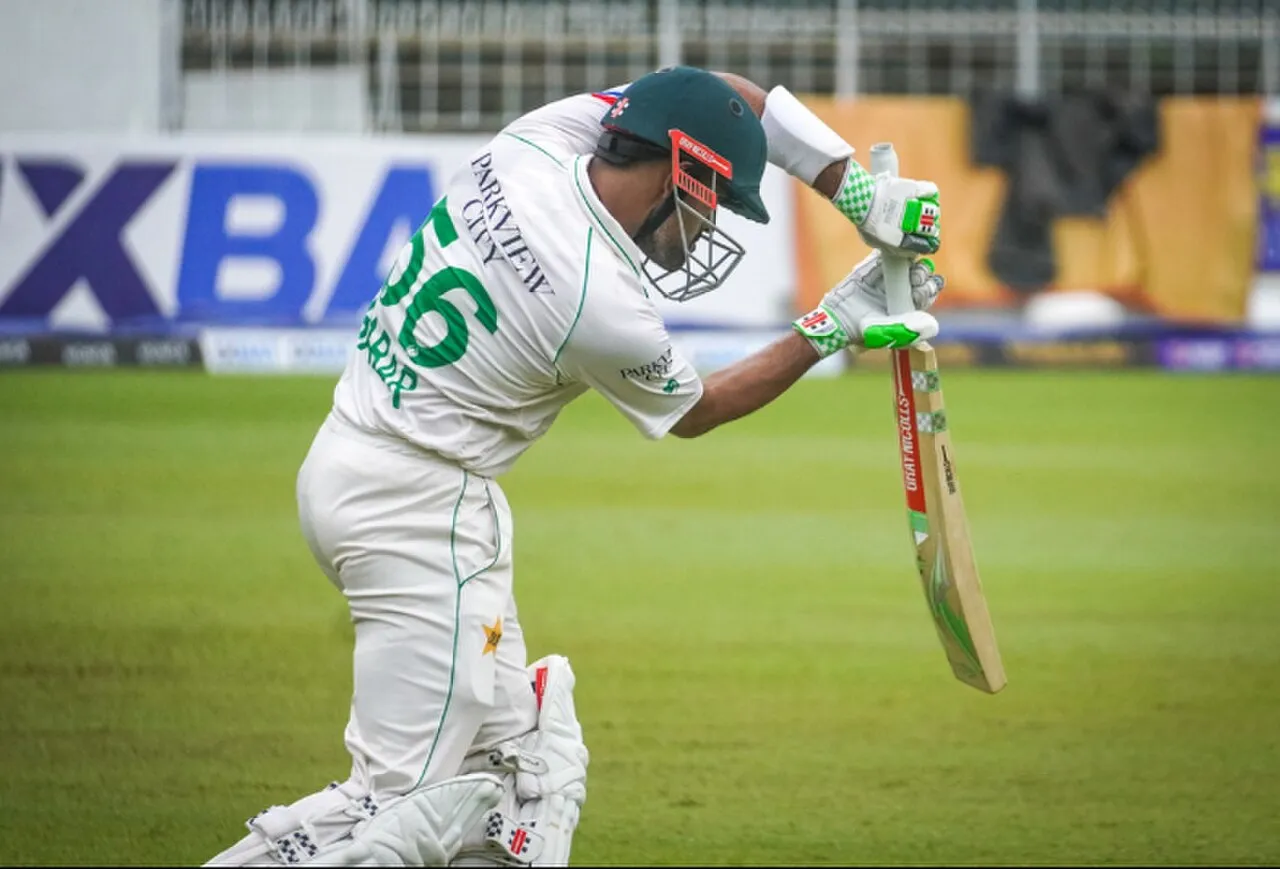
Babar batting in the second Test in Sri Lanka in July 2023. This is a separate format and event from the PSL innings discussed here.
How is batting average different?
Batting average divides runs by dismissals, rather than by balls faced. It therefore answers a different question from strike rate. Not-out innings affect the dismissal denominator, which is why a simple runs-per-innings calculation is not necessarily the batting average.
Consider an original fictional sequence: 40 out, 30 not out and 50 out. The total is 120 runs across three innings, but there are two dismissals. The batting average is sixty, while the simple arithmetic mean of runs per innings is forty.
Neither calculation should be mislabeled. If a worksheet asks for average runs per innings, dividing by three may be appropriate for that stated task. If it asks for conventional batting average, use dismissals and label the result accordingly.
If there are no dismissals in the selected sample, do not divide by zero or silently report an average of zero. Mark the field appropriately and explain why that calculation is not available from the sample.
How should you read the 588-run season total?
The PCB's final report identifies 588 runs in 11 matches as Babar's completed HBL PSL 11 tournament total. It is not the same figure as the 103 in the Qualifier and should not be placed in an international-career column.
Dividing 588 by 11 gives approximately 53.45 runs per match. That is our simple per-match calculation, not a claim that his official batting average was 53.45. You would need the relevant innings and dismissals to calculate that measure correctly.
This distinction matters in many sports statistics. A denominator that is easy to find is not automatically the denominator required by the metric. Keep matches, innings and dismissals as separate fields in a data project.
Do not extend a completed tournament total into a live all-format total without checking the additional records. A neatly formatted graphic can still mislead if it combines unrelated competitions or dates.
What can you look for when watching his batting?
Choose a specific observable question. For example, what options does the batter appear to have against a particular delivery, or where does he move after completing a run? Begin with the visible action before assigning a larger interpretation.
If you are studying a shot, compare the approach to the ball, contact and follow-through across suitable footage. Do not assume one still image reveals the full movement. Camera angle, timing and the part of the sequence shown affect what you can establish.
Keep the sample size visible. A small group of cover-drive highlights does not describe every shot in a season, and a compilation may omit dots, defensive strokes and unsuccessful attempts. Treat it as selected evidence rather than a complete match record.
These are observation suggestions, not professional coaching instructions or a claim that this article has analysed every ball of the Qualifier.
How can students build a useful batting worksheet?
Use separate columns for runs, balls, dismissal status, fours, sixes, format, competition and date. Add the source before calculating derived fields. This makes it easier to identify a missing input or a statistic copied from the wrong match.
Calculate strike rate only when a valid balls-faced denominator is present. Calculate average over an appropriate collection of innings with a known dismissal count. Check that the recorded boundary runs do not exceed the batter's total before presenting a breakdown.
For a fictional validation test, an entry showing twenty runs but six sixes is inconsistent because those sixes alone would contribute thirty-six. A program should flag the contradiction rather than print a polished chart from the impossible row.
Our Python lessons offer a place to practise these calculations and input checks. Start with invented examples, then use verified scorecard data once you can preserve its labels and source.
What should you check before sharing a ranking claim?
Use the current official table for the correct format and discipline, and record when you checked it. A successful innings does not itself establish a new ranking position. Nor does an old No. 1 graphic establish the player's position today.
Our ICC rankings guide separates player rankings, team ratings and tournament standings. It helps prevent a career or match statistic from being presented as a different type of ranking.
This article deliberately does not reproduce a live ranking number. Its purpose is a verified innings case study and clear statistical interpretation, not a constantly updating player dashboard.
What is the useful takeaway from this innings?
The reported Qualifier century supplies a concrete case for understanding what cricket numbers mean. Runs, balls, boundary counts and a season aggregate each describe a different part of the record. Correct arithmetic becomes useful when the labels and scope remain attached.
You can appreciate the performance while keeping the analysis precise: a match score is not a career total, strike rate is not average, and a remainder in a calculation does not reveal every missing scoring event. Those distinctions make both sports writing and student data projects more reliable.
Sources
Source 2: PCB Qualifier report
Source 3: PCB completed tournament report
Checked 1 November 2026 through indexed official records; direct page retrieval was restricted. Derived arithmetic and fictional examples are labelled. No current ranking, fitness or selection claim is made.
Image credits: cover: ICNA, source, CC BY 3.0. Resized and converted to WebP. inline: Nazly Ahmed from Colombo, Sri Lanka, source, CC BY-SA 4.0. Resized and converted to WebP.
Found an error or an outdated detail? Report a correction with the article URL and original source.