
ONGC Explained: Oil, Gas, Production Units and Company-Report Reading
Understand ONGC exploration and production, oil and gas units, reporting scope and financial distinctions using clearly labelled classroom examples.

ONGC, the Oil and Natural Gas Corporation, is associated with oil and natural-gas exploration and production. Reading a report about it requires more than looking at a share-price movement. Exploration activity, production volumes, commodity prices and financial results are different measurements. Understanding those differences helps students follow energy news without turning a company headline into an unsupported investment conclusion.
This guide was reviewed on 6 November 2026. It uses official company information and original classroom examples. It does not provide a live ONGC share price, a production forecast or a recommendation to buy securities. Current quotations require a market source, exchange, currency and timestamp; current company figures require the relevant dated disclosure.
What part of the energy chain does ONGC work in?
ONGC's official information describes exploration and production activities involving crude oil and natural gas. These activities belong to the upstream part of the oil-and-gas chain. Finding and producing a resource is a different function from transporting it, refining crude into products or selling fuel to a final customer.
A company group can have interests across several activities, so the boundary of a report matters. A statement about one operation should not automatically be presented as a statement about every subsidiary or the entire industry. Read whether the report concerns the parent company, a particular project or a consolidated group.
For a classroom diagram, draw resource, production facility, transport, processing and customer as separate boxes. Place a report's claim in the relevant box. This simple exercise prevents an upstream production figure from being mistaken for the amount of fuel sold through a retail station.
How is exploration different from production?
Exploration investigates where resources may exist and whether they can be understood and developed. Production concerns extracting resources from an operating arrangement. A successful exploration announcement and an increase in current output therefore answer different questions. Development work and other decisions can separate a discovery from sustained production.
Use an invented school project: a team identifies a possible underground water source but has not built an operating well. The identification is not a daily supply measurement. The analogy is limited, yet it explains why the words found, developed and produced should not be substituted for one another in a headline.
When summarising an actual company announcement, preserve the stage, project and date. Do not invent a timetable from a discovery to commercial output. An educational article can explain the stages while leaving project-specific quantities and future outcomes to verified disclosures and the evidence supporting them.
What do onshore and offshore describe?
Onshore and offshore describe the geographical setting of activities. An offshore installation is associated with an operation at sea, while onshore activity occurs on land. The location affects the practical setting, but those labels alone do not establish a project's profitability, environmental impact, technical difficulty or current operational status.
A photograph of a platform is useful context, not a production report. It may be historical, show one facility or depict a particular stage of work. A caption should identify what the source establishes and avoid suggesting that the picture proves current output or the status of every company operation.
For a comparison worksheet, separate location, resource, project stage and reporting period. Students can see that two photographs of very different facilities might still relate to the same broad industry. They can also see why appearance is a poor substitute for the measurements needed to assess an actual operation.
How should oil production units be read?
Oil can be reported using different volume or mass units and different time bases. A daily production rate and a total produced over a quarter are not the same quantity. Before comparing records, identify the unit, period, operational boundary and whether the value describes production, sales or another measure.
In an invented constant-rate exercise, two thousand units per day maintained for thirty days gives sixty thousand units. The multiplication is valid under the stated assumption, but it does not describe any ONGC asset. Actual production can vary, and a monthly total needs the actual reporting definition rather than a guessed constant rate.
Converting between mass and volume can require information about the material and applicable conditions. Do not invent a universal factor for all oil. A classroom example should supply any needed conversion assumption explicitly. In a real disclosure, follow the source's units and methodology instead of silently changing them.
Why are natural-gas measurements particularly sensitive to definitions?
Gas can be reported by volume under specified conditions or through energy-related measures. Temperature, pressure and reporting conventions matter when comparing quantities. A large number without its unit and measurement basis is not enough to establish that one report shows more usable energy than another.
Create two fictional records with identical digits but different units. Ask students what can be concluded. The correct answer is that the records need interpretation before comparison. Even a mathematically correct ratio can be meaningless if the underlying quantities use incompatible definitions.
Keep oil and gas figures separate unless a report explicitly provides an equivalent measure with a stated method. An equivalence calculation can help combine information for a particular purpose, but it does not turn the materials into identical products or establish equal selling prices. The definition travels with the number.
Are reserves, resources and annual output interchangeable?
No. A stock of estimated recoverable material and a flow produced during a period describe different concepts. Resource and reserve terminology also has reporting definitions that should be taken from the relevant disclosure. Do not label every estimate a proved reserve or infer recoverability from a broad resource headline.
A classroom analogy uses a library. Books held in the collection are a stock, while books borrowed this week are a flow. The analogy does not reproduce geological reporting rules, but it helps explain why a total inventory and a weekly activity count cannot answer the same question.
If a report discusses reserve replacement, first read its definition and scope. An educational summary should preserve the company's stated category and period. It should not calculate a precise remaining production lifetime by dividing two unrelated headline figures and pretending that output, prices and operating conditions will remain unchanged forever.
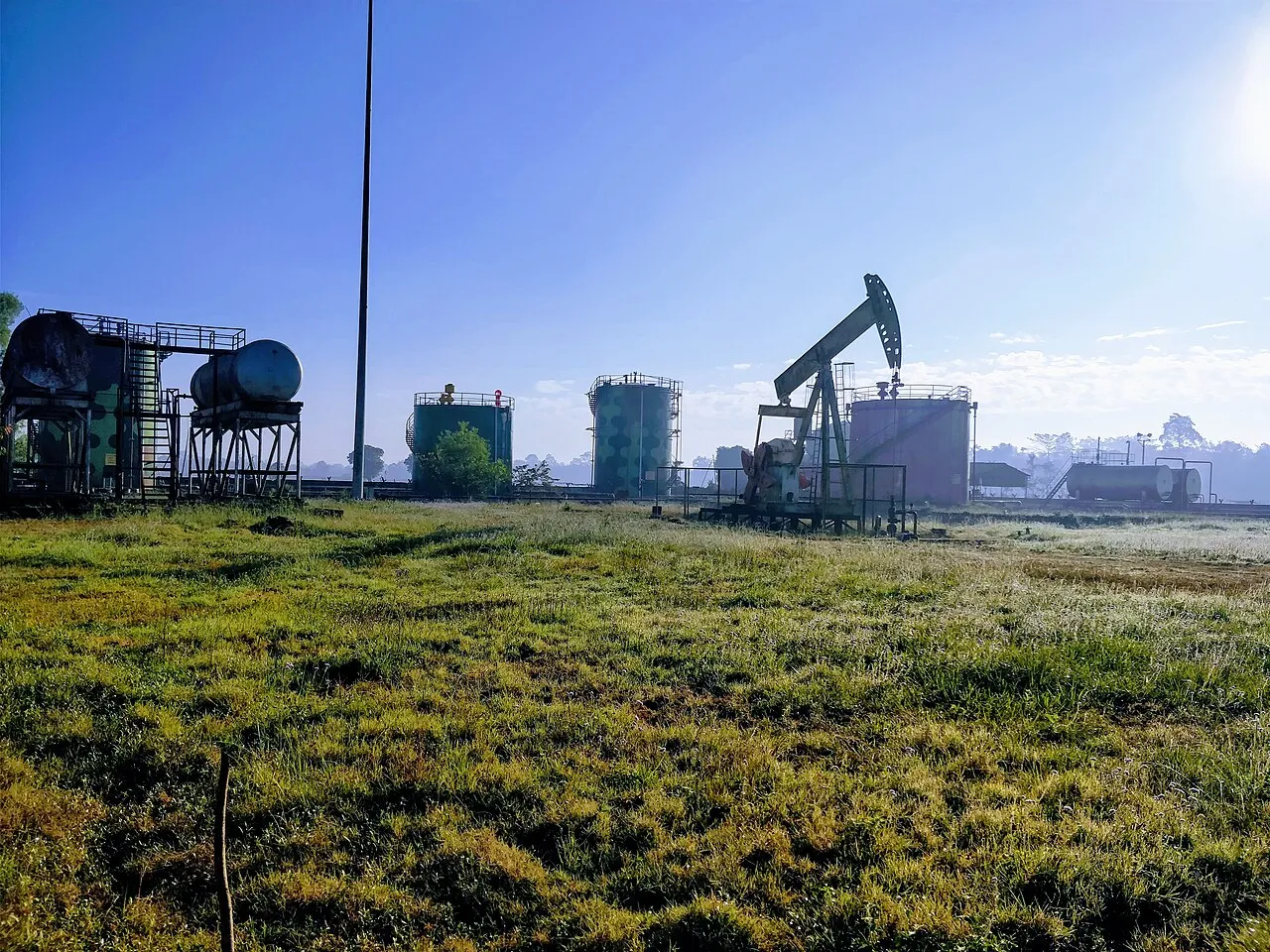
An ONGC oil-field pumpjack in Sivasagar, Assam, shown as onshore production context.
Why does a commodity price differ from a company share price?
A crude-oil benchmark is a price for a defined commodity reference. A share price is a market observation for an equity security. Their units, markets and determinants differ. They can be economically connected without moving in a fixed one-to-one relationship at every moment.
For an invented example, let a commodity reference increase by ten percent while a company's shares fall by two percent. The observations are not automatically inconsistent. Financial markets can respond to costs, expectations, disclosures and wider conditions. The example does not claim which factor caused a real movement.
When checking an actual quote, record the exchange, currency, time and whether the market is open. Compare like periods. A commodity's daily change should not be set beside a share's yearly return and described as a direct divergence over the same interval. Timing is part of the evidence.
Can production rise while revenue behaves differently?
Revenue depends on more than a physical production count. Selling prices, sales quantities, product mix and reporting scope can matter. Production and sales may also be different measures. A reliable explanation checks the financial statement's definitions instead of multiplying a headline output figure by an unrelated market benchmark.
Use a fictional model with one hundred units sold at ten currency units each, giving revenue of one thousand. In a second period, sell one hundred and ten units at eight each, giving eight hundred and eighty. Sales quantity rises while revenue falls under those simplified assumptions.
This exercise demonstrates a possible relationship, not ONGC's actual results. It excludes many real accounting and operating factors. The point is to make the assumptions visible and show why a volume headline alone cannot establish the direction of revenue, profit or the share price.
Why separate revenue, profit and cash flow?
Revenue records one aspect of business activity, profit reflects an accounting result after applicable items, and cash flow concerns movements of cash under the statement's classifications. These measures are related but not identical. A rise in one should not automatically be described as an equal rise in another.
Imagine an invented project that sells output but must also pay operating costs and fund equipment. The timing and classification of these activities affect different reports. A classroom diagram can place sales, expenses and equipment spending on separate lines without pretending to reproduce a company's complete accounts.
For an actual company review, use the published statements and notes. Identify whether a figure is standalone or consolidated and whether it covers a quarter or a full year. A technically accurate number can still mislead if the accompanying scope or comparison period has been changed.
How should overseas interests and subsidiaries be interpreted?
ONGC's official overview describes ONGC Videsh's overseas exploration and production role. The existence of an overseas interest does not mean that every volume associated with the project belongs wholly to the parent company. Ownership, participation and reporting definitions determine the relevant scope.
For an invented partnership, two organisations share a project. The project's total output and one participant's attributed share are different quantities. Do not add them together as though they represent separate production. This is a common double-counting problem that can arise when several reports describe the same underlying operation.
Write the project name, ownership boundary and measurement definition beside each figure. If those fields cannot be established, do not force the numbers into a combined total. A smaller set of well-defined facts is more useful than an impressive sum built from overlapping records.
What questions belong in an environmental and safety discussion?
Energy operations involve environmental and safety considerations that cannot be judged from a photograph or a production headline alone. A serious discussion identifies the relevant activity, location, reporting period and evidence. Company disclosures, regulators and documented project information answer different parts of that investigation.
Do not treat an educational diagram as permission to approach facilities or operate equipment. Industry sites can be hazardous and subject to restricted access. Students can learn from public documents, approved imagery and classroom models without conducting unauthorised field experiments or sharing sensitive operational details.
For a research worksheet, separate a measured outcome, a company target and an external requirement. A target is not automatically an achieved result. An environmental claim should retain its measurement basis and limitations, just as a financial claim should retain its accounting scope and period.
A practical method for reading an ONGC announcement
Start by identifying the document: a company disclosure, operational update, investor presentation or media report. Record its date and original source. Then underline the activity being described and circle every unit and period. This makes missing context visible before an interpretation is written.
Next, classify each statement as historical fact, current observation, target or explanation. If a paragraph moves from a confirmed discovery to a predicted profit increase, ask which additional evidence supports that step. Plausibility is not the same as a verified causal chain, especially when several business variables are changing together.
Finally, write a summary that keeps the strongest supported information and its limitations. Readers looking for broader cost relationships can use our energy-trade guide. Students can practise tables and unit conversions through study resources without treating a learning exercise as market advice.
Questions readers often ask
Does this guide show the live ONGC share price? No. It explains the company and the measurements needed to understand reports. Check a current market quotation with its exchange and timestamp, then consult the relevant official disclosures before interpreting why a price changed.
Is an offshore-platform photograph evidence of today's production? No. It illustrates a facility or setting at the time photographed. Current production requires a dated operational report. Captions in this article identify the images as context rather than implying that they prove a new discovery or live output figure.
Can an energy headline alone explain every financial result? No. Volumes, prices, costs, ownership and accounting scope need examination. A useful article makes those questions easier to ask; it does not replace the company's statements or guarantee an investment outcome.
Sources
- ONGC: company overview
- ONGC: exploration information
- US EPA: oil-and-gas sector and upstream activities
- ONGC: official website and disclosures
Image credits: cover: Ramchandra9, source, CC BY 3.0. Resized and converted to WebP. inline: Deepak G Goswami, source, CC BY-SA 3.0. Resized and converted to WebP.
Found an error or an outdated detail? Report a correction with the article URL and original source.