
Pakistan vs UAE: Hong Kong Sixes Chase and Two-Wicket Result
Read Pakistan vs UAE’s 2026 Hong Kong Sixes result and learn how targets, final totals, legal balls and wicket margins describe different parts of a chase.

UAE beat Pakistan by two wickets in their Group C match at the 2026 Hong Kong Sixes on 30 October. The organiser's result feed lists Pakistan at 106/2 and UAE at 109/4, both from six overs. This was a short-format tournament fixture, not the teams' 2025 Asia Cup meeting or a standard twenty-over international.
This guide was checked on 2 November 2026. It explains the completed result through original chase and decision-making exercises. It does not supply live commentary, invent a delivery sequence or predict a future meeting. Historical images are labelled as context and are not presented as photographs of the winning shot.
Which Pakistan versus UAE match is this?
The relevant fixture was Group C of Hong Kong Sixes 2026, played on 30 October. The organiser's structured feed identifies the pairing and records UAE as the winner. That event label matters because a search using only the two country names can return several formats, years and team levels.
Before reading a result, establish the competition and date. A familiar player name or national flag is not enough to identify a unique match. An older scorecard may be perfectly accurate and still answer the wrong question. Retain the event name when sharing a screenshot or a short result message.
For a small notebook exercise, create two fictional records with the same teams but different dates and formats. Give each an identifier. Then search by country names alone and notice that both match. Add date and competition to narrow the result. This is the same principle a reliable fixture page needs behind its interface.
The match's Group C label also locates it within the tournament. A group game contributes to progression under the event's rules; it is not itself the Cup final. The result can matter a great deal without automatically deciding the entire event's champion.
What was the completed score?
The organiser's feed records Pakistan 106/2 from thirty-six legal balls and UAE 109/4 from thirty-six, with the result “UAE won by 2 Wickets.” These are attributed innings fields. The feed provides totals and a result, not a full delivery-by-delivery account that establishes every change in the chase.
The team batting first set the reference total. The chasing team's final total exceeded it, which is consistent with a completed successful chase. The difference between 109 and 106 is not the wicket margin: runs and wickets measure different aspects of the outcome and should not be mixed in a summary.
Read the result in a full sentence before compressing it into symbols. UAE completed the chase and were the winning side; Pakistan's innings came first. A card that reverses team names without moving their scores can accidentally reverse the apparent winner even while displaying the original numbers.
For a teaching display, name the columns team, runs, wickets and legal balls. A reader should not have to infer that “4” means wickets rather than a ranking or over number. Clear labels make a simple scorecard accessible without making the user memorise the layout of a particular sports website.
Why is the target not simply 106?
In a straightforward unadjusted chase of a completed 106, the winning threshold is 107. Reaching 106 would only equal the earlier total. The target and the defending total are therefore separate quantities. This arithmetic explains the threshold without claiming a particular final-ball sequence that the summary feed does not supply.
Use a fictional chase to practise. If the target is 107 and the chasing side has 90, seventeen runs remain. Subtract from the target, not from 106. The difference may look small, but it decides whether a team has actually reached the winning threshold or only drawn level.
Now imagine the team needs one run and the next scoring stroke produces four. The final total can pass the minimum threshold. A successful chase need not stop at exactly the target number. This original example explains a general possibility; it is not a reconstruction of how UAE reached 109 in this fixture.
That boundary is important when writing an article from a summary. The final numbers can be compatible with several possible sequences. Do not choose the most dramatic one and present it as observed fact. Use a verified ball-by-ball record if the exact last delivery is the subject of the claim.
Why should a six-a-side wicket margin be read in its own format?
The organiser reports a two-wicket win in this competition. A reader should not reinterpret the event using an assumed eleven-player margin calculation from another format. Six-a-side cricket has its own playing conditions and scoring context; the event's official result is the appropriate label for this completed match.
This illustrates a wider rule: familiar notation does not make all underlying rules identical. A classroom game, a short exhibition and a senior ODI may all show runs and wickets, but their allocations and participant rules can differ. Identify the format before carrying a formula from one setting into another.
For an original modelling exercise, let a fictional game define its own maximum wicket count explicitly. Store that as a rule, not as an invisible constant copied from another competition. Then calculate a displayed margin only when the exercise's conditions actually support the method.
A real result card can avoid unnecessary reconstruction by preserving the organiser's declared result and linking the source. That is often more reliable than deriving every field from assumptions. A useful data project knows which values it calculated and which it received as an authoritative match outcome.
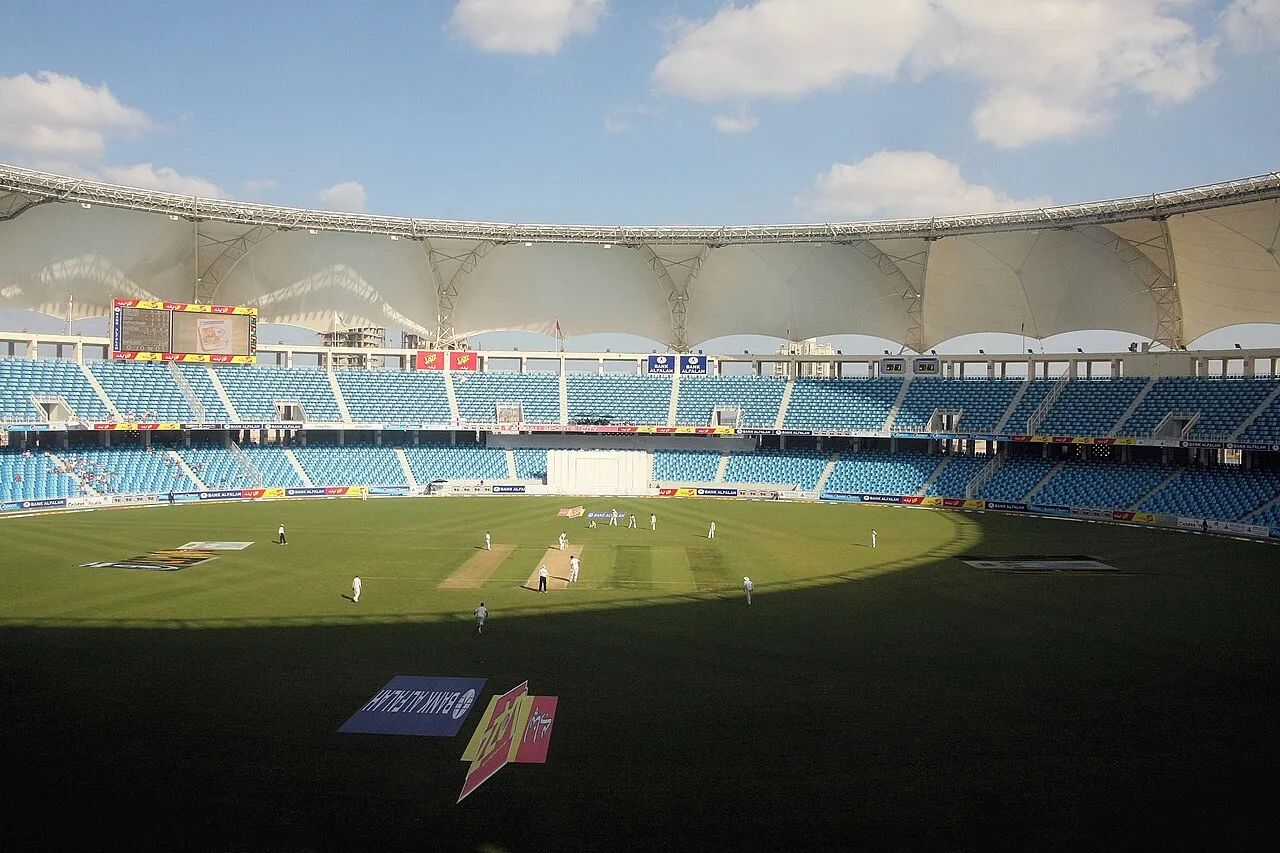
Historical UAE cricket setting; not the Hong Kong match venue.
What does completing six overs tell you?
The feed lists thirty-six legal balls for UAE's innings. With six balls per over, that corresponds to six completed overs. It identifies how much legal play was recorded, but it does not reveal the runs scored in each over or the order of every wicket without additional event data.
This distinction matters for dramatic claims about the final over. A final total alone cannot show how many runs were needed at its start. To state that number confidently, you need a verified score at the end of the previous over or a reliable delivery record. Do not infer the sequence backwards from the result.
Try a fictional six-over chase with 90 after five overs and a target of 107. Seventeen are required from six legal balls. Change the five-over score to 86 and the requirement becomes twenty-one. Both could finish at the same final total, so the final total cannot choose between them.
The exercise shows why a graph of required runs must be based on actual checkpoints. Invented checkpoints can be useful in a labelled lesson, but not in a chart presented as this match's progress. A professional visual preserves the distinction between an example and a recorded sequence.
How can a required rate help a beginner?
A required rate expresses a remaining run requirement over the remaining allocation. It is a descriptive average, not a command to score an exact amount in every over. In a fictional case needing eighteen from six legal balls, the average requirement is eighteen per six-ball over, or three per ball.
Scoring does not arrive evenly. A dot ball increases the rate needed from what remains; a boundary can reduce it. The underlying state changes after each event. That makes a chase a useful example of a small dynamic system whose next requirement depends on both the previous state and the new action.
For a practice card, record target, current total and remaining legal balls. Update those values after invented outcomes and calculate the new requirement. Keep extras and the legal-ball count distinct if you include them. Start with a simple model before attempting every special situation in an official competition.
You can build the exercise in our programming courses. The important feature is clear state, not a flashing live badge. A learner should know the numbers are fictional and see exactly why the calculation changed. That teaches a reusable concept without pretending to reproduce the UAE innings.
Does one group defeat decide a whole tournament?
Not necessarily. A team's route depends on the competition's full group results and progression rules. The 2026 organiser's bracket separated Cup, Plate and Bowl routes. A single group loss must therefore be read within that structure, rather than automatically described as elimination from all remaining matches.
This is why a headline about one fixture should not replace the tournament table. A team can lose a group match and still have later games. It can also win another prominent pairing without taking the main title. Our India–Pakistan progression guide addresses that separate question.
For a fictional three-team group, let each side beat one opponent and lose to the other. The win-loss totals are equal, but a ranking is still needed. Which side advances depends on the declared tie-break, not on which result a supporter found most memorable. Do not invent the rule after seeing the preferred outcome.
Keep group position, next opponent and final placing as separate fields. Each is established at a different stage. A later tournament achievement should not overwrite an earlier match result, and an earlier defeat should not erase the existence of subsequent fixtures. A clear archive preserves the whole route without rewriting its parts.
How should supporters discuss a close chase?
Describe the confirmed outcome before judging the people involved. A two-wicket result establishes the winner and declared margin. It does not justify claims about a player's attitude, private instructions or mental state. Those are different assertions requiring evidence, not conclusions that can be read directly from the scoreboard.
The same care applies to a label such as upset. It expresses expectations, not a statistical field supplied by the score. If you use it, explain the basis rather than treating a team's reputation as proof that its opponent could not reasonably win. Sport remains uncertain even when one name is more familiar.
A constructive discussion asks specific questions: what did the recorded requirement show, which actions are visible, and what would a fuller scorecard clarify? These questions leave room for analysis without inventing blame. They are more useful for a student learning cricket than a dramatic sentence that attacks a player but explains no part of the game.
For a review activity, rewrite an exaggerated fictional headline into a neutral result sentence. Keep the winner, date, competition and margin. Remove claims about humiliation or intent that the evidence does not establish. Notice that the factual version can still be interesting because the sporting outcome is meaningful on its own.
Make a reliable result card
Use the exact event identity and the organiser's completed totals. Put derived target arithmetic in a separate explanation, and mark any invented chase scenarios as practice. If no ball-by-ball sequence is available, leave a momentum graph out rather than populate one with plausible numbers.
Test the card with a reader unfamiliar with the event. They should identify UAE as the winner, recognise the six-a-side format and understand that 109 is the final total rather than the declared wicket margin. If they can do that without another explanation, the labels are doing their job.
Finally, keep the result's source and check date. A completed article becomes an archive quickly, but a well-labelled archive remains useful. It can explain a sporting event and teach score-reading without pretending to be a current live service, a broadcaster or an authority on every player's future prospects.
One final test is to hide the result sentence and read only the labelled innings. Can another learner identify the winning side and explain why the run difference is not the wicket margin? Restore the declared result to check the answer. If the two explanations conflict, inspect the labels before adding more statistics or a fictional turning point.
Sources
- Hong Kong Sixes: official result feed, record 5510, for the attributed totals, legal balls and result.
- Official fixture structure, for Group C identity and the competition's progression framework. Chase checkpoints and decision exercises in this article are fictional teaching examples, not reconstructed deliveries.
Image credits: cover: Zpotrick, source, CC BY-SA 3.0. Resized and converted to WebP. inline: Dave Morton, source, Public domain. Resized and converted to WebP.
Found an error or an outdated detail? Report a correction with the article URL and original source.