
Paris Masters 2026: Schedule, Draw and Pakistan Time Guide
Check the 2026 Paris Masters qualifying and main-draw dates, provisional rounds and arena information. Learn how to read the draw and convert times for Pakistan.

The 2026 Paris Masters main draw is scheduled for 2–8 November, with qualifying on 31 October and 1 November. As of this guide's check date, 1 November, the tournament's main-draw champion has not been decided. Do not mistake an older winner's photograph or a previous edition's result for the outcome of this year's event.
For readers in Pakistan, this guide separates the event dates, provisional rounds, daily order of play and time-zone conversion. It also explains how to follow a draw without turning a possible matchup into an announced fixture.
When does the 2026 Paris Masters take place?
The LTA's published schedule places singles qualifying on 31 October and 1 November, followed by main-draw play from Monday 2 November through the finals on Sunday 8 November. The wheelchair competition is scheduled within the later part of the event, from 6–8 November.
These dates explain why different listings may give different-looking tournament windows. A listing beginning on 31 October can include qualifying, while a 2 November start refers to main-draw action. Check what each date range covers before assuming that one must be wrong.
Keep the year attached when sharing a schedule. A search result about a previous edition can remain prominent, and the same tournament name returns every season. An old final does not become a current result because the event is trending again.
What is the provisional round schedule?
The following is a compact reading of the published schedule. It identifies planned rounds, not guaranteed start times for particular players. The daily order of play remains the document to check for a specific court and session.
| Date | Scheduled singles stage |
|---|---|
| Saturday 31 October | Qualifying |
| Sunday 1 November | Qualifying |
| Monday 2 November | First round |
| Tuesday 3 November | First and second rounds |
| Wednesday 4 November | Second round |
| Thursday 5 November | Third round |
| Friday 6 November | Quarter-finals |
| Saturday 7 November | Semi-finals |
| Sunday 8 November | Final |
Doubles has its own progression, with the final also scheduled for 8 November. Do not assume that a singles-round label describes every match being played that day. A multi-court event can contain several competitions and different stages simultaneously.
Where is the tournament being held?
The official ticketing site names Plenitude Arena for the 2026 event. Other tennis coverage uses Paris La Défense Arena for the venue. The ticketing information says the tournament moved there from the 2025 edition and describes a layout with four competition courts and a practice court.
This is why an older image of Paris Masters tennis may show a different setting. The historical Nadal–Wawrinka photograph in this guide is from the 2007 edition. It provides event history, not evidence of the current court layout or either player's participation in 2026.
For an in-person visit, consult the current official access information and the details on your actual ticket. This article does not establish a particular seat, entrance, resale entitlement or transport arrangement for a reader.
Which time should a viewer in Pakistan use?
Read the time-zone label first. A Paris local time, a UK broadcast time and a device-adjusted schedule can all display different numbers for the same event. Adding an offset to a page already converted to your device's zone would convert it twice.
For a hypothetical example on 2 November 2026, 11:00 in Paris converts to 15:00 in Karachi using the Europe/Paris and Asia/Karachi time-zone records. This is a conversion example, not an announcement that a particular match begins at 11:00.
Write both the source time and converted time in your note. Include the date as well, particularly when a late session can cross midnight in another zone. A clock conversion does not determine how long preceding matches will take.
If the order of play gives an estimated or “not before” time, retain that qualification. Do not turn it into a promise of an exact first serve. A useful viewing plan leaves room for the event's actual progression.
What is the difference between a draw and an order of play?
A draw shows the bracket and route through a competition. An order of play tells you which scheduled matches are assigned to a day, court and session. You need both kinds of information to understand a player's route and plan when to watch.
If a bracket suggests that two seeded players could meet later, that is a conditional possibility. Each must reach the relevant round, and the current draw must still support the pairing. “Could meet in a quarter-final” is not the same statement as “will play on Friday.”
For a fictional example, imagine Player A and Player B placed in the same quarter of a bracket. Their possible meeting depends on earlier results. Writing the condition explicitly makes the preview more accurate without making it less interesting.
Before sharing a matchup graphic, check whether it announces an actual scheduled match or illustrates a projected path. Many misleading tournament summaries begin by losing that distinction.
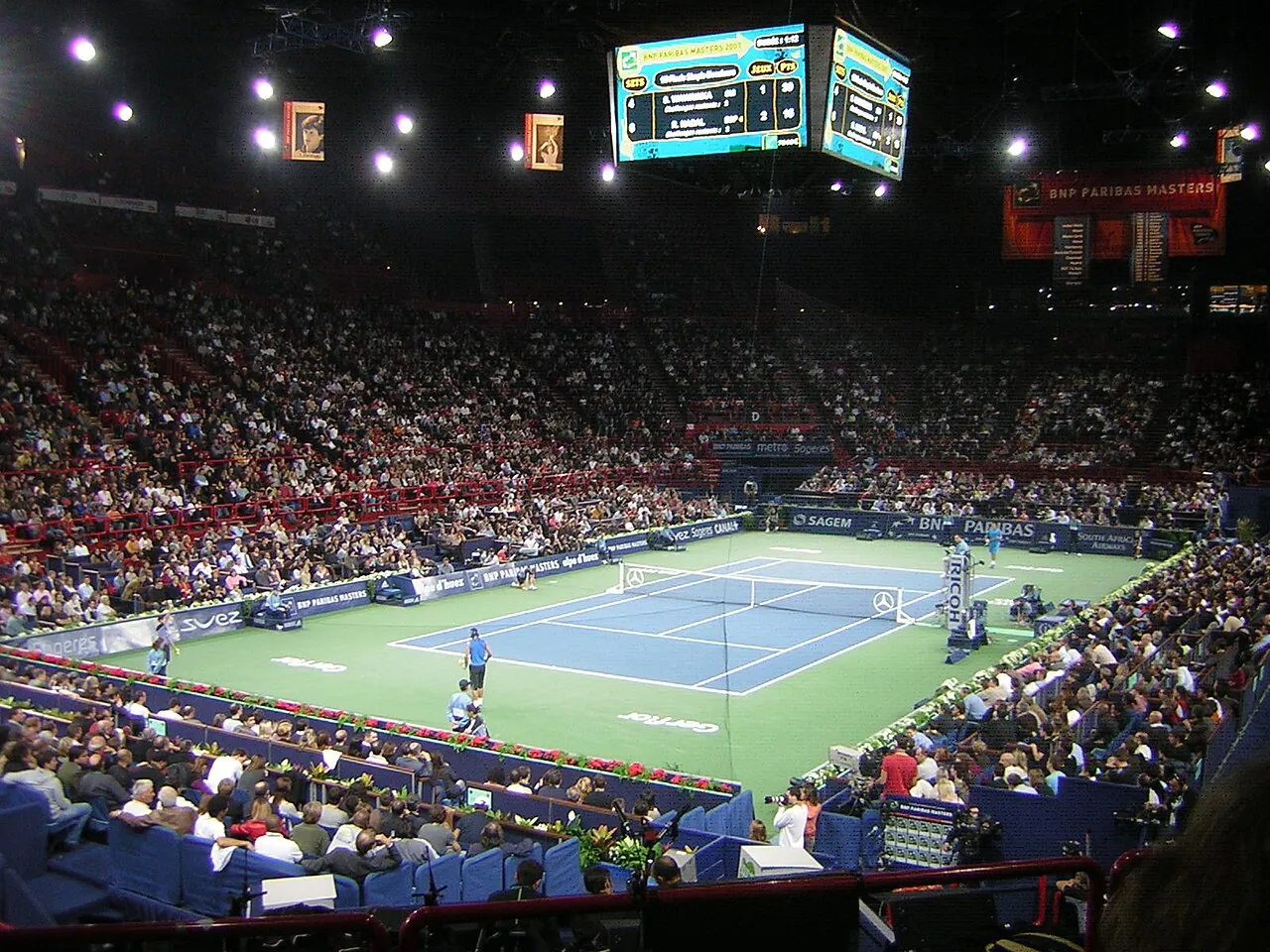
Nadal versus Wawrinka at the 2007 Paris Masters. Historical image, not a claim that either appears in the 2026 draw.
Which names appear near the top of the published preview?
The LTA preview checked for this guide lists Alexander Zverev, Carlos Alcaraz and Ben Shelton as its first three seeds. This is a dated preview reference, not a guarantee that each will reach a particular round or remain available throughout the event.
Use the current official draw for a player's actual placement and the daily order of play for a confirmed fixture. If a player withdraws or the bracket changes, an earlier preview may remain online without reflecting the newest position.
No winner or final pairing is predicted here. A useful preview can identify players of interest while preserving the uncertainty that makes a knockout event a competition rather than a scripted sequence.
How can a new viewer read a tennis score?
Distinguish the point score inside a game, the games within a set and the sets within a match. A display can show all three at once. If you read only one number without its position in the scoreboard, you may misunderstand the state of play.
Use an original fictional example: Player A leads 6–4, 3–2 in sets and games, while the current game is at 30–15. The 6–4 describes a completed set; 3–2 describes the current set's games; 30–15 describes the current game. They are not three competing versions of the same score.
When reading an actual match page, identify which player is serving and whether a number represents a tie-break point score or a set score. Consult the competition's applicable rules if the format is unclear. This article does not assume that every tennis competition uses identical scoring conditions.
For a classroom task, draw a small fictional scoreboard and label each layer. Explaining the labels is more useful than memorizing the position of the numbers on one application's screen.
What should you watch beyond the final score?
Choose a focused observation rather than trying to judge every aspect of a match immediately. You might track where a receiver stands, how often a player approaches the net or which direction a player chooses after a short ball.
Separate visible evidence from interpretation. “The player moved inside the baseline before this return” is an observation. “The player intended to intimidate the server” claims a motive that the image alone cannot establish.
Look at several points before describing a pattern, and acknowledge camera limitations. A close-up between points may not show a tactical change clearly. Your first note can be a question for further viewing rather than a final judgement about the player's entire style.
This makes a highlights clip more useful too. Ask what the selected points show and what they leave out. A compilation of winners cannot by itself establish the frequency of errors or the full rhythm of the match.
How can you check live viewing from Pakistan?
Use current authorized coverage information for Pakistan and inspect whether your package includes this event. A guide explaining how to watch in the UK does not automatically establish the same rights or service availability in Pakistan.
Do not assume that a past broadcaster still holds the event or that a free qualifying stream includes all main-draw matches. Coverage can differ by territory, stage and platform. Confirm the exact offer before making a payment solely to watch a particular session.
Our Tamasha guide and tapmad subscription guide explain how to inspect access and billing conditions. Linking those guides does not assert that either service carries this Paris Masters edition.
If you cannot verify local coverage, say so. A precise unanswered question is preferable to directing readers to an unauthorized feed or inventing a free-access promise.
What should you do when schedules change?
Return to the current official order of play and compare it with the note you saved. Keep the match, date, court and time-zone label together so that you can identify what changed. An updated court assignment is different from a changed opponent or a withdrawal.
If you shared an earlier schedule with friends, send a clear correction naming the changed detail. Do not simply circulate another unlabeled screenshot and expect everyone to infer which version is current.
For a study exercise, maintain two columns: what was scheduled and what actually occurred. This preserves the difference between a plan and a result, a useful habit in sporting coverage and ordinary project work.
What is worth checking before the first main-draw day?
Confirm that you have the 2026 draw, the correct day's order of play, a time you understand and legitimate viewing access for your location. Keep projected matchups separate from scheduled fixtures and remember that the provisional round calendar does not provide every match's exact start.
The tournament's opening context is clear: qualifying precedes main-draw play on 2 November, with the finals scheduled for 8 November. The results will be decided on court. This guide deliberately leaves those future outcomes open.
Sources
Source 1: provisional round schedule
Source 2: event preview and main-draw dates
Source 3: official venue and ticketing information
Checked 1 November 2026. The time-zone example was calculated independently using named time-zone records. It is not a real match start time, and no future champion or Pakistan broadcaster is asserted.
Image credits: inline: Patrice from France, source, CC BY 2.0. Resized and converted to WebP. cover: PARISDEFENSEARENA, source, CC BY-SA 4.0. Resized and converted to WebP.
Found an error or an outdated detail? Report a correction with the article URL and original source.