
Polish President Karol Nawrocki: Biography and Election Figures
Read Nawrocki's official career timeline and Poland's formal 2025 runoff result, then understand vote margins, percentage points and the denominator behind a share.

Karol Nawrocki is the President of the Republic of Poland, having taken office on 6 August 2025, according to the presidency's official biography. He won the presidential runoff held on 1 June 2025. The election commission's formal result records 50.89% of valid votes for Nawrocki and 49.11% for Rafał Trzaskowski.
This guide introduces the verified career timeline and explains how to read those election figures. It does not endorse a candidate, infer why every voter voted as they did or claim to explain an unverified current news event merely because a public figure is being searched.
Who is Karol Nawrocki?
The official biography records his birth on 3 March 1983 in Gdańsk. It describes his academic background in history at the University of Gdańsk, including a degree completed in 2008 and a doctorate defended in 2013. These are biographical credentials, not an independent assessment of his presidency.
Before becoming president, he directed the Second World War Museum in Gdańsk from 2017 to 2021 and later headed the Institute of National Remembrance. The biography dates his appointment as the institute's president to 23 July 2021.
Keep the institutions distinct when reading a short profile. The museum, the remembrance institute and the presidency are different offices. A timeline should not merge them into one uninterrupted role simply because the same person held each position.
When did he become Poland's president?
His official biography says he took the presidential oath before the National Assembly on 6 August 2025. This is different from the runoff election date and the date on the election commission's formal announcement.
| Milestone | Date |
|---|---|
| Presidential runoff | 1 June 2025 |
| Election commission result announcement | 2 June 2025 |
| Presidential oath and taking office | 6 August 2025 |
The distinction is useful when comparing reports written at different stages. An article calling someone president-elect before the oath and a later biography describing the person as president can both refer accurately to their respective dates.
Do not replace the date of taking office with the date you first saw a headline. Public events can be reported, discussed and rediscovered long after they occur. Preserve the event date as well as the publication date when keeping notes.
What were the official runoff results?
The election commission's announcement gives the following valid-vote totals for the runoff:
| Candidate | Valid votes | Share of valid votes |
|---|---|---|
| Karol Tadeusz Nawrocki | 10,606,877 | 50.89% |
| Rafał Kazimierz Trzaskowski | 10,237,286 | 49.11% |
| Combined valid votes | 20,844,163 | 100.00% |
The announcement declares Nawrocki elected. These are final reported totals from the formal document, not an exit poll, a prediction or a live count assembled from selected regions.
If you compare a screenshot with these figures, check whether it shows national results or a regional subset. A region can have a different distribution without contradicting the national total. The geographic scope is part of the result's meaning.
How large was the margin in votes?
Subtract the two official candidate totals: 10,606,877 minus 10,237,286 equals 369,591. That is the arithmetic difference between the valid votes credited to the two candidates in the announcement.
This calculation is our own check of the published inputs. It does not add a new category of votes or describe why the difference occurred. Avoid turning a numerical margin into a claim about every region, demographic group or voter's motivation.
For a student exercise, reproduce the subtraction using a calculator or a short program. Then label the output “difference in valid candidate votes.” The label prevents the result from being confused with the number of non-voters or invalid ballots.
Use the original integers for this calculation rather than estimating the vote difference from rounded percentages. Rounding can remove detail that is still present in the full totals.
What is the difference between percentage points and percent?
The difference between 50.89% and 49.11% is 1.78 percentage points. That is a subtraction of two percentage shares. It should not be described casually as the same thing as a 1.78% relative increase over the smaller number.
Use an original fictional example to see the distinction. If one share is 60% and another is 40%, the gap is twenty percentage points. Relative to forty, the difference of twenty is fifty percent. Both calculations are mathematically meaningful, but they answer different questions.
When writing about an election margin, state the measure you are using. “A 1.78-percentage-point gap in the published shares” is clear. “He won by 1.78% more” can leave readers unsure which calculation you mean.
The same distinction matters in examination pass rates, survey results and price changes. A small wording change can prevent a large misunderstanding of the numbers.
Does 50.89% mean 50.89% of every eligible person?
No. The candidate shares in this result use valid votes for candidates as their denominator. They do not state the share of all eligible people who supported each candidate. The official document separately records turnout and other ballot categories.
To interpret a percentage, ask “out of what?” before drawing a conclusion. A candidate-vote share, turnout rate and share of a regional electorate are different quantities. Mixing their denominators can produce a claim the source never made.
For a fictional classroom exercise, imagine 100 eligible people, 80 participating and 76 valid candidate votes. A candidate with 40 of those valid votes has 40 divided by 76 of the valid-vote total, not forty percent of the participants. The example is invented and is not a reconstruction of Poland's actual counts.
Write the numerator and denominator beside each rate in your notes. This makes errors easier to spot than keeping only a rounded percentage without its definition.
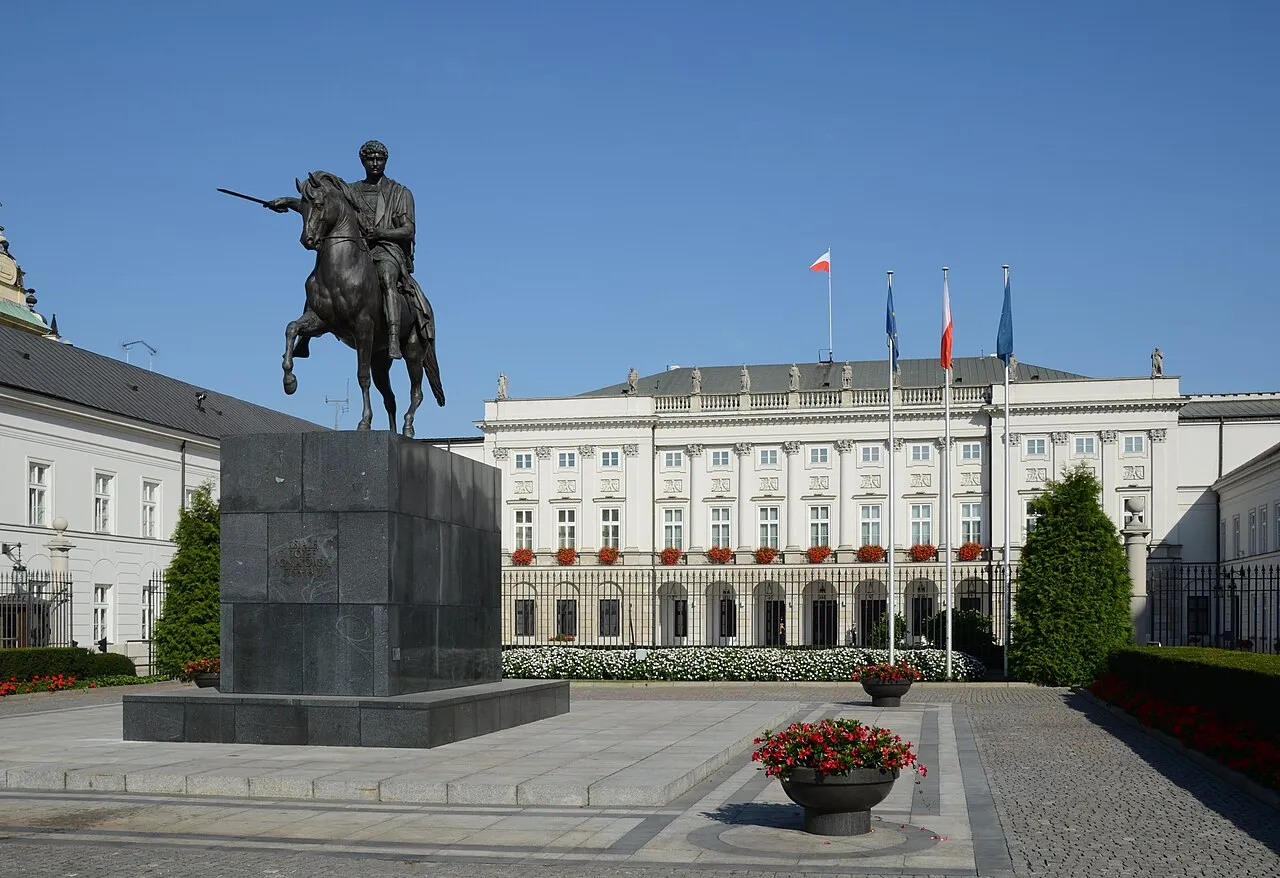
Historical view of Warsaw's Presidential Palace in 2011. It is not evidence of a current meeting or event.
How should you read turnout and ballot categories?
The formal result contains separate entries for participation, ballots and valid candidate votes. Those labels should remain separate when summarizing the election. A number appearing in an official table is not automatically interchangeable with the number above or below it.
If you are translating a foreign-language result, preserve the original label alongside your translation until you are confident of the meaning. Avoid guessing from the size of the number. Two totals can be close while measuring different stages of the voting record.
This article focuses on the candidate totals and does not reproduce every category from the announcement. Readers needing a detailed administrative breakdown should consult the complete document rather than infer the omitted fields from this shorter table.
What can an official biography establish?
It can provide the officeholder's stated career dates, institutions and credentials. It is also written from the perspective of the office publishing it. Treat factual chronology and evaluative praise as different kinds of material.
For example, a listed appointment date can anchor a timeline. A statement that someone transformed an institution successfully is a performance assessment requiring a broader evidence base if you want to evaluate it independently.
This guide uses the biography for identity and chronology, not as proof that every policy or institutional decision was effective. That distinction lets readers use a primary source without treating its entire narrative as an independent review.
How can readers verify a current political claim?
Identify the specific claim first. Is it about the officeholder's identity, a new speech, a bill, a meeting or a historical election result? Each calls for the relevant dated source rather than a general biography used for every purpose.
If the claim concerns a new event, look for the actual event record and date. A photograph from a previous visit cannot establish that another meeting happened today. A statement about a proposal also should not be silently converted into a statement that it has become law.
This article does not make a detailed determination of presidential powers or the legal status of a particular measure. Such questions require the applicable constitutional or legislative record and, where necessary, qualified legal interpretation.
For general information-checking practice, our AI study guide explains why fluent language is not evidence by itself. The same standard applies to political summaries written by a person or a model.
What should you check in a political photograph?
Read the original caption, creator, date and event. A cropped portrait can identify a person without showing the setting from which it came. That is acceptable when the caption explains the context, but misleading if it implies an unrelated current meeting.
The cover here comes from a photograph identified as a 3 September 2025 White House meeting. It is not presented as an image of a November 2026 event. The Warsaw palace photograph is a historical building illustration, not evidence that a particular meeting is happening inside.
Avoid interpreting a facial expression as proof of a policy, negotiation outcome or private intention. The picture records a visible moment; other claims need their own evidence.
How can students build a neutral profile from these sources?
Start with four fields: name and office, verified timeline, election result and source date. Keep a fifth field for unanswered questions instead of filling gaps with assumptions. This creates a useful reference without requiring a political judgement.
Next, choose one calculation you can explain. The vote difference or percentage-point gap provides a manageable exercise. Show the inputs, operation and label, then explain what the result does not establish.
Finally, review your adjectives. If the evidence establishes an appointment, say appointment. If it establishes a vote total, say vote total. Words such as “universally supported” or “certain to win again” make claims that this source set does not support.
What is the main takeaway?
Nawrocki's presidency and the 2025 runoff can be described through a clear official timeline and a formal result. Reading the figures carefully means keeping candidate shares, raw vote margins and other election measures distinct.
A useful profile does not need an invented reason for a trend, a speculative future outcome or a personal endorsement. Accurate identity, dates, source scope and arithmetic give readers a firmer starting point for understanding further news.
Sources
Source 1: official presidential biography
Source 2: election commission's formal runoff announcement
Checked 1 November 2026. The vote-margin calculations were independently performed from the published totals. Fictional percentage examples are labelled and no current visit, legal outcome or future election result is asserted.
Image credits: cover: The White House, source, Public domain. Resized and converted to WebP. inline: Marcin Białek, source, CC BY-SA 3.0. Resized and converted to WebP.
Found an error or an outdated detail? Report a correction with the article URL and original source.