
Punjab Pakistan Education: Boards, Notes and Student Guide
Choose the right Punjab education authority and programme resources, read notices carefully and organise notes, MCQs and past papers around your course.

For a student in Punjab, Pakistan, finding the right education information starts with identifying the qualification and responsible authority. A school board, a technical education board and a curriculum body do not answer exactly the same questions. Typing "Punjab result" into a search box without those details can lead to the wrong programme, year or country.
This guide explains how to choose a useful official source, organise study material and check a notice before acting on it. It does not announce a result date, school closure, admission deadline or fee. The source review was made on 1 November 2026.
Which Punjab education source should a student use?
Begin with the qualification written on your registration or institution record. For matriculation and intermediate examinations, identify the relevant Board of Intermediate and Secondary Education. For a technical diploma, confirm the awarding board through the institution and programme documents. For curriculum and assessment resources, the Punjab Education Curriculum Training and Assessment Authority provides a different kind of reference.
| Your question | First useful direction | Information to have ready |
|---|---|---|
| Which board handles my examination? | Institution and registration record | Qualification, session and registration details |
| Has my exam schedule changed? | Relevant board's dated notice | Programme, year, annual or supplementary session |
| Which book or curriculum applies? | Current official curriculum resources and teacher | Class, subject, edition and academic year |
| Where should I practise? | Relevant textbook, notes, questions and past papers | Exact subject and chapter |
The table is a navigation aid, not a claim that every programme follows one identical process. Start with your own record and the issuing authority rather than assuming the nearest city name settles every affiliation question.
BISE, PBTE and PECTAA: keep the roles separate
Punjab's Higher Education Department describes Boards of Intermediate and Secondary Education within its examination framework. Its student-affairs guidance distinguishes regular students, whose institutions handle registration responsibilities, from private candidates using the relevant board's official route. That does not make a third-party study website the authority issuing your registration or result.
The Punjab Board of Technical Education is a separate name students encounter in technical and diploma programmes. Its published recognition material includes Diploma in Information Technology among programme categories. That is a useful distinction from school-level Computer Science, but it does not establish the affiliation of every institute offering a similarly named course.
PECTAA's official functions page describes curriculum development, teacher training and assessment within its mandate. A curriculum resource can help explain what to study; a board notification may answer when a particular examination is scheduled. Do not expect one document to answer both questions unless it explicitly does so.
These distinctions are especially important when a qualification contains the word "computer." A diploma subject, an intermediate subject and an independently taught programming course may cover related ideas while using different syllabuses, assessments and awarding arrangements.
Make a qualification identity card for your own notes
Create a short private reference sheet with programme name, institution, board or awarding body, session, subject and book edition. Use the wording from your actual documents. Do not shorten two different qualifications into the same nickname and then use that nickname to choose exam material.
For a fictional example, Student A studies an intermediate Computer Science subject while Student B studies a technical diploma containing computer topics. Both might search for computer MCQs, but the correct chapter sequence and examination context may differ. Their shared interest in computers does not make every question bank interchangeable.
Your reference sheet does not need to be publicly posted. Keep roll numbers, registration details and private documents out of public comments when a general class-and-subject description is enough to ask for study help. Use official authenticated routes when an actual administrative enquiry requires private information.
Update the sheet when a teacher or official resource confirms a new edition or session. Preserve the old version's label rather than renaming an old PDF as the new syllabus merely because the file is convenient to keep using.
How can you read a Punjab exam notice correctly?
Read the issuing authority, programme, session and publication date before looking for the boldest deadline. Then identify whether the notice is an original schedule, a revision or a correction. A genuine older notice can become the wrong instruction when a later official revision supersedes it.
A fictional notice might say "Second Annual Examination, Year II." That wording does not automatically apply to a first annual Year I candidate. The correct response is to compare the candidate category with your own record, not assume every date under the board's logo applies to everyone.
Keep different deadlines separate. A registration date, fee-submission date, examination start and practical examination date are different events. Copy each into its own row with the exact label. Combining them into one calendar reminder can make a correct date misleading.
If a scan is unclear, do not guess a digit from a compressed forwarded image. Return to the official document or ask the institution to clarify the entry. A neat retyped table is only useful when its values remain faithful to the source.
What should you do with a forwarded result announcement?
Treat it as a lead to check, not as the result authority itself. Look for a dated notice on the responsible board's official site and confirm the qualification and session. A screenshot showing a familiar logo does not establish that its text is current or complete.
Also distinguish an announcement date from an individual result record. Knowing that a result has been announced does not tell you a particular student's marks. Use the official result route for the personal record and follow the board's own instructions for any further administrative step.
A gazette, an online lookup and a study site's explanatory article serve different purposes. The article can guide navigation and explain terms. It should not invent a student's result or claim that an unofficial copy replaces whatever document the relevant institution requires.
On RayTech, the results and gazettes section brings guidance and available documents together. Check the document's own board, class, year and session when choosing a file, and return to the official issuing authority for an authoritative personal result or correction process.
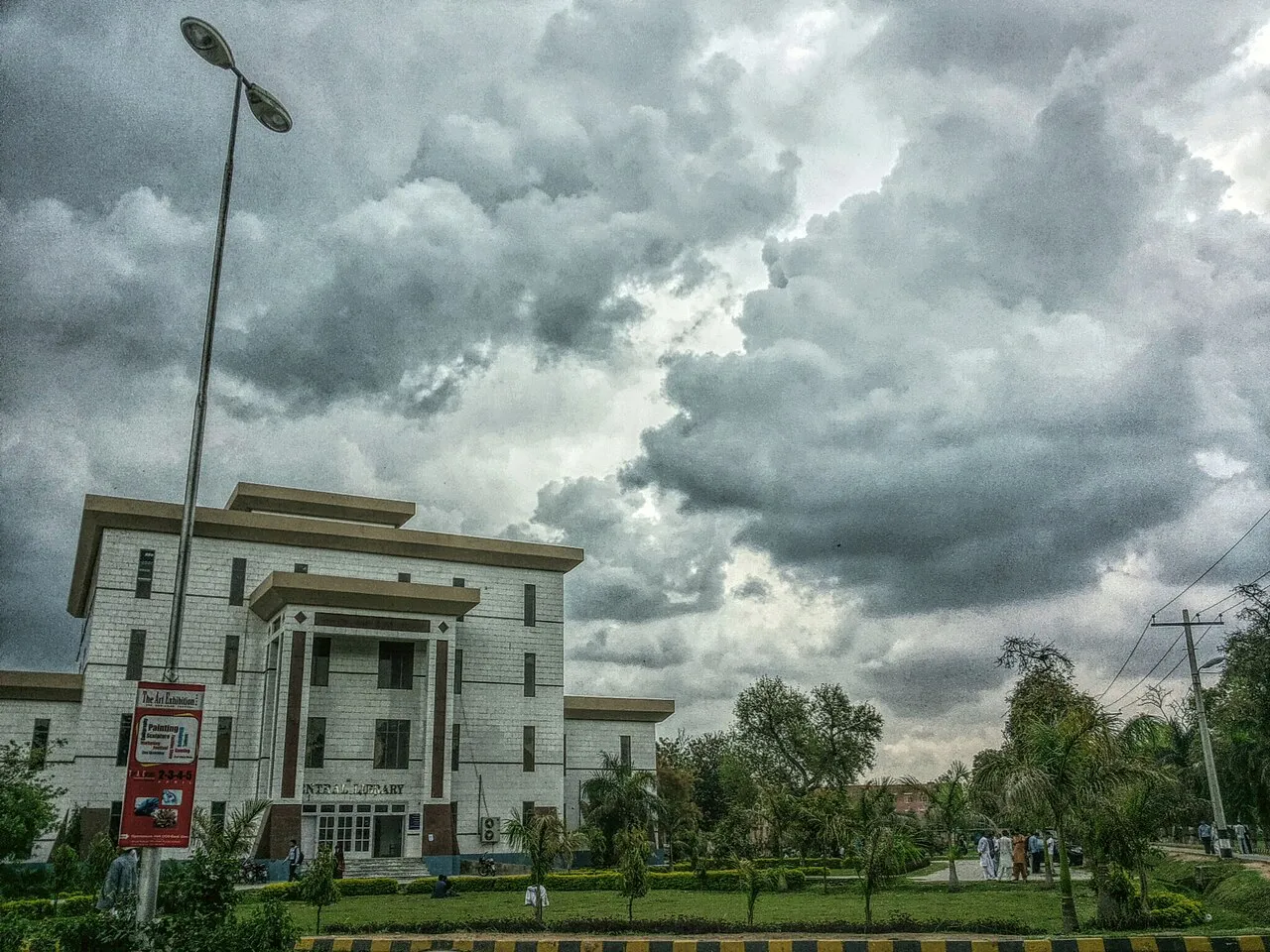
University of Sargodha Central Library, shown for educational context. The source photographer reports applying a cloudy visual effect; the image is not evidence of current weather or institutional endorsement.
Choose notes by chapter and topic, not only by file title
A file named "complete computer notes" may still be the wrong edition, qualification or chapter sequence for your course. Begin with the book's contents page and compare the chapter headings. Then open a sample section and see whether the concepts and terminology match what your teacher is covering.
For a fictional study task, suppose the assigned topic is networks and basic terminology. A general office-software PDF may be useful later but does not answer that task. Keeping book, chapter and topic as separate labels prevents a large folder from looking organised while actually mixing unrelated material.
Use our class resources to choose the relevant class and subject first. For D.I.T Computer Science, the chapter-organised notes page is the more specific starting route. The available material remains study support, not a claim that one resource list defines every institute's official syllabus.
Before downloading, read the title and surrounding details rather than pressing the first PDF button. Preview a relevant section when available, and keep the source and edition label with the saved file. A download folder is easier to use when its filenames preserve the context you checked.
Combine notes, MCQs and past papers for different jobs
Notes can help explain an idea. MCQs can test recognition and discrimination between plausible answers. Past papers can help you understand the kind of task used in a particular examination. One resource type does not automatically replace the others.
After reading a topic, close the notes and explain the idea in your own words. Then attempt a small set of relevant questions. If an answer is wrong, return to the concept behind the mistake rather than only memorising the letter attached to the correct option.
For D.I.T practice, use the Computer Science MCQ chapter selection to keep topics organised. Choose the assigned topic instead of mixing every chapter into the first practice session. Later, a mixed review can test whether you still recognise the ideas without the chapter heading as a hint.
When using a past paper, preserve its board, year and session. A question from a different programme can still be a useful exercise, but it should not be advertised as evidence of your own exam pattern without checking that relationship.
Build a weekly study plan around actual evidence
Start with the work your class is currently covering and any confirmed assessment dates. Estimate a manageable task for each session: one concept to explain, a short question set and a review of mistakes. Do not fill the calendar with vague entries such as "finish computers" that offer no clear stopping point.
Here is a fictional three-session plan. In the first session, read a network definition and produce one original example. In the second, answer questions about the same concept and explain why the distractors are wrong. In the third, revisit the mistakes and connect the idea to the next assigned topic.
The plan should respond to evidence. If you repeatedly confuse two terms, give that distinction another session. If a practice score is high only because you remember the option order, change the task to explaining the answer without looking at the options.
Keep a small error log with topic, mistake, explanation and review date. It is more useful than recording only a total score because it tells you what to do next. An assessment result becomes a study instruction rather than merely a number to celebrate or regret.
Search terms that reduce the wrong-result problem
Include Pakistan when the regional name could refer to another country. Add the board or awarding body, qualification, session and subject as needed. More words help only when they identify the actual task; a long search containing contradictory class names can still produce irrelevant results.
For a fictional query, "Punjab Pakistan technical diploma computer syllabus current session" is a clearer starting point than "Punjab computer paper" when you are trying to identify a diploma course. Once the awarding body is confirmed, use its exact name and official programme wording.
Do not assume the highest-ranked page is the issuing authority. Read the address and the page's role. A third-party article may be useful guidance, while the actual schedule or curriculum document belongs to an official organisation. Understanding that difference helps you use both without confusing their authority.
For checking clips and forwarded claims more generally, the viral-video verification guide explains how to separate a caption from its evidence. The same habit helps when an old exam notice is circulated with a new date in a message.
Common questions for Punjab students
Does every computer course use the same Punjab syllabus?
No such assumption should be made. Check the qualification, awarding body and current edition through your institution and official programme resources. Similar subject names can occur in different courses without establishing identical examination requirements.
Is this page announcing a holiday or closure?
No. It provides a source-selection and study workflow. A closure claim requires its own dated official notice covering the relevant area and institutions. This guide does not supply a new closure date or infer one from a circulating post.
Can notes replace a required textbook or registration record?
Study notes support learning, while textbooks, registration and official documents have their own roles. Use your institution's confirmed requirements for the actual course. A convenient PDF title is not proof that it satisfies every requirement.
Does an unavailable board page prove there is no announcement?
No. A temporary loading problem does not establish the content of a notice. Retry the official route and check with the institution through its established contact process. Do not fill a gap in access with a guessed date.
Are the photographs official endorsements?
No. The Punjab Assembly and university library photographs provide regional and educational context. They do not mean those institutions operate, endorse or award qualifications through RayTech Institute.
Sources
- Punjab Higher Education Department overview
- Punjab Higher Education Department student affairs
- PBTE published recognition programme categories
- PECTAA official functions
Image credits: cover: Sunni Person, source, CC BY-SA 3.0. Resized and converted to WebP. inline: Ranasajid36, source, CC BY-SA 4.0. Resized and converted to WebP.
Result dates, fees and eligibility must be checked against the issuing authority's current notice. Report a correction with the article URL and original source.