
South Africa Cricket Team: The 2026 Test Rise Explained
Understand South Africa's October 2026 Test series win, the difference between rankings and WTC standings, and a clearer way to follow the Proteas from Pakistan.
South Africa's national cricket team reached a significant Test milestone on 31 October 2026: a home series victory over Australia also moved the Proteas to first place in the men's Test team rankings. The result matters, but three different achievements should remain separate: winning a match, winning a series and leading a ranking table. None is automatically a statement about every cricket format.
For a student following South Africa from Pakistan, this is a useful moment to learn how international cricket fits together. This guide connects the verified series results with the team's earlier World Test Championship triumph, then explains how to read formats, margins, standings and player roles without turning one headline into a claim it cannot support.
The latest verified Test milestone
The ICC's report dated 31 October places South Africa first in the men's Test team rankings with a rating of 124, ahead of Australia on 122. The change followed South Africa's 2–1 home series win. These are dated facts from that report, not a live table that this article updates after every subsequent match.
The three results tell a clearer story than the series score alone:
| Test | Venue in the official report | Winner | Margin |
|---|---|---|---|
| First | Durban | Australia | 214 runs |
| Second | Gqeberha | South Africa | An innings and 31 runs |
| Third | Cape Town | South Africa | 176 runs |
A 2–1 series score therefore does not mean South Africa led throughout. They lost the opening match and won the next two. That sequence is important when assessing a comeback: the final tally records the outcome, while the order explains the route.
It is also a reminder to read the format before a familiar pair of country names. Australia and South Africa can appear in different competitions with different squads. A Test series result should not be inserted into an ODI points table or a short-format tournament bracket.
Why Cape Town was more than a comfortable-looking margin
The official match account describes South Africa conceding a first-innings lead of 100 before recovering to set Australia 288. On the final day, Kagiso Rabada struck early, while Simon Harmer finished with a five-wicket haul. The 176-run victory completed the series turnaround.
Those details illustrate a basic feature of Test cricket: a result can look decisive even when the path was uncertain. A first-innings deficit is a real disadvantage, but it is not a final verdict. There is another innings, another set of conditions and another sequence of decisions.
When watching a recovery, ask what actually changed. Was a partnership extended? Did the bowlers create sustained pressure? Was a dismissal a consequence of a difficult delivery, a risky stroke or excellent fielding? These are useful questions; the score alone cannot answer all of them.
Avoid the opposite mistake as well. A comeback does not prove that an earlier collapse was harmless or planned. Both parts of the game belong in an honest account. The team overcame a problem; that is different from saying the problem never mattered.
Test ranking and World Test Championship are different tables
The men's Test team rankings and the World Test Championship standings answer different questions. A rankings report uses a rating to order teams. The WTC standings track progress within a particular championship cycle, using the percentage of available points won.
The same ICC update that puts South Africa first in the Test rankings says New Zealand lead the current WTC standings, with South Africa back among the top two. There is no contradiction. The headings identify different systems.
For example, imagine opening two classroom scoreboards. One records a student's longer assessment record, while the other records performance in the current term's competition. A student can lead one without leading the other. This analogy explains the need to identify the table; it does not claim that cricket ratings use a school-mark formula.
Before sharing a screenshot, keep four labels visible: competition, format, date and metric. A cropped number without those labels is difficult to interpret. A rating of 124 should not be called 124 WTC points, a win percentage or a predicted score.
Learn the WTC percentage with a worked example
The official WTC standings explain that a win earns 12 points and a draw earns four, and that teams are ranked by the percentage of points won. Slow-over-rate deductions can affect the table. Always use the published standings for a real team's position.
Here is an invented example, not South Africa's current record. A team plays five Tests, wins three, draws one and loses one. Before any deductions, it earns:
- Three wins: 3 × 12 = 36 points.
- One draw: 4 points.
- One defeat: 0 points.
- Total earned: 40 points out of 60 available.
Its percentage is 40 ÷ 60 × 100, approximately 66.67%. That is different from its win percentage of 60%, because the draw earns some championship points.
Now suppose another fictional side earns 36 points from four Tests. Its percentage is 75%, even though its total earned points are lower. This shows why sorting by total points alone can misrepresent a competition in which teams have played different numbers of matches.
These examples leave deductions aside deliberately. When reproducing a real table, do not assume a mismatch is an error until penalties and the competition's published calculation have been checked.
The 2025 title belongs to a separate achievement
South Africa won the World Test Championship final at Lord's on 14 June 2025, beating Australia by five wickets. The official final report records Aiden Markram's 136 and Temba Bavuma's 66 as major contributions in the chase.
Keep that title separate from October 2026. The final was a single championship match in an earlier cycle; the newer achievement is a home series win and a rise in the Test rankings. Combining them into one undated event loses the chronology.
For someone building a cricket notebook, a useful entry has three parts: what happened, when it happened and what it established. The 2025 entry establishes a championship title. The October 2026 entry establishes the newer series result and the ranking reported afterwards.
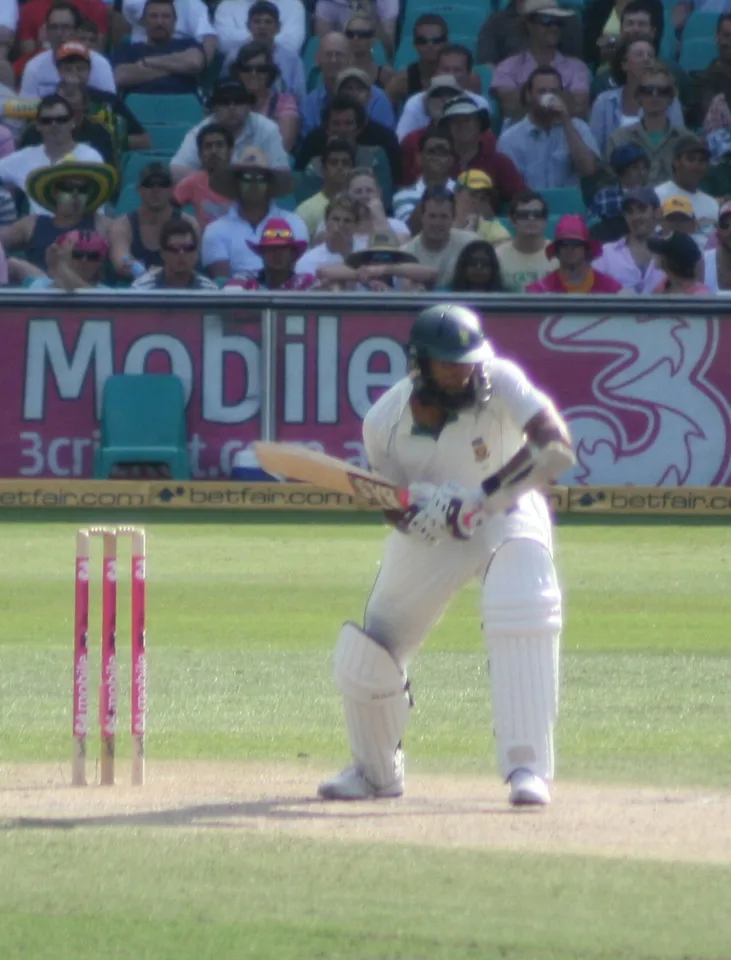
This also makes historical photographs easier to use honestly. A picture of an earlier South African batter can illustrate the country's cricketing history, but it is not evidence of the current XI. The cover shows Hashim Amla batting at the SCG in a historical photograph uploaded in January 2009.
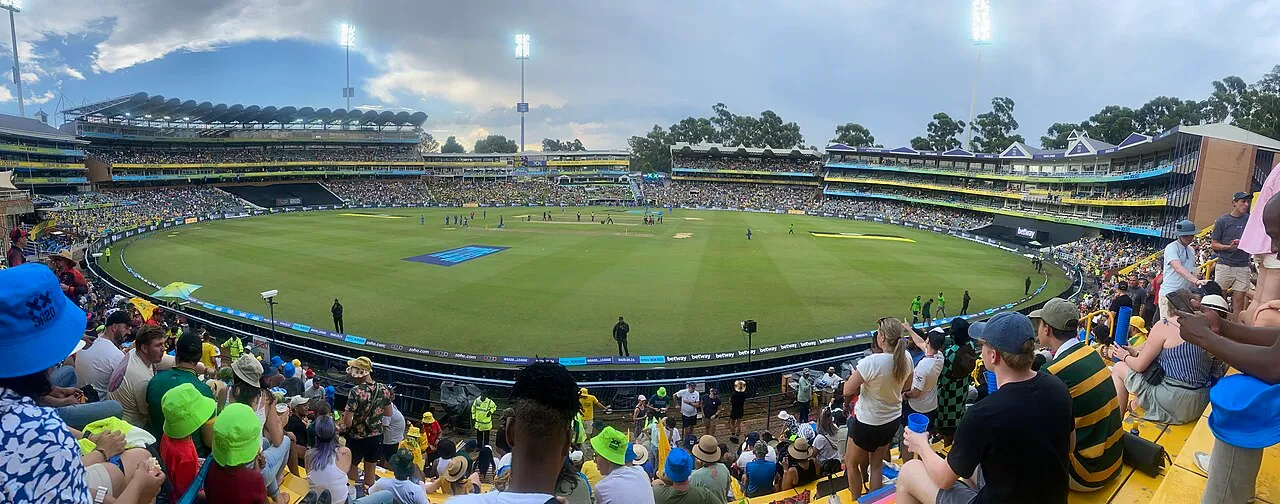
Wanderers Stadium during a Joburg Super Kings versus MI Cape Town match in January 2024. This domestic-fixture photograph illustrates venue context, not the Cape Town Test or the national team.
Understand team roles before comparing players
A national side is a combination of roles rather than eleven versions of the same player. An opener, a middle-order batter, a wicketkeeper and a specialist bowler face different responsibilities. Their best contributions may occur at different stages of a match.
A batter surviving a difficult spell can help a later partner attack. A bowler conceding few easy runs may contribute pressure even when another bowler takes the wickets. A sharp fielding intervention can change an innings without appearing in a batting average.
That does not mean every quiet performance should be praised automatically. It means the evidence must match the claim. If someone says a player controlled scoring, examine the spell and match situation. If they say a batter accelerated, identify the period and deliveries involved.
For a fuller bowling-statistics exercise, see our Kagiso Rabada milestone guide. It focuses on an individual bowler; this page focuses on interpreting the national team's results and competitions.
Do not treat a squad announcement as a confirmed XI
A squad is the group selected for an event or series. The playing XI is the team chosen for a particular match. A player appearing in a squad list does not guarantee that they will play every fixture, bat in the same position or bowl a particular number of overs.
When checking a team sheet, separate the announcement date from the match date. An earlier list can remain on a search page after circumstances change. The toss-time team sheet is more specific to a match than an old preview.
This guide does not publish a permanent current XI, because that would become misleading as soon as selection changes. It is more useful to explain where the uncertainty lies than to present an old eleven as a fresh answer.
The same care applies to captaincy. A captain in one format, tour or historical photograph should not be assumed to captain every South African team. Read the format-specific announcement instead of transferring a familiar name across contexts.
A better way to follow a Test from Pakistan
Start with the fixture's full identity: teams, format, venue and scheduled local start. If you are converting a time for Pakistan, keep the date attached as well. A calendar entry is more dependable when it includes a named time zone rather than an unlabeled clock time.
During the match, track the innings rather than only the largest total. Note who has batted, whether the innings is complete and how the lead or target was calculated. In a multi-innings game, a team's current score is not always the amount the opponent must chase.
After play, distinguish a daily position from a completed result. A headline about a strong fourth day is not the same as a final victory. Check the final report before updating a series record or claiming a ranking change.
Broadcast access is a separate question. This article does not guarantee a free stream or rights for a particular Pakistan service. Use a provider's current event listing, and avoid pages that ask for unnecessary software installations to reveal a supposed match feed.
Build a small match-reading notebook
Try a five-column record: date, format, stage, result and source. Put the three October Tests on separate rows, then add the series conclusion as its own summary. Add the June 2025 final on a different dated row rather than mixing it into the newer series.
In a second section, write questions instead of instant verdicts. What changed after the first defeat? Which innings created the final target? What does the ranking announcement actually say? Which claim still needs a scorecard or team announcement?
This habit makes watching more active. You are building an explanation from evidence instead of copying the loudest caption. It also leaves room to correct a mistaken inference without discarding the verified result.
Students learning data organisation can turn those columns into a simple table during our programming courses. Keep the exercise honest: a manually entered record is a learning project, not an automated live-score service.
Frequently asked questions
Are South Africa first in every cricket format?
The verified milestone here concerns the men's Test team rankings reported on 31 October 2026. It does not establish first place in ODI, T20I or women's rankings. Each table needs its own check.
Did South Africa win all three Tests against Australia?
No. Australia won the opening Test, and South Africa won the next two to take the series 2–1. A series score describes match wins, not a sweep unless every completed match supports that description.
Does the Test ranking lead guarantee a WTC final place?
No. WTC qualification uses that competition's standings and rules. A dated rankings headline is not a mathematical qualification certificate for a different table.
Why do the photographs show an older team and a different ground?
They provide labelled historical and venue context. The cover shows an earlier batting scene, while the ground photograph shows a domestic fixture. Neither depicts the October 2026 Cape Town winning XI or final wicket. An illustration should still tell the truth about what it depicts.
What is the most useful thing for a new follower to learn?
Learn to distinguish match, series, ranking and championship. Once those four ideas are clear, the same team appearing under different headlines becomes much easier to follow without confusion.
Sources
- Test rankings update, 31 October 2026
- Cape Town match and series report
- World Test Championship standings and points explanation
- World Test Championship final report, 14 June 2025
Image credits: cover: derivative work: Mattinbgn/talk Pm_cricket_shots09_6037.jpg: self, source, CC BY-SA 2.5. Resized and converted to WebP. inline: TapticInfo, source, CC BY 4.0. Resized and converted to WebP.
Found an error or an outdated detail? Report a correction with the article URL and original source.