
Supermarket Cyberattacks: Refrigeration Risks and Practical Defences
Understand reported supermarket refrigeration attacks, exposed controllers and defensive responsibilities without assuming every shop is affected.

Cyberattacks on supermarket refrigeration systems in Europe show how a digital intrusion can cause physical disruption. Reports in early November 2026 described unauthorized changes to cooling controls, while official alerts warned about exposed management interfaces and older equipment. The issue concerns operational technology, not simply a supermarket website becoming unavailable.
This guide explains the verified incident category, why connected controllers matter and what businesses can learn defensively. It does not identify an attacker without evidence, claim that every supermarket is affected or provide instructions for accessing refrigeration equipment. The practical lesson is to treat the systems controlling physical conditions as part of the security environment.
What happened to supermarket fridges and freezers?
Official Swedish information published on 3 November described a cyberattack affecting retail refrigeration and cooling systems, including raised temperatures. Reporting across Europe described further disruption after earlier incidents in October. The precise scope varies by report and update time, so a country list should not be treated as a complete final count.
The French CERT-FR alert, first issued on 12 October, names affected controller families and warns against exposing management interfaces directly to the internet. That official record provides a stronger technical starting point than a dramatic social-media claim that all connected fridges have suddenly become unsafe.
The important distinction is between a household appliance and the supervisory systems used to manage commercial refrigeration. They can differ substantially in scale, connectivity and maintenance. A report about one should not be generalized automatically to every device that keeps food cold.
What is operational technology?
Operational technology, often shortened to OT, includes systems that monitor or control physical processes. In a supermarket, a controller may help manage temperatures, defrost cycles or alarms. Its digital settings can therefore influence a physical environment rather than merely display information on a screen.
That makes the consequences different from some familiar account-security incidents. A compromised social account may expose messages or publish unwanted content. A compromised controller may alter an operating condition. Both deserve attention, but the assets, response requirements and potential impacts are not identical.
The boundary between ordinary IT and OT is not always clear in practice. A maintenance provider may remotely access equipment through a network also managed by another team. Security responsibilities need to follow those real connections rather than rely on organizational labels that leave gaps between departments.
Why connect refrigeration equipment at all?
Remote monitoring can help an operator notice faults, manage several sites and coordinate maintenance. A connected system may reduce the need for someone to inspect every setting locally. Those benefits explain why equipment that once operated in relative isolation becomes part of a wider network.
Connectivity also creates responsibilities. The organization needs to know who can reach the control interface, how access is authenticated and what happens when a supplier's account is no longer needed. A useful operational feature can become a security exposure if those questions are ignored.
The lesson is not that every remote connection must be abandoned. It is that the connection should be deliberate, limited and supported. A system's business value and its security requirements need to be designed together rather than considered only after an incident.
A management interface is different from a public website
A public website is intended to be reachable by visitors. An equipment-management interface serves a different audience and can expose functions that should be restricted to authorized operators. Treating the two as equivalent can place powerful controls where they do not need to be publicly reachable.
The French alert specifically identifies direct internet exposure as contrary to good practice for the affected management systems. Its recommendations concern protected access, configuration review and manufacturer guidance. Those are defensive actions for the organization and its qualified service providers.
This article does not publish addresses of exposed devices or instructions for finding them. A public-interest explanation does not require creating another route for unauthorized access. The useful question is how an operator can reduce exposure within the systems it owns or is authorized to manage.
Why default credentials and old software matter
Factory-default credentials are designed for an initial setup context, not as a permanent secret shared across deployed equipment. If they remain unchanged, access protection may be much weaker than the operator assumes. A device being physically inside a shop does not make its remote interface private.
Older software can create another problem when security fixes are missing or the product is no longer supported. The organization must understand both the installed version and the vendor's support position. A device that still performs its mechanical function can nevertheless need a different connectivity arrangement or a replacement plan.
Avoid reducing this to a vague demand to update everything immediately without planning. Operational changes can affect availability and safety. Qualified teams should follow the vendor's guidance, test appropriately and coordinate the change with the people responsible for the physical process.
How can a cyber incident spoil stock?
Commercial refrigeration depends on maintaining appropriate operating conditions. Unauthorized changes to controls can interfere with that process. Even after settings are restored, the business may need to assess the affected stock through its food-safety procedures rather than assume that returning the display to normal resolves every consequence.
This is why technical recovery and operational recovery are different tasks. Restoring access to a controller is one action. Confirming that the equipment is functioning correctly and determining the status of products are separate actions involving the appropriate staff and standards.
Readers should not use a news article to decide that a particular food item is safe. Follow the retailer's and relevant food-safety authority's instructions. Appearance alone is not a substitute for the business's documented assessment of the affected stock.
What has not been established?
The reviewed reports do not justify assigning every incident to one named attacker or government. Similar effects can arise through related weaknesses without proving that all victims were targeted by the same people. Attribution requires evidence beyond a shared headline or a familiar pattern.
Likewise, operational disruption does not automatically establish customer-data theft. A controller incident, a payment-system compromise and a personal-data breach are different claims. An article should not add stolen-card warnings unless the specific evidence supports that conclusion.
The exact scale can also change as organizations investigate. Report a figure with its source and date if one is needed, and do not convert an early estimate into a permanent final total. The absence of a final count is a reason for careful wording, not an invitation to choose the largest number available.
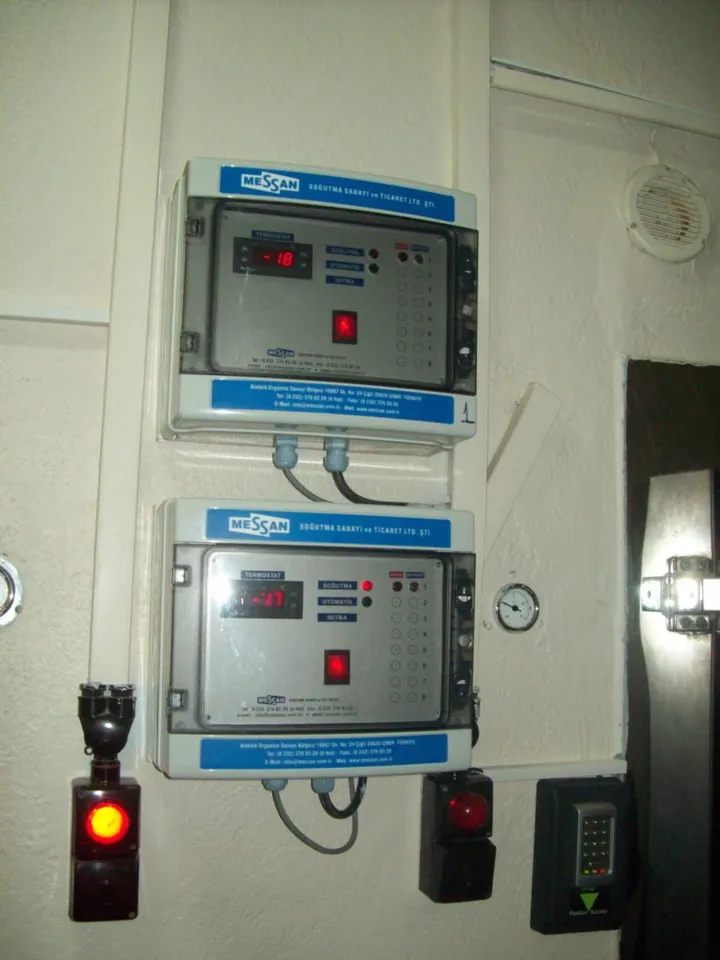
A temperature controller at a seed-storage facility; illustrative control equipment, not a supermarket incident device.
The first business question: what equipment do we have?
A practical defensive review begins with an inventory. Identify the controller, software version, responsible owner, maintenance provider and network connection. Without that information, an organization may struggle to determine whether a vendor notice applies to its equipment.
Include responsibility as well as hardware. Who approves remote access? Who notices an unexpected setting change? Who can contact the refrigeration specialist outside normal hours? An inventory that contains only model numbers can still leave the response process unclear.
This is an organizational learning exercise, not a request to scan other companies' systems. Work within the equipment and networks the team is authorized to manage. Security improvements should strengthen legitimate control, not create new unauthorized access activity.
Separate access, permissions and monitoring
Access determines who can reach the system. Permissions determine what an authenticated person can do. Monitoring helps the organization notice relevant events. These controls serve different purposes and should not be treated as substitutes for one another.
A protected connection is useful, but it does not automatically justify giving every maintenance account unrestricted privileges. A strong password is useful, but it does not prove that changes are being reviewed. An alarm is useful, but it may be less reliable if the same compromise can disable both the process and the warning.
For a classroom diagram, draw the shop, equipment, maintenance provider and remote connection as separate boxes. Mark the trust boundaries and identify what evidence would show an authorized change. This helps students see why security is a system of decisions rather than one protective button.
Why a reset may not be a complete solution
Resetting equipment can change its current state, but it does not necessarily remove the weakness that allowed unauthorized access. If the same exposed interface, unsupported software or insecure account arrangement remains, the system may face the same risk again.
The French alert explicitly distinguishes recovery actions from the need to restore secure operation. Businesses should follow the applicable vendor and official guidance rather than assume that a generic online reset tutorial is sufficient for their installation.
Preserve the information required for an investigation through the proper response process. A rushed action can sometimes remove useful evidence or disrupt a physical system unexpectedly. The right recovery sequence needs the people responsible for both cybersecurity and the equipment's operation.
How to read a refrigeration-security advisory
Check the issuing organization, publication date, revision date and affected product names. A notice about a particular controller family does not automatically apply to every refrigerator made by a company with a similar name. Model identification matters.
Next separate the described risk from the recommended action. The notice may include different paths for equipment believed to be compromised and equipment not showing a compromise. Those categories should not be merged into one oversimplified instruction for every organization.
Finally consult the manufacturer's current documentation and the organization's responsible specialists. A news summary is useful for awareness, but it cannot capture every contractual, operational or configuration detail relevant to a real installation.
What should ordinary shoppers do?
Do not assume that a headline means every store or every item is affected. Follow notices from the retailer and relevant local authorities for a specific shop or product. The Swedish public-information page reviewed for this guide stated that it had no specific recommendations for the general public at that time.
Also be cautious about messages exploiting the news. A supposed refund, compensation offer or urgent account-verification link can be unrelated to the actual incident. Independently open the retailer's normal contact route rather than provide payment details through an unsolicited message.
Our account and device safety guide explains those personal precautions separately. The distinction is useful: a shopper's account protection and an operator's refrigeration-system security are connected topics, but they require different actions.
Questions readers are asking
Were all European supermarkets hacked?
No reviewed source establishes that claim. Reports and official notices describe affected organizations and controller incidents, with scope that may change during investigation. Do not turn a multi-country story into a statement about every shop.
Was this definitely ransomware?
The incident should be described through the verified evidence. Unauthorized changes and disruption do not automatically prove a ransom demand or identify the attacker's motive. Use a specific label only when the relevant reporting or official findings support it.
Does a restored temperature display prove all stock is safe?
No. Technical restoration and product assessment are different processes. The business must follow the appropriate food-safety procedures. A reader should follow the retailer's or relevant authority's instructions for an actual affected product.
What is the main cybersecurity lesson?
Systems controlling physical processes need identified owners, appropriate access restrictions, supported software and a coordinated response plan. The lesson extends beyond supermarkets without requiring exaggerated claims that every connected device is already compromised.
Give each defensive task an owner
A useful business checklist names both a task and the person responsible for it. The facilities team may understand which cabinet is connected to a controller, while the technology team manages the network and an external contractor maintains the equipment. If each assumes the other controls remote access, a gap can survive for years.
Write down who approves changes, who receives alerts, who can contact the supplier and who decides whether stock needs assessment. Test those contact routes during normal working hours rather than discovering a broken number during an incident. This is an organisational safeguard, not a claim that paperwork alone prevents an attack.
Sources
- French official refrigeration-controller alert
- Swedish public-information notice
- Contemporary European incident reporting
- United Kingdom business reporting
- Operational technology security reference
Image credits: cover: 維基小霸王, source, CC BY-SA 4.0. Resized and converted to WebP. inline: Shuhrataxmedov, source, CC BY-SA 3.0. Resized and converted to WebP.
Found an error or an outdated detail? Report a correction with the article URL and original source.