
Varun Chakaravarthy: Spin Bowling and Cricket Records
Explore Varun Chakaravarthy with clear explanations, worked examples, source checks and practical questions for independent student learning.

Varun Chakaravarthy is an India bowler associated with spin bowling, with BCCI listing his T20I debut in 2021 and ODI debut in 2025. His name is also encountered with the spelling Chakravarthy. When comparing records, match the player identity rather than assuming that a spelling variation represents another cricketer. This guide explains his profile and the cricket concepts needed to read it carefully.
The information was checked on 2 November 2026. Current rankings, selection and career totals can change, so this is not a live statistics feed. The numerical examples are original classroom exercises, not additional claims about his matches. They focus on spin, pressure, wicket attribution and the difference between a bowler's return and a team's result.
What does the official profile establish?
BCCI identifies Chakaravarthy as a bowler, a right-handed batter and a right-arm leg-break bowler, with a birth date of 29 August 1991. The ICC uses a leg-break-googly description. These are broad profile classifications. They do not establish the precise type, speed or intention of every individual delivery a viewer encounters in a clip.
The two international-debut categories should remain separate. A 2021 T20I debut does not mean the ODI debut also happened that year. Format labels are part of a cricket record's identity. They matter just as much as the number when building a timeline or comparing two profiles.
A useful beginner's notebook has a separate row for role, batting style, bowling style and each format milestone. Add the source and date checked. That structure is more reliable than one long paragraph in which a later editor might accidentally attach the correct year to the wrong competition.
What does mystery spinner mean?
“Mystery spinner” is a descriptive expression used in cricket discussion for a bowler whose variations can be difficult for batters to identify. It is not a separate scorecard format or a guarantee that every batter will be deceived. The ICC's profile discusses Chakaravarthy in that context, but the sporting effect still has to be examined delivery by delivery.
For an original analogy, imagine a teacher presenting two similar-looking patterns that lead to different next steps. A learner must notice a small cue before predicting the result. The analogy illustrates uncertainty and recognition; it does not reproduce a bowler's grip, release or physical technique.
Avoid treating the label as a magical explanation. If a wicket falls, the label alone does not tell us whether turn, pace, flight, accuracy, batter choice or field placement was decisive. Describe what the available evidence shows and leave unobserved technical details open rather than filling them with confident-sounding terminology.
How does spin differ from a simple direction label?
A bowler's profile category and a particular ball's observed movement are related but not identical. The profile describes a broad style. A delivery can differ in pace, line, length and behaviour after pitching. A viewer needs adequate footage and context before claiming that a specific variation was used or that a ball moved in a measured way.
Try an original paper exercise: draw a pitch from above and mark three possible landing areas. Then draw different intended routes after pitching. Label them as conceptual diagrams rather than measured ball tracking. Discuss how a batter's position could change the practical meaning of the same landing area.
The drawing is useful precisely because its limits are clear. It cannot show the force, rotation or surface interaction of a real ball. A good teaching model isolates a question without pretending to explain the whole physical system. The same principle applies to simplified animations of spin bowling.
What can a batter find difficult about variation?
Variation can challenge timing and prediction. If a batter expects one pace or path and receives another, the intended stroke may no longer fit. That is a conceptual explanation, not a claim about every Chakaravarthy dismissal. Actual analysis requires identifying the delivery, the batter's response and the match situation.
Imagine a fictional sequence of three balls. The batter moves early on the first, waits on the second and attempts a larger shot on the third. A short highlight showing only the final ball cannot establish how the earlier deliveries influenced that decision. The sequence may matter, but it must be observed rather than invented.
When footage is incomplete, use careful wording. “The batter appears early on the shot” describes an observation. “The bowler planned this exact dismissal three overs earlier” asserts an intention that usually needs additional evidence. Clear writing does not confuse a plausible explanation with a demonstrated plan.
How do bowling figures relate to team pressure?
Bowling figures record particular outcomes, but pressure can be distributed across an innings. One bowler may concede few runs while another takes a wicket. A scorecard can show both records without fully explaining their relationship. It is reasonable to ask about the connection, but not to assign an unmeasured contribution as though it were an official statistic.
Use an original fictional pair of spells. Bowler A concedes sixteen runs in four overs without a wicket. Bowler B concedes thirty-two in four overs and takes three wickets. Their economies are four and eight. Which contribution mattered more depends on the situation and the question being asked, not simply on which number looks smaller.
Do not convert a quiet spell into a zero contribution because the wicket column is empty. Equally, do not claim that every later wicket belongs morally to the previous bowler. Keep the recorded figures intact and discuss tactical interpretation as interpretation, with relevant sequence evidence where available.
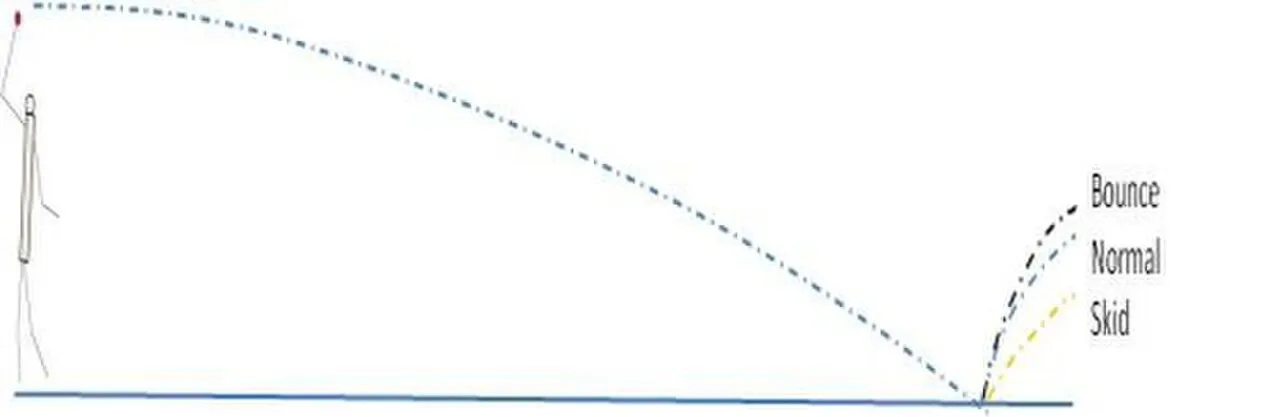
Conceptual teaching image, not measured tracking of a Chakaravarthy delivery.
Which dismissals count in a bowler's figures?
A team's wickets and a bowler's credited wickets are not always the same total. Run-outs, for example, are not credited as wickets to the bowler. Read the dismissal information in a full scorecard before attributing every wicket that occurred during a spell to the person delivering the ball.
For a fictional exercise, imagine an over containing a caught dismissal and a run-out. The batting side loses two wickets, but the bowler is credited with the caught wicket, not both. A summary saying “two wickets fell in the over” can be true while “the bowler took two wickets in the over” is false.
This distinction matters when reading short social posts or highlight captions. The team event, fielding contribution and bowling return each have their own meaning. A careful explanation can acknowledge all of them without forcing every useful action into the bowler's wicket count.
How do economy and wicket-taking measures differ?
Economy rate is runs conceded per over, bowling average is runs per credited wicket and bowling strike rate is legal balls per credited wicket. Each measure answers a different question. None should be published without a clear category and enough inputs to calculate it. A label such as “average” is incomplete unless the measure is identified.
Consider an imaginary four-over spell with twenty runs and two wickets. Twenty-four legal balls produce an economy of five, an average of ten and a strike rate of twelve. Now keep twenty runs and change the wicket count to one. Economy stays five, while average becomes twenty and strike rate becomes twenty-four.
These changes demonstrate the definitions, not the quality of a real performance. A wicket at a crucial moment can matter differently from another, while numerical summaries aggregate outcomes. Use the measures to inform a question rather than expecting one column to contain the entire story of a match.
Why do small samples need care?
A short spell or a few matches can produce a dramatic rate that changes quickly with the next result. Always state the sample being discussed. A number calculated from one innings should not be presented as a permanent description of a player's ability, particularly when compared with a much larger career record.
In an original exercise, a bowler begins with two wickets for eight runs, giving an average of four. In a second fictional match, the bowler takes no wickets and concedes thirty-two. Across both matches, the combined average is twenty, not the simple midpoint between four and a zero average. The second match has no finite per-wicket average of its own.
Combine totals before calculating the aggregate ratio. This is an important lesson for spreadsheets: averaging already calculated averages can be misleading when denominators differ. Keep runs, wickets and balls as the underlying data, then calculate the measure for the exact group of matches you intend to describe.
What does a ranking tell you?
A ranking is a dated position within a particular system and format. It is not the same as the player's total wickets, best figures or selection status. A current ranking page may change after a match, and a historical article can become misleading if it copies a number without preserving the date and category.
This guide therefore does not freeze an undated current rank into its introduction. If you need one, consult the relevant official ranking and note the format and update date. Explain whether the number is a position or a rating. Those two values can appear near one another while answering different questions.
For a fictional chart, place “rank,” “rating,” “matches” and “wickets” in separate columns. Ask students which values can be added and which cannot. Adding two ranking positions does not produce a meaningful team ranking. Correct arithmetic still needs a meaningful operation and an appropriate unit.
How should students discuss a spinning delivery?
Use a short sequence that can be accessed legally and describe only what can be observed. Identify the batter's stance, the apparent landing area and the outcome. If the camera does not show the release clearly, do not pretend that the grip is visible. If the footage lacks measurement, do not invent an exact degree of turn.
Write an original analysis paragraph with three parts: observation, possible explanation and limitation. For example, a batter may appear to play outside a ball's final path; a change of direction could be relevant; one camera angle may not be sufficient to establish the precise variation. This structure supports careful reasoning without removing the interest of the sporting moment.
Keep physical practice separate from a profile. A young learner can explore notation, probability and observation without copying a professional action or using hard balls unsupervised. Technical coaching depends on the individual and should come from an appropriate coach rather than a general article about a famous player.
A final calculation and reading challenge
An imaginary bowler delivers 3.3 overs, concedes twenty-one runs and takes three wickets. The spell contains twenty-one legal balls. Economy is six runs per over, average is seven runs per wicket and strike rate is seven balls per wicket. None of these is a Chakaravarthy match return; it is a deliberately simple teaching example.
Now suppose a run-out also occurs during the spell. The batting team has lost four wickets during those deliveries, but the credited bowling wicket count remains three. Write two accurate summaries: one describing the team events and one describing the bowler's figures. This tests both arithmetic and the language used to report it.
Explore more cricket learning articles with the same habits. A useful understanding of Chakaravarthy begins with his verified profile, but it grows through precise questions: which format, which delivery, which sample and which measure? Those questions turn a catchy description into a clearer understanding of how the game is recorded and discussed.
Before sharing a comparison, read each column heading aloud. Check whether it names a quantity, a rate, a position or a category. A convincing chart can still be wrong when unlike records are placed beside one another. Correct the labels and scope before adding colours or drawing conclusions about a player’s ability.
Keep both the category and the date visible.
For a separate spin-bowling performance and carefully labelled figures, read our Noor Ahmad guide.
Sources
- BCCI: Varun Chakaravarthy profile, for the published role, birth date, styles and format-debut years.
- ICC: Varun Chakaravarthy profile, for style terminology and the descriptive mystery-spin context. Rankings are not reproduced as permanently current figures. All numerical exercises are original, fictional teaching material.
Image credits: cover: JokerDurden, source, CC BY-SA 4.0. Resized and converted to WebP. inline: Rkghadai, source, CC BY-SA 3.0. Resized and converted to WebP.
Found an error or an outdated detail? Report a correction with the article URL and original source.